|
|
| Third quarter of the 4th century B.C. Second century B.C ... 1961 Κ A 2316 A 2199 A 306 A 907 ... Third quarter of the 4th century B.C ... Second century B.C. |
| Preface. List of Plates. Abbreviations and Bibliography. Introduction. Catalogue. Observations on Athenian Portrait Style in the Roman Period. The Romanization of Greek Portraits. The Late Republican Period ... Agora 1 vii ... The Early Third Century (A.D. 200-235) ... The Third Quarter of the Third Century ... The Last Quarter of the Third Century |
| The Last Quarter of the Third Century. Graindor, Cosmétes, no. 33. The Fourth Century. I.G. II (2), 3669 ... Agora 1 105 ... 275-300 A.D ... The Last Quarter of the Third Century ... The Fourth Century |
| Investigations in the area of Archaic Temple Added by E.V June 1963 ΕΛ 324-331. In the annual report for 1959 both the building of the temple itself, and the red limestone addition are dated in the early ... First half of 6th c. B.C. - early 5th c. B.C ... I Pre-Temple levels : Mainly first half of 6th century B.C., with some material as late as the third quarter ... II Temple, first phase: Much first half of 6th c. B.C., with some of the third quarter and a few scraps of the last quarter. |
| Pairs of maenads and satyrs dance on a drinking cup of the third quarter of the 6th century B.C ... Craig Mauzy ... Cf. 2007.01.1552 Horizontal (normal) ... 23 Sep 2004 ... Pairs of maenads and satyrs dance on a drinking cup of the third quarter of the 6th century B.C. |
| Andros ... Context [``Layer 2 of MJ''] with Period III Athenian coins to third quarter of 2nd century B.C. [three Agora XXVI, no. 98: Athena/Amphora]; see Agora XXVI, no. 984. Coin no. 16. Martyr I, Layer 2. Head ... 4th-2nd c. B.C. |
Scanty debris filling in a pit. The wishbone-handled bowl (P 16753) is of the middle of the third quarter of the 5th. c. century, as are also two red figured fragments, P 25820 and P 25821; the deposit ... Ca. 450-400 B.C ... Scanty debris filling in a pit. The wishbone-handled bowl (P 16753) is of the middle of the third quarter of the 5th. c. century, as are also two red figured fragments, P 25820 and P 25821; the deposit as a whole is somewhat later. Last quarter of the 5th. c. |
Flaring rim, flanged inside; steep walls, flattened bottom. Very gritty red clay.
Close in size and make, P 27195 E 29:1, found in 1964 in a cistern filling of the third quarter of the 4th century ... Context second half of 4th c. B.C ... Close in size and make, P 27195 E 29:1, found in 1964 in a cistern filling of the third quarter of the 4th century. |
Wall fragment, slightly convex. Max. dim. 0.051.
Symposion. The fragment preserves the top of the leg at the head of the couch with the volutes and ovules and a bit of the mattress and pillow. Near the ... Third quarter of the 5th century B.C.? ... Third quarter of the 5th century B.C.? |
Inscribed fragment.
Inscribed face only preserved.
Seven lines of the inscription preserved.
Gray marble. Found in Turkish context north of the Eleusinion, over the area of the late Roman Fortification ... Third quarter of 4th. century B.C. |
The right thigh and upper leg of a standing draped woman.
Clay fine, buff, soft. Traces of white slip underlying yellow paint. Wall Trench N4, filling B ... Third quarter of IV century B.C. |
| Inscribed fragment.
Broken all around. A start has been made at reworking the back in the form of a rough pilaster. Original back (smooth) perhaps preserved.
Laurion mines.
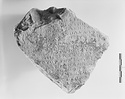
Sixteen lines of the inscription ... Third quarter of 4th. century B.C. |
Deep flaring rim; strap handles, attachment points on neck and shoulder marked by wheelrun groove; pointed body; spreading base slightly concave beneath. Clean light red clay; remains of light buff surfacing ... Context ca. 510-480 B.C ... Clean light red clay; remains of light buff surfacing.
For the shape in black-figure of the third quarter of the 6th century, cf. ... See also the black, 1, Pl. 1. |
Wall fragment with start of rim. Narrow reserved band on inside near top. Max. dim. 0.044.
Wreathed head of man emerging from between a pair of wings. Preliminary sketch. Relief contour: profile. White ... Third quarter of the 5th century B.C ... Third quarter of the 5th century B.C. |
Wall fragment from just below rim. Glaze thin in places on outside.
Max. dim. 0.059.
Grypomachy. Griffin (most of head and neck, part of body and wings) to right. At the right break, elbow of an Arimasp ... Third quarter of the 4th century B.C ... Third quarter of the 4th century B.C. |
Wall fragment. Max. dim. 0.059.
At the left, someone carrying a loutrophoros-amphora in the crook of his left arm (upper part of arm; part of body, neck and one handle, start of other at far left, of ... Probably third quarter of the 5th century B.C ... Probably third quarter of the 5th century B.C. |
The woman stands wrapped in an himation, drawn across her right breast. She stands with her left leg swung somewhat forward.
Clay buff, fine, soft, hollow, no vent. Head and lower part missing. Traces ... Third quarter of IV century B.C. |
Fragment of top side with start of spout. Max. dim. 0.07. Hoffmann, Sexual and Asexual Pursuit, p. 14, cat. no. R 6.
Head (except for muzzle), neck, and shoulders of donkey to left. Below, reserved line ... Third quarter of the 5th century B.C ... Third quarter of the 5th century B.C. |
Wall fragment with start of cul at very bottom. Max. dim. 0.07.
Satyr (legs, the right frontal, the left in profile, end of tail), leaning to right (the glaze lines on the inside and the bit of ground ... Probably third quarter of the 5th century B.C ... Probably third quarter of the 5th century B.C. |
| (RSY=Pyre 2). Pyre in the industrial area west of the Areopagus, in House B. In northern corner of room. No pit discerned. A deposit of small stones (a marker/) lay 0.30m above the level of the pyre, ... Third quarter of the 4th. century ... Third quarter of the 4th. century. |
Wall fragment with part of rim. Glaze fired red on outside and slightly pitted; some abrasion on inside. Max. dim. 0.096.
Grypomachy. At the right is the head of an Arimasp to left; then the top of a ... Third quarter of the 4th century B.C ... Third quarter of the 4th century B.C. |
Fragment of slightly domed lid, glazed on underside. Max. dim. 0.112.
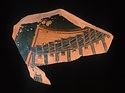
From center out: egg pattern; women and Eros. At the left, a woman (upper half) is seated to left, looking back at Eros (forearms, ... Third quarter of the 4th century B.C ... Third quarter of the 4th century B.C. |
Wall fragment. Max. dim. 0.045.
Sandaled foot of a man standing to left on a slightly flaring object, overlapped by a curved narrow object (uncertain what). At the left, part of another figure (leg[?]) ... Third quarter of the 5th century B.C ... Third quarter of the 5th century B.C. |
Shoulder and neck fragment. Dull glaze, fired brownish on upper right. Max. dim. 0.081.
Youth (lower parts missing) standing to left, dressed in a himation, looking at a round object in front of him, ... Third quarter of the 4th century B.C ... Third quarter of the 4th century B.C. |
Wall fragment from near shoulder. Max. dim. 0.034.
Woman (a bit of face, raised bent left arm with bracelet, part of right hand) to right, looking downward and holding a staff or scepter, probably seated ... Third quarter of the 5th century B.C ... Third quarter of the 5th century B.C. |
| Brann, E. T. H ... American School of Classical Studies at Athens ... This volume reports on Athenian pottery found in the Athenian Agora up to 1960 that can dated from about the middle of the 8th century, when “the appearance of a painter of sufficient personal distinction ... 1962 ... This volume reports on Athenian pottery found in the Athenian Agora up to 1960 that can dated from about the middle of the 8th century, when “the appearance of a painter of sufficient personal distinction to enliven the whole craft” marks a real break from the earlier Geometric style, through the third quarter of the 7th century when Protoattic gives way to black-figure and black wares. ... The topographical features of the Agora that are indicated by the places of discovery of deposits of late Geometric and Protoattic pottery are summarized under wells, houses, workshops, sanctuaries, cemeteries, and roads ... The Athenian Agora: Results of Excavations Conducted by the American School of Classical Studies at Athens |
Outcurved rim flattened on top; low disc foot with slightly spreading profile.
1804-1806 illustrate the shapes and rim profiles of the latter part of the third quarter of the 5th century; the foot may ... Context ca. 435-425 B.C ... Outcurved rim flattened on top; low disc foot with slightly spreading profile.
1804-1806 illustrate the shapes and rim profiles of the latter part of the third quarter of the 5th century; the foot may be still simpler, either a half-round or nearly straightsided; cf. |
Rim and neck fragment with start of handle plate. Glaze abraded on top side of rim and at inner edge. P.H. 0.067; est. diam. of rim 0.032.
On top side of rim, laurel wreath with berries. On overhang, ... Third quarter of the 5th century B.C ... Third quarter of the 5th century B.C. |
Handle, part of shoulder, a little of wall, all of foot missing. P.H. 0.135; diam. 0.053.
Owl (part of head and body missing). At right, olive sprig. On the shoulder: rays; above, tongue pattern.
Originally, ... Third quarter of the 5th century B.C ... Third quarter of the 5th century B.C. |
Rim and wall fragment. Glaze flaked and abraded in places. Max. dim. 0.05.
Man (most of head) to left. Just below rim, laurel wreath to left. At the far right, end of leaf from handle ornament.
For a ... Probably third quarter of the 5th century B.C ... Probably third quarter of the 5th century B.C. |
Fragment of ridged handle. P.H. 0.083.
At root of handle, two addorsed palmettes, the lower one encircled ... Probably third quarter of the 5th century B.C ... Probably third quarter of the 5th century B.C. |
Mouth and handle missing.
Small squat jug; ribs narrow, formed by vertical grooves. Blister ware; buff to pink clay, gray surfaces.
Cf. Corinth C-31-417 and 418: Corinth, XIV, pl. 49, 33, 34, from a ... Context ca. 375-350 B.C ... Corinth C-31-417 and 418: Corinth, XIV, pl. 49, 33, 34, from a votive deposit in the Asklepieion, third quarter of 4th century; the ribs still narrower. |
Several joining fragments give the neck substantially complete to a point below the lower handle attachment.
Stamp on one double handle only. Corpus no. 571.
Prof: PD 1454-88*
Dim: Drim 0.12* Cistern, ... 7 April 1949 ... Several joining fragments give the neck substantially complete to a point below the lower handle attachment.
... Cistern, upper fill; containers 1 and 2; third quarter of 2nd century B.C. |
Mended with the missing pieces restored in plaster and painted, notably all of one handle, significant portions of the wall. Profile complete. Some of the glaze on the inside fired reddish brown. H. 0.17; ... Third quarter of the 5th century B.C ... Third quarter of the 5th century B.C. |
Wall fragment with start of rim. Reserved line on inside. Glaze has a brownish cast. Max. dim. 0.105.
Capital of Doric column with key pattern to left, painted on the neck. On top of the abacus, bottom ... Probably third quarter of the 5th century B.C ... Probably third quarter of the 5th century B.C. |
Wall fragment from return with start of neck. Glaze fired red on inside of neck. Pitted on outside. Max. dim. 0.066.
Uncertain subject. What remains is the top of a scepter crowned by a finial in the ... Third quarter of the 5th century B.C.? ... Third quarter of the 5th century B.C.? |
Shoulder, much of body. P.H. 0.06; diam. 0.052.
Fallow deer (hindquarters missing) rearing up against a tree, trying to reach the leaves. On the shoulder: rays; above, tongue pattern. Dilute glaze: muscles ... Third quarter of the 5th century B.C ... Third quarter of the 5th century B.C. |
Fragment of rim and body with start of one handle. P.H. 0.115.
Anodos of Aphrodite. Eros (lower legs, both feet missing) moves to right, his right arm outstretched, a cloak over his left. Before him, ... Third quarter of the 4th century B.C ... Third quarter of the 4th century B.C. |
Mended with the missing pieces restored in plaster and painted, notably much of the rim, neck, and a bit of the body on Side A. Much of the glaze fired red, otherwise dull. Surface pitted in places. H ... Third quarter of the 4th century B.C ... Third quarter of the 4th century B.C. |
Floor fragment underside scored with a spiral. Much of the glaze fired greenish. Max. dim. 0.05; est. inner diam. of tondo 0.054.
I, owl (part of head, feet missing). Around tondo, stopped-maeander pattern ... Probably third quarter of the 5th century B.C ... Probably third quarter of the 5th century B.C. |
|
|
.png.icon.jpg)
.png.icon.jpg)