|
|
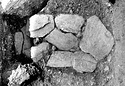
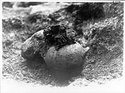
| Crevice in Rock (Grave?) at 70/ΝΣΤ (below modern surface accumulation).
Identified as a sacrificial pyre, with characteristic banded plates and saucers, by SIR ... 4th c. B.C./300-250 B.C ... Crevice in Rock (Grave?) at 70/ΝΣΤ (below modern surface accumulation).
|
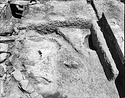
| A cave-in not long after the digging of this shaft destroyed its possible usefulness as a well and thereafter it was used as a dump. Two principle periods of such use were noted, and within these several ... Ca. 575-480 B.C ... Rectangular Rock-Cut Shaft |
Estimated Grid ... Ca. 510-480 B.C ... Rectangular Rock-Cut Shaft Upper fill |
Containers Lot Α 306-Lot Α 340. Estimated Grid ... Ca. 575-535 B.C ... Rectangular Rock-Cut Shaft Lower fill |
Refuse pit in rock by heavy wall on West Street ... Ca. 500-480 B.C ... Refuse pit in rock by heavy wall on West Street. |
Well on the north slope of the Areopagus. Unfinished, probably because of hardness of rock, and refilled at once, perhaps with sanctuary dump and with collapsed rock from the shaft itself.
Diameter 1.15m ... 3rd quarter of the 7th c. B.C ... Unfinished, probably because of hardness of rock, and refilled at once, perhaps with sanctuary dump and with collapsed rock from the shaft itself.
|
Stuccoed pit, 2m x 2.50 m, rock-cut. Coins:
26 March 1937 #1 (not a coin) ... Ca. 400-350 B.C ... Stuccoed pit, 2m x 2.50 m, rock-cut. |
It seems likely that the well was never used due to poor quality of rock. Uniform fill of collapsed bedrock ... 650-625 B.C ... It seems likely that the well was never used due to poor quality of rock. Uniform fill of collapsed bedrock. |
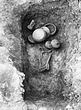
| Grave in west peristyle of Hephaisteion. Grave XXXVIII in notebook. Layer VI over rock. Coins:
7 March 1939 #11 Neg. KK 353 ... 7-10 March 1939 ... Layer VI over rock. |
Well 8: Archaic. On the northwest slope of the Acropolis.
Depth from surface of rock, -16.10m.
Diameter top ca. 0.90; bottom ca 0.80m. Water level, ca. -9m ... Late 6th - early 5th c. B.C ... Depth from surface of rock, -16.10m.
Diameter top ca. 0.90; bottom ca 0.80m. |
Well 8 (in Tholos), put out of use by a fall of the rock walls and replaced by well G 11:3. Scanty use filling at and near the bottom, separated by a mass of fallen rock from a debris filling in the upper ... Ca. 550-500 B.C. and 480 B.C ... Well 8 (in Tholos), put out of use by a fall of the rock walls and replaced by well G 11:3. Scanty use filling at and near the bottom, separated by a mass of fallen rock from a debris filling in the upper part of the well and around its mouth. |
Archaic Pit at 25/ΙΓ, near the northeast corner of the market square. Filling in upper part of shaft, cleared only to a depth of 3.10m because of rock conditions ... 600-550 B.C ... Filling in upper part of shaft, cleared only to a depth of 3.10m because of rock conditions. |
Well-shaft abandoned before use because of crumbling of rock.
From top to 15.00m. a dumped fill predominantly early Roman but containing material of late 1st c. B.C. to mid-1st c. A.D. A rock filled shaft ... 1st c. B.C. to mid-1st c. A.D ... Well-shaft abandoned before use because of crumbling of rock.
From top to 15.00m. a dumped fill predominantly early Roman but containing material of late 1st c. ... A.D. A rock filled shaft below 15.00m. |
Well at 21/Ε (beneath Library of Pantainos).
The clearing of the well was abandoned because of a cave-in of the rock walls. Heavy dumped filling, the proportion of fine black table ware high ... Ca. 440-425 B.C ... The clearing of the well was abandoned because of a cave-in of the rock walls. Heavy dumped filling, the proportion of fine black table ware high. |
Basin in rock at NW corner of Church of St. Athanasius. Walls lined with small stones and bricks and covered with plaster or mortar.
Dimensions length 1.99, width 0.37, depth 0.77. Coins:
1 April 1939 ... 3rd c. A.D ... Basin in rock at NW corner of Church of St. |
Rectangular shaft cut in rock with NE-SW orientation. Upper part of grave cut into fill over bedrock; this fill later swept away. Paving of small stones. Few human teeth and ribs.
(Dimensions: L. 1.62m, ... 725-200 B.C ... Rectangular shaft cut in rock with NE-SW orientation. |
A circular pit below Byzantine floor. It Is 1.28m deep and its bottom rests upon virgin soil, a gray clay formed by the disintegrated native rock. It is constructed for about 0.30m at the top with tiles, ... 12th c. A.D ... It Is 1.28m deep and its bottom rests upon virgin soil, a gray clay formed by the disintegrated native rock. It is constructed for about 0.30m at the top with tiles, below with mudbricks. |
At the top was roughly square, but below was rounded. The walls were built of small stones laid without much effort where large ancient blocks ( some belonging to Great Drain) formed the sides. At the ... Turkish ... At the bottom was bedrock, a greenish clay hard and rock. The width varied from 0.95 to 1.10m. |
| A flask-shaped storage pit or cellar, cut in the rock at the south edge of the levelled top of Kolonos Agoraios. Filled late in first quarter of 6th. c. B.C. (2.95m from east to west by 2.70m from north ... First quarter 6th. c. B.C ... A flask-shaped storage pit or cellar, cut in the rock at the south edge of the levelled top of Kolonos Agoraios. |
Well at 40/Λ, in the "plataia" ca. 600m north of the terrace wall and ca. 10m east of the Valerian wall. Top diameter of 1.00m, bottomm diameter 0.95m
The shallowness of the shaft, and the fallen condition ... 550-500 B.C ... Top diameter of 1.00m, bottomm diameter 0.95m
The shallowness of the shaft, and the fallen condition of the rock wall suggested that the well was abandoned and filled immediately, before completion. |
| Grave 7 in notebook. Area disturbed in Roman times; outlines of the shaft had been obliterated.
The northwest end, however, was preserved in a cutting in the rock of the sloping hillside. This cutting, ... 750-700 B.C ... The northwest end, however, was preserved in a cutting in the rock of the sloping hillside. This cutting, 0.59m wide, extended to a total depth of 0.62m below the rock surface. This depth had provided space for two separate burials, one above the other. |
| Susan I. Rotroff ... Grave 4 under Royal Stoa. Cist Grave cut into bedrock and lined with limestone and schist slabs. There were two layers of cover slabs with a layer of dirt between. Grave measured 0.98x0,25-0,32x0,25-0,30 ... Final Mycenaean/Submycenaean ... Grave measured 0.98x0,25-0,32x0,25-0,30 deep. Rock packing around slabs.
|
North and South Rectangular Stereo-cut Rubbish Pits. These two adjacent rock-cut pits, of uncertain original purpose, were filled with deposits of rubbish evidently contemporary and probably dumped simultaneously, ... Second half of 5th c. B.C ... These two adjacent rock-cut pits, of uncertain original purpose, were filled with deposits of rubbish evidently contemporary and probably dumped simultaneously, since P 16426 is represented by fragments from both. |
| Grave 8 in notebook.
Inhumation in Tholos Cemetery. Length of shaft 1.75m; Width at upper end 0.95m; Depth from cover 0.70m.
One end cut into sloping rock.
Skeleton of a woman, with head southeast. Most ... 750-725 B.C ... One end cut into sloping rock.
Skeleton of a woman, with head southeast. |
Well (diameter shaft 0.95m) with POU and dumped fillings, separated by about 2.00m. of plain mud apparently fallen from the collapsed sides of the well. The fillings are, however, closely contemporary ... Ca. 425-400 B.C ... Upper part of well a chaos of rock falls and caves.
|
Well at 18/ΜΓ, on the lower north slope of the Acropolis, under the course of the later Panathenaic Way, west of the Archaic Building.
Diameter 0.97m. Water level 8m.
At the mouth of the well and to a ... Late 8th to 675 B.C ... At the mouth of the well and to a depth of 4m, the soft bedrock had collapsed leaving a large irregular pit. The rock from this collapse filled the well-shaft down to a depth of 7m.
below this point lay the water jars from a period of use, to a depth of 8,50m. |
Cistern A for 1935 (there is another Cistern A, for 1936, D-E 8-9:1) Coins:
16 May 1935 #4-#5
17 May 1935 #1-#2
18 May 1935 #1-#2
20 May 1935 #1-#2
22 May 1935 #1
23 May 1935 #2-#6
24 May 1935 #1-#7
25 ... 16-25 May 1935
6 February 1936 ... Also, from rock-cut channel leading south from cistern (27/8/1961) S 589, S 590, SS 4316, IL 254, IL 258, IL 286, T 885, T 901, A 578, P 5947, P 6449 and coins ΠΘ-34, ΠΘ-35. |
| Well west of the Eponymous Heroes monument. The shaft was of irregular width (ca. 0.81m where the full circle was first preserved), sunk in soft bedrock clay much of which had collapsed around the top ... Ca. 600-550 B.C ... Excavation terminated at a depth of 4.25m. due to collapse of rock in the well.
Sherd being heavily worn around the broken edges indicating that they had been broken and discarded long before they were deposited in the well. |
| This filling is the largest deposit of its time found in the Agora. It may be compared with H 6:5 and with N 7:3.
Dug in soft bedrock to a depth of 11.40m; footholds cut on opposite sides of the shaft ... Ca. 490-450 B.C ... An ample supply of water, encountered (in may) at a depth of 5.30m, along with the relatively sound condition of the rock walls, suggested that the well could have been used. |
Well 15: Mycenaean. It was situated about 35 meters down the slope northwest of the exit of the Mycenaean Fountain.
Well circular or roughly oval in section.
Diameter max. width to -4.0: ca. 1.50, below ... Late Mycenaean ... The bottom of the shaft was rough, blocked by a ledge of rock too hard to cut, which still bears in two places the marks of a pointed tool with which it was tested. |
A well on the NW slope of the Areopagus; unfinished well-shaft dug to a depth of only 3.05m., and refilled with broken pottery and other debris. The shaft clearly was begun with the intention of digging ... Ca. 520-480 B.C ... The shaft clearly was begun with the intention of digging a well, since footholds were cut in the sides; the reason for the abandonment was not clear; the rock appeared quite suitable for well-sinking. |
| Dorothy Burr Thompson ... Grave 1. Urn cremation (trench-and-hole), adult female 30-40 years old).
Mentioned as Grave XVII in Deposit list.
Consisted of a roughly circular pit, approximately 0.30-0.40m in diameter, cut into ... Late Protogeometric ... Consisted of a roughly circular pit, approximately 0.30-0.40m in diameter, cut into soft bedrock against the face of an outcrop of natural rock, described by the excavator as limestone, to a depth of about 0.35m. |
| Mycenaean Chamber Tomb occupies a considerable part of the western half of section ΕΕ; lies about half way up the north slope of the Areopagus towards its eastern end, just below the highest point of the ... Myc. III A:1 ... The tomb consists of a roughly rectangular chamber approached from the north by a long dromos. it is entirely hewn out of the rock of the hill and except for the wall of rough stones that blocked the doorway, there is no masonry. The rock from which it is cut, is the greenish clayey shale which underlies most of the Agora area.
... Across the east and west ends of the chamber there is a low rock-cut bench (average width 0.75m; average height 0.60m). |
Washed-in filling at the base of the Acropolis cliffs, some 7m. east of the Klepsydra; the fill was characterized by teh fragments of a series of red-figured oinochoai of special shape, of the late 5th ... Late 3rd c. B.C ... Between the foot of the rock and three or four large fallen boulders, it was found a hollow roughly 1.50m, in diameter, which was filled with a loose, slightly gravelly black earth. |
| Extract from notebook ΠΘ XIX, pp. 3644-3646. Well at 105/ΝΗ (report on sorting of pottery, July 19, 1951 - H.S. Robinson).
"Not a useful well" HSR.
Well dug to 1.50m., vi/9/36; dug from 1.50m. to bottom ... Early Roman; use fillings of 2nd. c. B.C. and 1st. and 4th. c. A.D.; dumped filling of late 4th. c. (HSR)
Fill I: 2nd. c. B.C.
Fill II-V: to second half of 4th. c. A.D.
Fill VI: mixed to Byzantine ... Cut in bed-rock (no tiles reported); diameter at mouth: 1.04m.; depth 22.80m.
|
|
|