|
|
Ash and Carbon Dump in Corridor directly behind Room C of Brick Building.
This material comprises what appears to have been a household dump associated with the period of use of the Brick Building, but ... To mid-2nd century ... Agora XXVII, pp. 153-165, 205-206, 231 (selection of pottery). |
Tiled Well in Square Building Foundations, equipped with evenly spaced hand-holds, with a good supply of water. There was no period of use represented and the dumped fill consisted mostly of chunks of ... Third quarter of 4th c. B.C ... There was no period of use represented and the dumped fill consisted mostly of chunks of bedrock, with many fragments of pebble mosaic and a few marble chips; the pottery was extremely scanty and very fragmentary. the well had been intentionally filled and carefully covered over a large slab in preparation for the foundations of the Square Building over it. |
House C, Room 4 (Pottery dump of stamnos wall and fill below floor). Coins:
1 July 1947 #13
2 July 1947 #1
Coins from House IV:
14 May 1947 #1-#2
19 May 1947 #6-#7
20 May 1947 #32 ... First half 3rd c. B.C ... House C, Room 4 (Pottery dump of stamnos wall and fill below floor). |
A dumped filling including red figured fragments of the second quarter of the 4th c. B.C. Coins:
25 June 1931 #12 (in strosis above pottery deposit) 15 November 1952, going through the containers Tin 59-Box ... Ca. 375-350 B.C ... 'Pottery Deposit' |
Pottery discarded ... Mixed to Roman, 3rd c. A.D ... Pottery discarded. |
Brian Martens ... This deep stratum (ca. 030m) is delayed Persian destruction cleanup deposited in the 470s B.C. it contains about one generation's worth of pottery, almost exclusively dating between about 500-470 B.C ... 29 June-19 July 2017
12–15 July 2022 ... This deep stratum (ca. 030m) is delayed Persian destruction cleanup deposited in the 470s B.C. it contains about one generation's worth of pottery, almost exclusively dating between about 500-470 B.C.
... The dump of pottery raised the floor level of the building; atop J 1:18 was a layer of crushed bedrock and a renewed floor surface.
|
16 March 1957 pottery discarded nb.p. 122 ... 20-21 June 1947 ... 16 March 1957 pottery discarded nb.p. 122. |
Formerly deposit G 14:4.
Turkish context; pottery discarded ... 10 March 1932 ... Turkish context; pottery discarded. |
Turkish sherds from this level. No tins of pottery ... August 1951 ... No tins of pottery. |
| Burned Deposit. A thick deposit of ash, cinders and pottery fragments extending alongside wall of cemetery. Character of pottery like the pyre of F 12:2 ... Late Geometric ... A thick deposit of ash, cinders and pottery fragments extending alongside wall of cemetery. Character of pottery like the pyre of F 12:2. |
Hole at 65/ΚΔ; small cutting in bedrock with scanty pottery ... 450-400 B.C ... Hole at 65/ΚΔ; small cutting in bedrock with scanty pottery. |
Clay pit with clear light yellow clay thoroughly suitable for pottery making ... 1st-early 2nd c. A.D ... Clay pit with clear light yellow clay thoroughly suitable for pottery making. |
Construction fill below floor of Brick Building.
Areas involved:
a) Western portion of Room A: packing below floor.
b) Room B: packing below floor of northern,larger room.
c) Fill over water channel in ... First quarter 2nd century, before its end ... Agora XXVII, pp. 153-165, 202-204, 231 (selection of pottery). |
Found while cleaning wall running east-west over 57. Contained late glazed pottery ... Byzantine ... Contained late glazed pottery. |
Well in Stoa Terrace opposite Shop 5.; small amount of pottery. Estimated Grid ... 6th c. B.C ... ; small amount of pottery. |
Well 14: Turkish Coins
17 March 1939 #4-#5 Pottery not sorted (March 1940) ... Early Turkish ... Pottery not sorted (March 1940). |
Outside the market square, near the southeast corner, on the south edge of the east-west road, where it passes to the south of the Mint.
There is no doubt that the pottery from the well is "stratified" ... Early 1st to 6th c. and of 8th c. A.D ... There is no doubt that the pottery from the well is "stratified" in the sense that a very definite sequence could be observed from the late 6th c. pottery near the top down to pottery of the 1st c. A.D. in the lowest containers (some Byzantine pottery ... probably represents a brief reuse of the well after a long period of disuse). ... 173 containers of pottery. |
Well D: Archaic
Well on the northwest slope of the Acropolis. Debris filling with scanty pottery remains; most of the pottery is earlier than the lower limit. Diameter at top ca. 1.20m; bottom ca. 1.10m ... End of 6th c. B.C ... Debris filling with scanty pottery remains; most of the pottery is earlier than the lower limit. |
Shallow rectangular pit in bedrock at 44/Η. It contained a very small quantity of pottery, mostly coarse but including a few black glazed pieces, one stamped. Agora XII, p. 396.
No container, pottery ... 450-400 B.C ... It contained a very small quantity of pottery, mostly coarse but including a few black glazed pieces, one stamped ... No container, pottery discarded. |
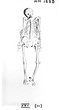
Grave north of Hephaisteion. Grave XIII in notebook. One damaged skeleton. No pottery, no coins ... 20 May 1936 ... One damaged skeleton. No pottery, no coins. |
Irregular pit in bedrock; deposit chiefly of terracotta figurines, with a small amount of pottery ... 6th c. B.C ... Irregular pit in bedrock; deposit chiefly of terracotta figurines, with a small amount of pottery. |
Pocket roughly cut in bedrock; its greatest dimensions ca. 1.50m Terracotta figurines; some pottery fragments ... Early 5th c. B.C ... Terracotta figurines; some pottery fragments. |
Water channel in north part of section. Hellenistic and Early Roman pottery. No inventoried finds ... 13-14 March 1936 ... Hellenistic and Early Roman pottery. No inventoried finds. |
Pocket of late Geometric pottery in bedrock behind Stoa Shop V; apparently a household deposit ... 750-700 B.C ... Pocket of late Geometric pottery in bedrock behind Stoa Shop V; apparently a household deposit. |
The pottery of the first six meters (containers 1-3 of 117 containers total) contains a good deal of unglazed early Byzantine along with very late Roman. Below this begins a great mass of Roman pottery ... 4th-6th c. A.D. POU ... The pottery of the first six meters (containers 1-3 of 117 containers total) contains a good deal of unglazed early Byzantine along with very late Roman. Below this begins a great mass of Roman pottery that continues to 16.00m. Below 16.00m there is much less pottery and it seems somewhat earlier than the rest, perhaps late 4th c. |
Filling around rubble wall (35/ΚΕ). It contained a mass of pottery, most of it uninventoried ... Ca. 425-400 B.C ... It contained a mass of pottery, most of it uninventoried. |
| Grave XXI in notebook = RSY Grave 11. Pottery discarded; late Roman, mostly coarse. PD 731-e ... Ca. 530 B.C ... Pottery discarded; late Roman, mostly coarse. |
Tins 6-7.
The mending of pottery revealed a break at about 19.60, although the nature of the pottery seems about the same: "A" and "D" ware, gouged ware, flaring-mouthed jars, micaceous water jars and ... Late 3rd.-early 4th. c. A.D ... The mending of pottery revealed a break at about 19.60, although the nature of the pottery seems about the same: "A" and "D" ware, gouged ware, flaring-mouthed jars, micaceous water jars and various large amphorae. |
Pocket of soft fill in bedrock at corner of Late Roman house, with a hoard of lead tokens. No pottery catalogued.
Herulian debris: cf. D 10:1, D 11:7 Coins:
25 May 1935 #8 Estimated Grid
No pottery catalogued ... 25 May 1935 ... Pocket of soft fill in bedrock at corner of Late Roman house, with a hoard of lead tokens. No pottery catalogued.
... Estimated Grid
No pottery catalogued. |
A smaller deposit, but with some good household pottery, and red-figure both Meidian and sub-Meidian ... 17-22 May 1939 ... A smaller deposit, but with some good household pottery, and red-figure both Meidian and sub-Meidian. |
Lower red fill with mixed Hellenistic pottery running into the 2nd. c. Coins:
4 May 1936 #1 ... 1-5 May 1936 ... Lower red fill with mixed Hellenistic pottery running into the 2nd. c. |
Actually in 38/ΙΕ, nbp. 766).
Pit contained at top much pottery and a few coins; sand for about 0.70m below, produced little pottery but many coins including some 2nd century Imperial and one of Salonica ... 3rd c. A.D ... Pit contained at top much pottery and a few coins; sand for about 0.70m below, produced little pottery but many coins including some 2nd century Imperial and one of Salonica 253-268 A.D. The pottery should then be late 3rd and possibly just pre-Herulian. |
Shallow pit containing pottery, burning and tiny fragments of bone. A dumped group of pottery in an amphora pit, ca. 1.00 m. in diameter, 0.60m. in depth. Many tiny fragments of bone were in the fill ... 375-325 B.C ... Shallow pit containing pottery, burning and tiny fragments of bone ... A dumped group of pottery in an amphora pit, ca. 1.00 m. in diameter, 0.60m. in depth. |
Reused as part of a modern cistern; scanty remains of ancient fill towards bottom. No containers of pottery ... 1st c. A.D ... No containers of pottery. |
Water channel in north part of section. Pottery late 2nd.-1st. c. B.C. Coins:
14 March 1936 #8 ... Late 2nd.-1st. c. B.C ... Water channel in north part of section. Pottery late 2nd.-1st. c. |
Very little pottery and mainly broken tiles in this well, all mixed from Hellenistic to Early Byzantine (nbp. 1441) ... 25 May-1 June 1939 ... Very little pottery and mainly broken tiles in this well, all mixed from Hellenistic to Early Byzantine (nbp. 1441). |
| Eugene Vanderpool ... "Submycenaean" grave into Mycenaean gully.
Rectangular trench cut partly in bedrock, partly through Mycenaean domestic filling. No pottery catalogued ... Late Helladic IIIC-Early Protogeometric ... No pottery catalogued. |
Byzantine pottery begins after 4.70m.; above that Roman.
Diameter 0.92m; water level -5m. Tiled well; height of tiles 0.62m ... Byzantine re-use of Roman well ... Byzantine pottery begins after 4.70m.; above that Roman.
|
Small fill; most pottery Hellenistic but a few fragments of early Roman present. Coins:
27 May 1937 #3-#4 ... 265-200 B.C ... Small fill; most pottery Hellenistic but a few fragments of early Roman present. |
Well L.
Use filling and well-head; abandonment filling chiefly of mud and stones, with a scattering of pottery ... ca. 575-550 B.C.-To early 5th c. B.C ... Use filling and well-head; abandonment filling chiefly of mud and stones, with a scattering of pottery. |
|
|