|
|
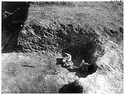
Rectangular pit over bedrock in north part of E. Building. Broken jars and household basins with a few black glazed and black-figured fragments (uninventoried). The figured pieces indicate the lower limit ... Late 6th-ca. 480 B.C ... Rectangular Pit over Bedrock in North part of East Building |
Fillings associated with reuse of walls in north part of area.
Red fill under and in North Building ... 5th c. B.C. with Hellenistic/ Roman disturbance as late as 3rd c. A.D ... Fillings associated with reuse of walls in north part of area.
Red fill under and in North Building. |
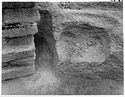
Water channel in north part of section. Hellenistic and Early Roman pottery. No inventoried finds ... 13-14 March 1936 ... Water channel in north part of section. |
Water channel in north part of section. Pottery late 2nd.-1st. c. B.C. Coins:
14 March 1936 #8 ... Late 2nd.-1st. c. B.C ... Water channel in north part of section. |
Water channel in north part of section, giving access to water system. Channel Mouth 1. Six stamped amphora handles; two-thirds of bowls long-petal ... Late 2nd century-Early 1st c. B.C ... Water channel in north part of section, giving access to water system. |
Water channel in north part of section. Coins:
20 February 1936 #2-#3
Five stamped amphora handles; Type 48 A lamp; one-third of bowls long-petal; one long-petal mold ... Second half of 3rd c.-Early third quarter of 2nd c ... Water channel in north part of section. |
Water channel in north part of Section: Channel Mouth 4. Coins:
22 February 1936 #16-#18
24 February 1936 #1-#2
Twenty stamped amphora handles; type 38 lamp; type 56 A lamp; over half of bowls long-petal ... 120-86 B.C ... Water channel in north part of Section: Channel Mouth 4. |
Fillings associated with Southwest and North Buildings (78-99/ΙΣΤ-ΚΘ) and early walls to west of Great Drain.
pottery p. 1189, vol VII ... Subdivisions:
.1=Filling over bedrock.
.2=Fillings behind retaining ... Various levels and dates ... Fillings associated with Southwest and North Buildings (78-99/ΙΣΤ-ΚΘ) and early walls to west of Great Drain.
... Subdivisions:
.1=Filling over bedrock.
.2=Fillings behind retaining wall and in road.
.3=Dumped fillings probably of construction of Great Drain.
.4=Fillings of reuse of walls in north part of area.
.5=Late fillings over early walls. |
Lower fill may be original. Part of North side cut away by modern bothros wall. Fragments of Pilgrim Jug of Grey Ware, related to Turkish Grey Ware? ... 12th or 13th c. A.D ... Lower fill may be original. Part of North side cut away by modern bothros wall. |
Near the SW corner of the market square beneath the north part of the Heliaia (?).
No clear distinction in the filling, either of date or of character, could be observed but the presence of a number of ... Ca. 625-570 B.C ... Near the SW corner of the market square beneath the north part of the Heliaia (?).
|
Well at 35/ΛH. In the northern part of the market square, north of the altar of Ares. Stony fill with late Geometric sherds. Not dug ... Late 8th century B.C ... In the northern part of the market square, north of the altar of Ares. |
Geometric Well South of Middle Stoa Pier 14, in the north-central part of the South Square. Water jars, simple household vases and utensils, a trial piece for use in a potter's kiln, bones of pigs and ... 775-750 B.C ... Geometric Well South of Middle Stoa Pier 14, in the north-central part of the South Square. |
Cistern system West of Bouleuterion: (see also B: cistern system to West of Tholos). First Chamber from North.
Part of three-chamber cistern system, including also G 11:1, with Byzantine and modern disturbance ... 150-ca. 75 B.C., with Byz. disturbance ... First Chamber from North.
Part of three-chamber cistern system, including also G 11:1, with Byzantine and modern disturbance throughout; The uppermost fill-modern. |
Some objects listed in deposit nb. V are not on this list because they in fact come from disturbed fills or are part of the material from above well 2 (G 12:21) ... 20 February-1 March 1935
6 March 1935
11 March 1935
20 March 1935
25 March 1935 |
| Mycenaean Chamber Tomb by Stoa Pier 12 (Burial 10).
The entire north side of the chamber had been cut away by Stoa Pier 12 and most of the depth by leveling operations in connection with Square Building, ... Early Myc. IIIA ... The entire north side of the chamber had been cut away by Stoa Pier 12 and most of the depth by leveling operations in connection with Square Building, so that the greatest preserved depth was only 0.25m. What remained of the chamber measured 1.30m east-west by 0.90m north-south. Despite the disturbance two skeletons were found in order as far as their thighs, lying inn a north-south position with their heads to the south; the east skeleton lay on its right side with the right hand under the head, the left over the chest; the west skeleton had the left arm raised to its chin, the right arm at its side. There was no trace of offerings of any kind, but these may have been in the north part which was demolished by the Stoa Pier. |
Investigations within the Stoa of Zeus, the north part, various levels.
Notebook references: Stoa Trench E Layers IV and V, Stoa Pits A, B and C, and Layers I and II of area between back wall and retaining ... 5th c. B.C ... Investigations within the Stoa of Zeus, the north part, various levels.
|
Built largely of tiles, upper part missing, plaster lined and broken through near the bottom on the north. Probably filled up at one time during the Turkish period. Preserved height 1.65m. Coins:
5 February ... Turkish ... Built largely of tiles, upper part missing, plaster lined and broken through near the bottom on the north. |
| John Camp ... Burial north of Roman temple, E. of polygonal wall.
The tomb, as preserved, consisted of the cinerary urn, which stood in an upright position, its upper part damaged by later disturbance. It contained ... Late Helladic IIIC Late-Final Mycenaean/Submycenaean ... Burial north of Roman temple, E. of polygonal wall.
The tomb, as preserved, consisted of the cinerary urn, which stood in an upright position, its upper part damaged by later disturbance. |
Well on the lower north slope of the Areopagus. The pottery apparently belongs to a filling of one period, since it exhibited no marked difference in character to the bottom. No where was the deposit very ... Ca. 410-390 B.C ... Well on the lower north slope of the Areopagus. ... Tile curbing in lower part of shaft |
Drain channel system along the line of an ancient north-south road, the channel in part at the surface and in part tunneled and accessible by shafts. Over a considerable part of this channel the hard water ... 2nd-early 3rd c. A.D ... Drain channel system along the line of an ancient north-south road, the channel in part at the surface and in part tunneled and accessible by shafts. Over a considerable part of this channel the hard water deposit at the bottom, belonging to the period of use, is consistently of the second and early third centuries, although coins of Gallienus in the upper part of the filling show that the channel was not abandoned before the time of the Heruli. |
Cistern chamber at 52/Θ (53/Θ). Part of the H-I 16-17 system.
Cf. S.E. Tunnel (container 147) and west and north passages (container 156).
Upper fill: (packing for LR mosaic floor)
Lower fill: Hellenistic ... Hellenistic-Late Roman ... Cistern chamber at 52/Θ (53/Θ). Part of the H-I 16-17 system.
... Tunnel (container 147) and west and north passages (container 156).
|
| Pithos ay the bottom of the north slope of the Areopagus with single fill; Part of Hellenistic Group D.
One stamped amphora handle dates slightly after 146. Latest coin dates in first two decades of 2nd ... 160-130 B.C ... Pithos ay the bottom of the north slope of the Areopagus with single fill; Part of Hellenistic Group D.
|
| Eugene Vanderpool Homer A. Thompson ... Mycenaean Grave to W. of "Court Room" below Stoa Terrace with "Ballot Box" (Grave XXIX).
Unusual type, conforming neither to our pit nor to our cist graves, and consisted of two parts. The outer part was ... Mycenaean III A-B ... The outer part was a rectangular pit (2.10 by 1.30m) cut down in the soft bedrock to a depth of ca. 0.90m, with both long sides walled with field stones, leaving a passage only 0.45m wide in the middle. The narrow space was full of gray earth and clay with no trace of bones or any offerings, although the base of a goblet was embedded in the stones of the north side. The inner part of the grave was revealed when the stone packing along the north side had been removed. ... Along the north side lay a skeleton with head to the northeast, legs slightly flexed at the knees, and hands crossed over the chest.
|
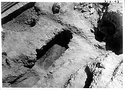
| Mycenaean grave. It consisted of a shallow rectangular cutting in bedrock about 1.40m by 0.70m, but it was probably somewhat bigger, since the east side and a large part of the north side had been cut ... Myc. IIIA:1-2 ... It consisted of a shallow rectangular cutting in bedrock about 1.40m by 0.70m, but it was probably somewhat bigger, since the east side and a large part of the north side had been cut away by later builders. |
| Mycenaean Grave to W of Pier 12 (Burial 11).
The northern part of the tomb had been cut away by the foundation trench for the south stylobate of the Square Building that preceded the Stoa, and the dromos, ... Myc. IIB-IIIA:1 ... The northern part of the tomb had been cut away by the foundation trench for the south stylobate of the Square Building that preceded the Stoa, and the dromos, if one existed, must have been lost in this operation. The chamber was small with an original east-west dimension of 1.60m and a preserved north-south dimension of 1.20m, the walls preserved to a maximum height of 0.90m. A single skeleton lay in some disorder in the eastern part with its head to the south. |
| Homer A. Thompson ... PG grave to NW of Pier 19 (Grave 4).
It consisted of a rectangular pit, oriented north-south, cut into bedrock. Only the lowest part of the tomb pit was preserved; the upper part was cut away in the Classical ... Earlier-Developed Protogeometric ... It consisted of a rectangular pit, oriented north-south, cut into bedrock. Only the lowest part of the tomb pit was preserved; the upper part was cut away in the Classical period. |
Filling under North-South Road surface, apparently to raise the level of the road as thickness of fill varies depending on height of road. Fill sits on earliest, cobbled road layer. The road surface set ... Mid-6th c. B.C ... Filling under North-South Road surface, apparently to raise the level of the road as thickness of fill varies depending on height of road. ... Broken ceramic material in fill concentrated in the northeast part of excavated area; material remains in scarp. |
Trial trench IV. A thin strip of undisturbed fill excavated on the north side of the upper terrace, just inside the line of the Archaic peribolos wall.
Probably this small patch of clay represents part ... Protoattic ... A thin strip of undisturbed fill excavated on the north side of the upper terrace, just inside the line of the Archaic peribolos wall.
Probably this small patch of clay represents part of the ground surface of the sanctuary in the 7th century, pressed into the high bedrock.
|
| Marcie Handler ... Fill within the drain from the basin on the west side of Roman Room B through Wall A.
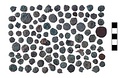
After we removed the fill within the basin on the west side of Roman Room B (BZ XXVII p. 5325), we began excavating ... Late Roman ... After we removed the fill within the basin on the west side of Roman Room B (BZ XXVII p. 5325), we began excavating in the cutting on the east face of a conglomerate block that is part of Wall A. The cutting was semicircular, and the fill was silty and very hard-packed. The cutting is probably a drain that carried water from the basin through Wall A and onto the North-South Road. Seventy-eight coins were found in the fill, of varying sizes but all badly corroded. |
Cistern at 70/ΚΕ and channels. Part of same system as D 17:3 and D 17:5. It was set against a corner of the lowest foundation block. Thus one is forced to assume that enough of the wall remained at least ... Ca. 200-150 B.C ... Cistern at 70/ΚΕ and channels. Part of same system as D 17:3 and D 17:5. ... After Sulla many of the blocks at the east and were pulled out, the north wall of court F was placed on the western foundations, but at a slightly different angle, and the wall as such ceased to exist.
|
| David Scahill ... Below packed clay floors in Room 2 of Classical Building II; bordered on east and south sides by polygonal cross wall and back wall extension for Classical Building. Late Roman wall and drain installation ... LHIII A:1 ... Chamber cut into soft bedrock, depth ca. 50.926msl, diameter ca. 2m. roughly square.
Upper part of tomb cut away by leveling for floors of Classical Building. ... At floor of tomb, concentration of bone fragments and pots, mostly broken in situ, concentrated against the north side of the tomb, with some bone fragments across the middle, and on the south side with more pots. ... Toward the west against the north side, a bronze dagger and spear point. |
Well 15: Mycenaean. It was situated about 35 meters down the slope northwest of the exit of the Mycenaean Fountain.
Well circular or roughly oval in section.
Diameter max. width to -4.0: ca. 1.50, below ... Late Mycenaean ... About 0.30m below, a late Roman pit which cut into the north side sherds occurred in fair quantity and the fill seemed to be pure.
... Seems to constitute a dump fill from neighboring houses of the Mycenaean III B period, and is somewhat earlier than the major part of the dump fill of the Fountain. |
| Sacrificial pyre in Poros Building, NW Room (RSY= Pyre 1).
Against east wall of room 5 west. artifacts, bone, carbon and ash in pit in floor sequence. the pyre lay below a floor covered with marble dust, ... Middle of 4th c. B.C ... Against east wall of room 5 west. artifacts, bone, carbon and ash in pit in floor sequence. the pyre lay below a floor covered with marble dust, the lowest floor that can be associated with the north wall of the room. ... A lekane and the lower part of an amphora set into the floor of this room may have served industrial purposes. |
Mycenaean Deposit (Gully) in front of NE Stoa (corrected from P 7:1).
It consisted of a series of irregular pits, some gradually linked up with one another to form what seemed a natural gully. The largest ... Mycenaean IIIA-B ... The largest pit measuring 1.70m east-west by about 1.20m north-south and having a maximum depth of 0.90m was situated from five to ten meters northeast of the gully proper and was cut at the north by the back wall of Northeast Stoa, which was set down a little into it.
The gully itself ran in a southwesterly direction and yielded about twenty small painted sherds, fragmentary cooking pots, unglazed kylix stems, fragments from pithoi and other coarse pots, as well as part of a stone grinder and many animal bones.
... Because of its proximity to the chamber tombs and because of the exceptional quality of several of the vases, it seems likely that some of the material came from disturbed tombs
Addenda 2025: Pit with Mycenaean pottery cut at the North by NE Stoa. Towards the south, it ends at an irregular piece of bedrock. |
| Mycenaean Double Grave (Graves A and B).
Grave A was in Layer II. We laid a skull and a few other bones, three vases and a stone bead. We have dug to a maximum of about 0.06m below the top of Layer II ... Myc. IIIA/B ... To the South of Grave A and separated from it by a narrow wall apparently of bedrock, was part of another grave. ... The skeletal material (AA 177) ... does not agree with the evidence of the plan and the excavator’s description since AA 177 consisted of bones of a M. about 40 to the north, and a F.(?) |
| Marcie Handler ... Continued from 2000 season, 10-12 July 2000; BZ XXIII p. 4472.
The hoard was originally excavated during the 2000 season (Lot BZ 1049, 5th-6th centuries AD), from a higher elevation through a gap in the ... 10-12 July 2000
21-22 July 2003 |
Fillings associated with early houses on the lower north slopes of the Areopagus; various levels and dates.
Both houses were built in the 6th century B.C. and destroyed by the Persians; both also have ... 6rd c. B.C.-3rd c. A.D ... Fillings associated with early houses on the lower north slopes of the Areopagus; various levels and dates.
... Southwest House, Rooms I-VIII, 42-55/ΚΖ-ΜΖ:
The earliest house had a court on the west with a Well (B) and two small rooms at the north. A pit at 54/ΛΓ (M 17:7) served the area and a good water pipe ... ... See also L 17:3 where objects SS 14318 and T 3576 are listed as part of the well deposit but are actually from the filling over the undug well, i.e. strosis 3, Room IV in Southwest House (nbp. 1393). |
| Mycenaean Chamber Tomb occupies a considerable part of the western half of section ΕΕ; lies about half way up the north slope of the Areopagus towards its eastern end, just below the highest point of the ... Myc. III A:1 ... Mycenaean Chamber Tomb occupies a considerable part of the western half of section ΕΕ; lies about half way up the north slope of the Areopagus towards its eastern end, just below the highest point of the hill. ... Its roof has entirely caved in, except for a small bit projecting at the north end of the west side; probably was not flat but slightly concave (all along the north side it seems that it rises from the sides toward the center).
... Group of objects:
a) on the east bench, a little north of its center (BI 511, P 15234-15239)
b) on the floor in the northeast corner of the chamber just to the left of the door (B 704, P 15358-15359)
c) on the floor of the chamber, about 0.40m from the south wall, near its mid-point (B 705, BI 513, BI 514, BI 530
d) on the floor in the northwest part of the chamber, at the foot of the bench about midway between the grave and the north wall of the chamber (J 64, J 65, J 68) |
| Mycenaean Small Chamber tomb.
The cist measures 1,90m E to W, 0.75-0.90m N to S, max. depth -1.30m. Nothing was found in it; cleaned in modern times and used as a cesspool. Some of the SW part of it had ... Myc. IIIA, early 14th c ... Some of the SW part of it had also been cut away in Roman times by a terracotta drain. All that remains of the chamber is a small segment with a maximum preserved dimension of 1.20m, which is bordered on the north by a modern wall and on the east by a cesspool. ... It must have been from the north as the hill slopes downward in this direction, but everything was cut away in modern times if not earlier. |
| Brian Martens ... Mycenaean Chamber Tomb J 1:11, located in the area north of Wall K, was partially excavated during the 2014 season. At this point the full western extent of the chamber has not been located because of ... LHIIIA ... Mycenaean Chamber Tomb J 1:11, located in the area north of Wall K, was partially excavated during the 2014 season. ... The chamber was disturbed during the Late Geometric period (ca. 700 B.C or the decades shortly thereafter), when it was packed with fill, apparently as part of a deliberate operation.
... Just to the north, we excavated additional glass-paste beads, presumably part of a second strand.
|
|
|