|
|
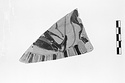
| Two wall fragments from an open bowl with sharply curving side, glazed inside. Rim broken off.
a) The hindquarters of a panther, right, and the foreleg of another creature behind him.
b) At left, part ... 18 May 1939 ... Cf. for shape: CVA Munich 3, pl. 139: 1-2. |
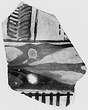
| Fragment from the floor preserving part of a groove and tiny part of the foot.
Around tondo, tongue pattern alternately red and black. Lower part of a draped figure right. Leg of someone lunging(?) to ... July 1947 ... Agora:Object:CVA Munich, pl. 18, 2 and 20, 1. |
| Three non-joining fragments.
a) Mended from three fragments, preserves part of upper body and projecting rim. On upper body, rectangular panels alternately reserved with slanting lines in dilute glaze ... 17-24 May 1940 ... Agora:Object:CVA Munich pl. 94, 6. |
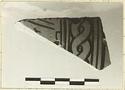
| Fragment broken all around. Guilloche. At bottom, clay to right; strands of a mane.
Glaze brown to black.
Cf. Munich 6077; London 1865.7-20.1(A 471). Pit. Leica, 81-534, 81-571 ... (September 1958) ... Glaze brown to black.
Cf. Munich 6077; London 1865.7-20.1(A 471). |
Wall fragment from near start of rim. Reserved band on inside. Max. dim. 0.045.
B, youth (most of head, start of shoulder) to left, wearing a himation.
The Painter of Munich 2335 (ARV2 1165, 70) ... Ca. 420 B.C ... The Painter of Munich 2335 (ARV2 1165, 70). |
Wall fragment from near rim. Reserved band on inside near top. Glaze fired brownish on outside. Max. dim. 0.059.
B, youth (head, part of right arm) to right.
The Painter of Munich 2335 (ARV2 1165, 69) ... Ca. 420 B.C ... The Painter of Munich 2335 (ARV2 1165, 69). |
NM 16059
Flat bottom; continuous profile.
Black to brown glaze.
Others include Kerameikos V, 1, pl 139, inv. no. 356; C.V.A., Munich 3[9], 117[399], 7-8; C.V.A., Copenhagen 2[2], 70[71], 6; Thorikos ... LG IIB ... Others include Kerameikos V, 1, pl 139, inv. no. 356; C.V.A., Munich 3[9], 117[399], 7-8; C.V.A., Copenhagen 2[2], 70[71], 6; Thorikos IV, p. 88, fig. 69 |
Apparently complete.
Some kind of symbol or perhaps a ligature involving the letters alpha and delta: cf. two 6th c. B.C. ligatures of these letters from the precinct of Aphaia on Aigina, A. Furtwangler, ... Furtwangler, Aegina, Das Heilihtum der Aphaia, Munich, 1906, p. 466, nos. 367, 368. |
Wall fragment, unglazed inside.
Chin, neck and a little of shoulder of Athena to left; the edge of the neck-piece of her helmet appears just below the break. White for flesh.
Charikleides group (363/2): ... Schmidt, Archaistiche Kurst, Munich, 1932, pl. 7,2) |
Part of lid with incurving rim. On underside, two concentric circles with a band between. Glaze fired greenish in places. H. 0.01; est. diam. 0.12.
On top side, from knob out: dots; egg pattern with dots; ... Ca. 430-420 B.C ... For the patterns, see the lid of Munich 2720 by the Drouot Painter (ARV2 1223, ---, 4; Addenda 349). |
Wall fragment from just below rim with start of handle at far left. Narrow reserved band on inside near top. Max. dim. 0.09.
B, youth (head and shoulders) to right, wearing a himation.
During his visit ... Probably late 5th century B.C ... During his visit to the Agora in the summer of 1953, Beazley noted on the record card: "doubtful but possibly by the Painter of Munich 2335"; not in ARV2. |
| From the top of the wall of a bell krater. Inside, a narrow reserved band; outside, reserved band below start of rim. Head and shoulders of a youth, right; traces of another figure at the extreme left ... 29 March 1934 ... ADDENDA Doubtful, but possible by the P. of Munich 2335, (JDB summer 1953). |
Lid and pyxis intact except for a few chips. H. with lid 0.042; without lid 0.038; diam. of pyxis at bottom 0.067.
On top side of lid: chest with lid partly open.
Inscribed on underside of lid and glazed ... Late 5th century B.C ... Inscribed on underside of lid and glazed over:
on underside of pyxis:
For a similar chest, but with the lid shut, see Munich 2726 A (CVA, München 2 [Deutschland 6], pl. 99 [295]:2). |
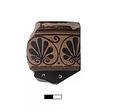
| Circumscribed black figure palmettes on rim zone.
Inscribed: on wall just below rim, in white paint, the inscription broken at both sides.
Cf. The ornament used by Euthymides on the Munich amphora, Pfuhl ... June 1952 ... The ornament used by Euthymides on the Munich amphora, Pfuhl (1923), fig. 369.
|
Shoulder and neck fragment. Max. dim. 0.08. Choes and Anthesteria, p. 91, cat. no. 233.
Frieze of upright encircled palmettes and lotuses. Below:
Below, at right break, part of a thick fillet tied around ... Second quarter of the 5th century B.C ... The pattern has a parallel on Munich 2493, a middle work by the Berlin Painter (ARV2 210, 187). |
| The fragment first found comes from the middle of the back of the figure. The hair, worn in a heavy mass, square at the bottom, falls nearly to the small of the back. The folds of the garment, drawn tight, ... Early Roman Period (?) ... From replica of Munich Tyche.
White marble. |
Two non-joining fragments of neck and wall, a with start of handle. Dull black glaze, misfired red in places. Max. dim. a) 0.135, b) 0.102.
Fragment a shows the top of a head to left; fragment b (detail ... Ca. 420 B.C ... The Painter of Munich 2335 (ARV2 1162, 23). |
Part of domed lid and brim with start of knob or ridge around knob. Concentric bands on underside. Est. diam. 0.13; max. dim. 0.114.
Head of woman (Aphrodite[?]) to right with sakkos, facing a palmette ... Late 5th or early 4th century B.C ... Perhaps similar to Munich 2725 from the Chalki Group (ARV2 1503, 3; Addenda 383). |
Wall fragment from just below rim. Reserved band on inside near top. Glaze fired red on inside. Max. dim. 0.099. R. S. Young, Hesperia 20, 1951, pl. 79:4.
Maenad (head, left shoulder, and left arm) probably ... Ca. 420 B.C ... The Painter of Munich 2335 (ARV2 1163, 36). |
Floor fragment with start of stem. Incised line on stem. Max. dim. 0.057.
I, nude male (part of left side of torso, legs except for calves and feet) bending forward about to lift a pointed amphora (lower ... Ca. 520-510 B.C ... For a similar composition, only with a satyr, see Munich 2613 by the Poseidon Painter (ARV2 136, 3; Paralip. 334, 3; Addenda 178); also one of the komasts on Brussels A 3047 by the Epeleios Painter (ARV2 146, 7). |
| Most of body and foot missing, handle and neck practically complete. Partly restored in plaster. Round-bodied oinochoe; band handle; brown wash inside. At top of handle, a palmette between two half-palmettes; ... 2-19 May 1939 ... P 15010 and Munich 2450, CVA München, pl. 89, no. 2. |
Preserved except for handle. Glaze abraded in places, somewhat thin here and there. H. 0.03; diam. 0.091. Hoffmann, Sexual and Asexual Pursuit, p. 11, cat. no. Aa 1, pl. 1:3.
Hound pursuing a hare. Reserved ... Ca. 430 B.C ... Perhaps by the same hand as the unattributed askos Munich 2541 (CVA, München 2 [Deutschland 6], pl. 102 [298]:1, there the hound pursues a fox). |
Floor fragment with stem and start of fillet. Incision at edge of fillet. Max. dim. 0.069.
I, runner (head, upper part of right arm, right leg from the knee down and left foot missing) to right. In his ... Ca. 520 B.C ... Incision for anatomy occurs, for example, on the red-figured side of the bilingual amphora Type A in Munich, 2302 (ARV2 6, 1; Addenda 150; Lullies in CVA, München 4 [Deutschland 12], p. 8); another is the red-figured amphora Type A in Philadelphia 5399 (ARV2 7, 3); for the incision, see W. ... Beazley (Vases in America, p. 6) adds two others: Munich 2590 by Phintias (ARV2 24, 12; Paralip. 323, 12; Addenda 155) and an unattributed cup contemporary with Psiax, Compiègne 1106 (CVA, Compiègne 1 [France 3], pl. 13 [111]:10). The proportions of the runner on 1575 agree reasonably well with those of the warriors on three cups: Cleveland 76.89 (ARV2 7, 7; Paralip. 321, 7; Addenda 151); Munich 2587 (ARV2 7, 8; Addenda 151) and New York, M.M.A. 14.146.1 (ARV2 8, 9; Addenda 151). |
Shoulder fragment with start of neck. Max. dim. 0.05. Choes and Anthesteria, p. 89, cat. no. 222, fig. 368; Burn, Meidias Painter, p. 98, cat. no. M 14, pl. 14:b.
Eros (wreathed head, shoulders, wings, ... Ca. 410-400 B.C ... Burn (Meidias Painter, p. 26, note 2) suggests that this might be a scene of Eros wrestling and cites as a parallel Munich inv. 8926 by the Washing Painter (ARV2 1127, 6 bis; Addenda 332; Schefold, Göttersage, p. 198, fig. 269). ... If this were the subject of 710, as on the Munich lebes, there should be a hand on the shoulder of Eros and no ball or stone in his hand.
|
Wall fragment. Narrow reserved band on inside near top. Max. dim. 0.08.
Poseidon (most of head, torso, left arm and thigh) leaning forward a bit, probably seated or standing with his left leg bent, the ... Ca. 430-420 B.C ... The Painter of Munich 2335 (ARV2 1163, 44). |
| The whole lower part, and one-third of the upper part including one handle missing. Satyr running to right, holding thyrsos in the left hand. Partial relief contour.
Good glaze inside; outside, dull ... 1 June 1951 ... The Type B shape similar to that of the Anymone painter's kantharos in CVA Munich, pl. 93, 1-2 (ARV, p. 550, no. 3), but ours more likely stemless; note straighter wall of bowl; also difference in handles: ours not rising at all above the rim and the lower attachment is set at the bottom of the rim, not on the body wall. |
Wall fragment with return. Thin glaze on inside. Max. dim. 0.055.
Youth (head) to left, with head thrown back. Relief contour: chin.
Dilute glaze: muscles.
The position of the youth's head and his open ... Ca. 480-470 B.C ... Cf. the youth on side B of Munich 2346 by the Pig Painter (ARV2 565, 32 bis). |
Two non-joining shoulder and neck fragments. Max. dim. a) 0.037, b) 0.044. Choes and Anthesteria, p. 86, cat. no. 204, fig. 122.
Torch race. Fragment a preserves the head, chest, start of arms of one ... Ca. 400 B.C ... The scene on 730 probably looked like that on one in the Villa Giulia by the Painter of Munich 2335 (ARV2 1166, 105). |
Lid, preserved except for knob and large chip in brim. Unglazed on underside, except for two concentric circles with central dot. P.H. 0.023; diam. 0.112.
From knob out: egg pattern with dots and double ... Ca. 420 B.C ... The system of decoration on 1015 bears some similarity to that on Munich 2722 by the Montlaurès Painter (ARV2 1296, 26; Addenda 359). |
Bowl fragment. Traces of burning at left (surface is gray). Max. dim. 0.04. H. A. Thompson, Hesperia 6, 1937, p. 13, fig. 6:a.
A, two women (bottom of chiton, left foot of one; right foot, a little of ... Ca. 510-500 B.C ... The drawing of the drapery folds and the horizontal line across one of them are closest to these two by the Hermaios Painter: the maenad in the tondo of Boston, M.F.A. 95.33 (ARV2 110, 3; Addenda 173) and the warrior or Amazon in that of Bochum S 489 (Paralip. 332, 8 ter; Addenda 173); the maenads on Munich 2589 by the Chelis Painter (ARV2 112, 1; Addenda 173). 1404 may be by either painter. |
Wall fragment. Glaze streaky reddish brown and dull black on inside. Max. dim. 0.062. A. Ashmead, Hesperia 35, 1966, pl. 8:6.
Man or youth (lower legs, right foot frontal, left in profile). Preliminary ... Ca. 480 B.C ... E 441, Theseus on side A (ARV2 187, 57; Addenda 188); Villa Giulia 26040, the figure of Patroklos (ARV2 188, 63; Paralip. 341, 63); Munich inv. 8770, Odysseus (Paralip. 341, 73 bis); and Malibu, the J. |
Wall fragment. Max. dim. 0.097.
Nude woman (head, lower legs missing) moving to left, carrying an amphora with a bail handle (a little remains at each side) from which water pours into a laver (part of ... Late 6th or early 5th century B.C ... For the shape of the amphora and its handle, see Munich, inv. 8762 by Myson (ARV2 1638, 2 bis; Addenda 201; JdI 102, 1987, p. 62, fig. 1); Berkeley 8.3225 by the Boot Painter (ARV2 822, 24; Addenda 294). |
Wall fragment. Glaze cracked near top. Max. dim. 0.083.
Nike (middle of body dressed in a peplos, arms) flying to left, holding something (shaft), probably a torch, in her right hand. At the left, lower ... Ca. 440-430 B.C ... For the drapery, compare that of the woman holding the hydria on her head on Munich 2360 (ARV2 1186, 30; Addenda 341; LIMC V, 1990, p. 128, no. 2916, pl. 120, s.v. |
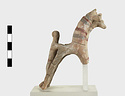
| Four horses with driver figurine.
Forelegs missing; mended from many fragments.
The driver leans against the long hind legs of the central horses and rests his hands on their backs. The driver stands on ... 31 March 1932 ... Another piece in the Munich Pinakothek (no. 5602). |
Wall fragment. Glaze slightly pitted and abraded. Max. dim. 0.068.
Woman (lower part of head to left, shoulders, upper part of torso), to right, dancing(?). She wears a brassiere (ταινι'α or ἀπο'δεσμος) ... Probably early 4th century B.C ... PE 12, pl. 93); Havana, once Lagunillas by the Painter of Munich 2335 (Olmos, Vasos griegos . . . |
Two non-joining wall fragments. Max. dim. a) 0.055, b) 0.077. A. Ashmead, Hesperia 35, 1966, pl. 8.
Fragment a preserves most of the filleted head of an old man (Phoinix) to left, holding a spear or staff ... Ca. 490 B.C ... Döhle (Klio 49, 1967 [ pp. 63--143], p. 105) thinks that 254 may come from a representation of the Mission to Achilleus, based in part by the presence of Phoinix in the same scene by the Kleophrades Painter on his hydria in Munich, inv. 8770 (Paralip. 341, 73 bis; Addenda 189). In the Munich scene, however, he stands while Hermes and Achilleus sit, facing one another. |
Thirteen non-joining wall fragments with thin reddish wash on inside. Mended in antiquity (part of lead repair in b; hole in d). Glaze pitted and abraded here and there. P.H. a) 0.14; max. dim. a) 0.281, ... Ca. 440 B.C ... KL 1, pl. 125), Munich 2415, the middle youth on side B (ARV2 1143, 2; Paralip. 455, 2; Addenda 334; Matheson, p. 406, cat. no. ... KL 39); for the outer contour of the himation on fragment c, cf. Munich 2414, the aulos-player (ARV2 1143, 6; Paralip. 455, 6; Addenda 334; Matheson, p. 407, cat. no. ... Ferrara 44894 = T.57 C VP, Munich 2415, or Munich 2361 (ARV2 1145, 36; Paralip. 456, 36; Addenda 335; Matheson, p. 414, cat. no. |
Three non-joining wall fragments, a with wall and cul, b with rim and part of one handle, c with a bit of the cul. Max. dim. a) 0.095, b) 0.09, c) 0.05.
On rim, tongue pattern above a row of dots. On ... Probably late 5th century B.C ... For complete examples, see Vienna 1124 (CVA, Vienna 1 [Österreich 1], pl. 46 [46]:4) and Munich 2571 (CVA, München 2 [Deutschland 6], pl. 94 [290]:6). 1235 is not from the same kantharos as 1236: the color of the glaze is different. |
Mended from several fragments, with the missing pieces restored in plaster and painted. Mouth completely restored. H. to top of handle 0.135; rest. diam. of body 0.118. R. S. Young, Hesperia 20, 1951, ... Ca. 430 B.C ... Perhaps by the Painter of Munich 2335 (Addenda and Corrigenda, p. 1685 to ARV1 779--783; not in ARV2). |
Wall fragment from turn of shoulder. Glaze thin and dull on inside. Max. dim. 0.055.
Satyr (part of face, beard, ear, and hair) to right, wearing a spotted feline skin. Overlapping the locks of hair at ... Ca. 490 B.C ... Cf., e.g., the maenad with the fawn skin over her chiton who holds both a thyrsos and a snake on Munich 8732 = 2344 by the Kleophrades Painter (ARV2 182, 6; Paralip. 340, 6; Addenda 186); also the huge serpent held by Dionysos on Louvre Cp 10748, where the god attacks a falling giant (ARV2 187, 55; Addenda 188).
|
|
|