|
|
Middle Stoa Building Fill.
Cf. also H-I-J 14-15, H-K 12-14 (ask SIR) (unsolved)
This deposit is not definitive and must be considered with the above deposits before details are entered into database; ... Before ca. 150 B.C ... Middle Stoa Building Fill.
|
Middle Stoa Building Fill (with filling to S) (See also Κ: H-I-J 14-15 and Λ: K-M 13-14)
This deposit is not definitive and must be considered with the above deposits before details are entered into database; ... To ca. 180 B.C ... Middle Stoa Building Fill |
| Located in Middle Stoa, west, south aisle, beneath pressure pipe (cf. A 4900). The siting of the well is remarkable in its proximity to Well I 13:3, also Geometric in date, which was found in 1968 only ... Second half of 8th c B.C ... Geometric Well in Middle Stoa |
Located in road west of Middle Stoa. It was 4.80m deep. Owing to its shallowness, it was probably kept clean. The southernmost block of the N-S peribolos (?) wall west of the Middle Stoa partly covered ... 200-165 B.C ... Located in road west of Middle Stoa. It was 4.80m deep. ... wall west of the Middle Stoa partly covered the mouth of the well. |
Geometric Well South of Middle Stoa Pier 14, in the north-central part of the South Square. Water jars, simple household vases and utensils, a trial piece for use in a potter's kiln, bones of pigs and ... 775-750 B.C ... Geometric Well South of Middle Stoa Pier 14, in the north-central part of the South Square. |
| Square Byz. Well South of Middle Stoa Pier 21 (Iliad Well) Estimated Grid ... Byzantine ... Square Byzantine Well South of Middle Stoa Pier 21 |
Backfill of demolition of Great Monument beneath Middle Stoa.
[Soft pit below Layer II of south aisle (=fill of early "Great Drain")] ... Early 4th c. B.C ... Backfill of Demolition of Great Monument beneath Middle Stoa |
Crosscut between Middle stoa Piers 1 and 2 from west (south aisle), layer II.
Chiefly late 5th to mid-4th c. B.C. Coins:
2 July 1965 #1 ... Late 5th to mid-4th c. B.C ... Crosscut between Middle stoa Piers 1 and 2 from west (south aisle), layer II.
|
Nbp. 1740: From the gravel fill at the level of the lowest step, late Hellenistic pottery, higher up (middle to top steps) early Roman. Coins:
23 March 1948 #1-#4
24 April 1948 #1-#33
26 April 1948 #1-#26 ... Late Hellenistic-Early Roman ... Filling over steps of Middle Stoa and road to west |
South Stoa II Construction Fill.
About 85 stamped amphora handles, many with parallels in building fills of Middle Stoa and Stoa of Attalos. Fragments of long-petal bowls confirm date after mid-2nd c ... To ca. 140 B.C ... South Stoa II Construction Fill.
About 85 stamped amphora handles, many with parallels in building fills of Middle Stoa and Stoa of Attalos. |
Burnt Layer inside retaining wall of Middle Stoa Terrace (Θ) and NW Corner of Middle Stoa, burnt debris inside terrace retaining wall (Ζ). Coins Ζ: Coins Θ:
1 June 1951 ... Mid-3rd c. A.D ... Burnt Layer inside retaining wall of Middle Stoa Terrace (Θ) and NW Corner of Middle Stoa, burnt debris inside terrace retaining wall (Ζ). |
Well beneath 4th c. Klepsydra Drain, within foundations of west end of the Middle Stoa. Diameter 0.90m, cut through bedrock, with handholes on sides. Top 4.50m. dumped fill; 4.50-6.15m. period of use ... Mid-8th c. B.C ... Klepsydra Drain, within foundations of west end of the Middle Stoa. Diameter 0.90m, cut through bedrock, with handholes on sides. |
Herulian Destruction Debris in and around west end of Middle stoa and in and around Civic offices (House F) . Separated in two groups: H-I 12:1 and I 12:1. Asterisk: I 12* ... Herulian Destruction Debris in and around west end of Middle stoa and in and around Civic offices (House F) . |
Water deposit in Polygonal Drain (43-44/Γ-Ζ and martyra)immediately south of the south foundations of the Middle Stoa. Early branch of the original course of Great Drain. P 2248 added to this deposit by ... Ca. 420-390 B.C ... Water deposit in Polygonal Drain (43-44/Γ-Ζ and martyra)immediately south of the south foundations of the Middle Stoa. Early branch of the original course of Great Drain. |
| This cutting was filled in at the time Road 6 was laid. Homogeneous dumped fill.
This deposit represents fill which was brought in at the time Road 6 at the west end of the Middle Stoa was laid to fill ... Ca. 480 B.C ... This deposit represents fill which was brought in at the time Road 6 at the west end of the Middle Stoa was laid to fill in a deep gully which had formed in the earlier road, Road 7. |
| Well I: PG, ELS. The collapsed well north of the Middle Stoa Terrace. This pit, or shallow well, into which a Turkish storage pit lined with stones was set, produced purely Proto-Geometric pottery and ... Protogeometric ... The collapsed well north of the Middle Stoa Terrace. |
Hellenistic Fills South of Middle Stoa (1954) (cf. K-M 13-14, etc) (unsolved)
This deposit is not definitive and must be considered with the above deposits before details are entered into database; left ... Hellenistic Fills South of Middle Stoa (1954) (cf. |
Hellenistic fill South of Middle Stoa near NW corner of Heliaea. This fill contained material later in date than that which made up the middle Stoa Building Fill.
Only the coins (and a few amphora handles ... To ca. 140 B.C ... Hellenistic fill South of Middle Stoa near NW corner of Heliaea. This fill contained material later in date than that which made up the middle Stoa Building Fill.
... Descriptions on coin envelopes:
Hell fills of middle stoa and s of drain c (lowest);
Hell fill over intermediate strosis + cutting intermed. strosis 22/ΛΒ;
20/ΛΔ Hell fill.
|
Located in front of west end of Stepped Retaining Wall, Heliaia. Filled in and covered in last stages of grading of area after construction of Middle Stoa.
Pottery from settling basin nondescript. Single ... 175-150 B.C ... Filled in and covered in last stages of grading of area after construction of Middle Stoa.
Pottery from settling basin nondescript. |
Well at 66/ΛΖ. Homogeneous fill.
14 stamped amphora handles. Rhodian and Knidian handles find parallels in Middle Stoa building fill. Type 27 D lamp agrees with this date. Fragments of 50 bowls and one ... 225-175 B.C ... Rhodian and Knidian handles find parallels in Middle Stoa building fill. |
Middle Stoa Building Fill (East End) (Inside building and to South) Cf. H-I-J 12-13 (Θ, ΜΣ) and H-I-J 14 -15 (Κ) (unsolved)
This deposit is not definitive and must be considered with the above deposits ... Middle Stoa Building Fill (East End) (Inside building and to South) Cf. |
Burial disturbed. Located in Middle Stoa, north aisle, "upper trench", piers 3 and 4. Two individuals: small child (ca. 5 yrs. old) and adult female.
In its disturbed state the burial was found (at elevation ... First half of 7th c. B.C ... Located in Middle Stoa, north aisle, "upper trench", piers 3 and 4. |
| Well A, early 5th c. B.C. Near the Agora Boundary Stone, northwest corner of Middle Stoa; diameter at top 0.92m, widening to 1.15m and more below. Shaft neatly faced with stones to a depth of 0.70m below ... Ca. 520-480 B.C ... Near the Agora Boundary Stone, northwest corner of Middle Stoa; diameter at top 0.92m, widening to 1.15m and more below. |
N-S Cut on 50m. line (area of Road, area of Stoa, area N of Stoa) various levels and dates over the three areas.
Investigations to the northwest of the market square in the area of the road running out ... Prehistoric to Roman ... N-S Cut on 50m. line (area of Road, area of Stoa, area N of Stoa) various levels and dates over the three areas.
... Area of Stoa:
Layer I: 2nd-3rd c. ... Coins:
8 March 1939 #1 (stoa, layer IV), #2 (stoa, layer V), #3 (road, layer VI)
9 March 1939 #1-#1a (road, layer VII), #2 (stoa, layer VII)
10 March 1939 #1-#2 (road, layer VII-VIII), #3 (road, dump) |
Investigations in the Hellenistic Metroon, various levels. Stoa Pits A, B, C, D, E, F, H and I (various layers).
Locations include:
SW corner of Primitive Bouleuterion; from contemporary filling alongside ... 8th-6th c. B.C ... Investigations in the Hellenistic Metroon, various levels. Stoa Pits A, B, C, D, E, F, H and I (various layers).
... B.C. with much earlier material
- early to middle 6th c. B.C.
- first quarter of 6th c. |
| Mycenaean Chamber Tomb below Middle Stoa Terrace.
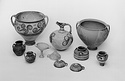
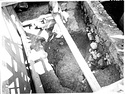
The tomb was entered from the west by a stepped dromos, at least 4.20m long by 1.10 to 1.50m. wide, splaying slightly toward the doorway, which was 1.26m ... Myc. IIIA:1 ... Mycenaean Chamber Tomb below Middle Stoa Terrace.
|
| Eugene Vanderpool Homer A. Thompson ... Mycenaean Grave to W. of "Court Room" below Stoa Terrace with "Ballot Box" (Grave XXIX).
Unusual type, conforming neither to our pit nor to our cist graves, and consisted of two parts. The outer part was ... Mycenaean III A-B ... Mycenaean Grave to W. of "Court Room" below Stoa Terrace with "Ballot Box" (Grave XXIX).
... The outer part was a rectangular pit (2.10 by 1.30m) cut down in the soft bedrock to a depth of ca. 0.90m, with both long sides walled with field stones, leaving a passage only 0.45m wide in the middle. The narrow space was full of gray earth and clay with no trace of bones or any offerings, although the base of a goblet was embedded in the stones of the north side. |
|
|