|
|
| A deep plate, or shallow bowl; mended from many pieces. Rather high ring foot; rounded rim.
Pinkish brown clay; poor glaze, most of which has peeled off. Well, in north cistern arm. Leica, 4-334 PD 346 ... 3 March 1934 ... Hesperia 3 (1934), no. E 1. |
| About one-third of the plate preserved. On the floor, within a triple circle of shallow rouletting, four stamped palmettes.
Thin and very metallic glaze. Cistern. Leica, 4-322 PD 345, PD 346 ... 1932 ... Hesperia 3 (1934), no. C 1, p. 347. |
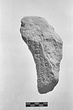
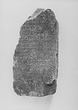
| Fragment of inscription.
Small bit of inscribed surface preserved; otherwise broken or chipped all round.
Pentelic marble. Found in Byzantine context, at bottom, in the southwest corner of the Market Square ... Late 5th. century B.C ... Hesperia 3 (1934), p. 1 ... Agora XVI, no. 26, p. 35, pl. 3. |
| Mended from three fragments; about three-quarters of the ring base preserved but none of the sides or rim of the dish, which shows a very faint upward curve toward the edges of the fragment. At the center, ... 4 April 1933 ... Hesperia 3 (1934), no. A 1, p. 316, fig. 2. |
Resembles rising less angular Rhodian type; fragmentary; worn all around.
Light red clay; yellow near surface; cream slip
Impression resembles Rhodian in shape; broken away at right; twice stamped; letters ... 23 July 1931 |
From straight rim.
Fine pink clay, light buff slip.
Stamped. Dim: L 0.069, Hrim 0.05, Th 0.024* On top of drain. HEON (HE and ON lig, prhps inv) Leica ... 10 March 1932 |
Rising; angular.
Typical clay.
Impression badly set; letters worn away; traces of rose. Finished letters
rose
(in O) Leica ... 15 March 1932 |
Arched, rising, broken at curve, neck not preserved.
Typical clay; red core very distinct.
Impression nearly worn away; traces of rose and one or two letters. Rdg: rather lrg lets(VG)*
Date: DB says ... 29 March 1932 |
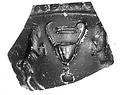
| Rim fragment with double spirals combined with leaves in upper zone. Below, goats rampant with krater between. Cistern. Leica, 99-20-1(2,3,4,5) PD 315 ... 1932 |
| Fragment from inscribed block.
The inscribed surface shows a slight horizontal curve.
Parts of twenty-two lines of the inscription preserved; non-stoichedon.
Pentelic marble. Pre-excavation. Found in the ... 1933 |
Small, thick, nearly cylindrical.
Medium fine, red clay; slightly micaceous; pinkish-buff slip.
Impression broken away left of two letters. [---]ΤΑ 427 Leica ... 16 July 1931 |
Broad, curved, level.
Medium coarse red clay, greyish at core; slightly micaceous; pinkish buff slip.
Monogram; lower part flaked away. Rdg: poss =Th=; animal dev?*
Par: par w/ attribute not found(VG)* ... 17 July 1931 |
Flat, curved shape; similar to Knidian but small.
Coarse greyish-red clay, micaceous.
Impression so carelessly made and so worn as to be almost illegible. Ἐπὶ Θε
[---] 427 Leica ... 16 July 1931 |
Small, thick, start of curve.
Medium fine clay, yellowish brick red clay; considerable traces of dark red paint.
Shallow, worn impression; small suggesting seal; content seems to be pictorial. Human ... 1931 |
Parts of lip and floor remain. Restored in plaster. The plate was broken in antiquity and mended with lead clamps of which one remains. The inner flange is dovetailed at either end and carefully inlaid ... 3-12 March 1934 ... Hesperia 3 (1934), no. ... Agora XXXII, no. 3, fig. 1. |
Broad, arched.
Rather coarse clay; cream surface, red just beneath; distinct gray core.
Indistinct impression from wear. Dim: W 0.037* Μενιπ( (Ν retr) Leica ... Late Hellenistic |
Mended from two fragments; complete save for minor fractures.
Buff clay. Thin black glaze on the inside; the outside, and the rim with two grooves, unglazed. Well. Leica, 4-310 PD 347 ... 21 March 1933 |
| Neck preserved nearly complete; handles broken away below curve.
Stamp on outside of heavy rim [H. (letter) 0.022m.]:
Coarse red clay. Lighter at surface. Fill over south end of drain 1. Leica, 4-55, ... 17 May 1932 |
Rim fragment. Gently flaring lip with plain rim.
Gritty, yellow clay. Covered with thin brown glaze on the inside only. Pithos. Leica PD 350 ... 1932 |
Restored in plaster. False base ring set off from the side wall by a shallow groove. On the inside, about 0.01m. below the lip the glaze has been scratched from the bottom of a shallow groove.
Thin black ... 1932 |
Only the middle of the floor preserved, which rested on a false base ring formed by the downward continuation of the side walls. Around the outside are shallow corrugations run on the wheel. On the floor, ... 1932 |
The neck preserved to its original height over one-half of its circumference. Gently concave in profile. Around its middle runs a garland of ivy leavs c arefully rendered in thinned clay. Just under the ... 1932 |
Mended from seven pieces; parts of rim and sides still missing. Small flat bottom; bulging sides narrowing toward the neck; small flaring lip; single vertical ribbon handle.
Light reddish buff clay ... 17 March 1932 |
Mended from two fragments preserving the complete circle of the base and part of the rim. Low heavy ring base; incurving rim.
Pink clay; the glaze thin, discolored and worn. Well. Leica ... 20-21 March 1933 |
Fragments of rim and body missing. Low ring base; incurving rim.
Pink clay; good black glaze, metallic in places. Well. Leica ... 20-21 March 1933 |
Mouth, handle, and parts of the side wall broken away. Restored in plaster. Heavy base ring, broad shoulder; slender neck with wheel-run grooves around its lower part; strap handle.
Buff clay, covered ... 3-12 March 1934 |
Only a fragment of the bottom remains. High thin base ring; almost flat floor. Vertical side wall.
On the bottom within the base ring, incised in the dry clay:
Buff, slightly micaceous clay, covered ... 3-12 March 1934 |
Fragment from the base of a saucer similar to P 2857. Outcurved lip.
On the floor is a circle of rouletting enclosing a number of free standing stamped palmettes of which two remain.
The black glaze ... 1933 |
Part of the handle and rim are preserved.
Rim flat on top and bound by a shallow groove on either side.
Cf. Agora XXXIII, nos. 250, 280. Well. Leica PD 350 ... 1933 |
Fragment of rim, gently convex on top.
Buff clay covered with brown glaze inside and out.
Cf. Agora XXXIII, no. 255. Well. Leica PD 350 ... 1933 |
One handle and part of rim preserved. Rim almost flat on top. Heavy loop handle projecting well beyond the edge of the rim.
Buff clay covered with flaky brown glaze on the inside and on the top of the ... 1933 |
Fragment of rim, sharply downturned.
Greenish yellow clay, unglazed. Well. Upper fill. Leica PD 350 ... 1933 |
| Two joining fragments from rim.
Upper zone shows areca flowers. Pithos. Leica PD 331 ... 1932 |
Rim fragment. The lip of this imported Megarian bowl is incurved.
On the outer wall there remain parts of three zones divided by raised lines; the uppermost is occupied by a band of egg-and-dart; the ... 1932 |
Rim fragment.
Egg-and-dart pattern in upper zone. Pithos. Leica PD 331 ... 1932 |
Small fragment.
Rabbit's head shows on the side. Pithos. Leica PD 331 ... 1932 |
Rim fragment.
Rim flat on top but bent sharply down toward the outside.
Gritty, buff clay covered on the inside with thin brown glaze and spattered on the outside with the same.
Cf. Agora XXXIII, no ... 1932 |
The lip flares and was fitted with a ledge to receive a lid.
Decorated on the outside with horizontal rows of dots applied "en barbotine".
Coarse clay fired gray and red. Very thin fabric. Pithos. Leica, ... 1932 |
A garland of pointed pendents rendered in thinned clay suspended between the handles. On the neck, above, a horizontal line in white paint. Several more small fragments of this ware, two of them showing ... 1933 |
Rim fragment, slightly convex at top.
Coarse buff clay covered with thin brown glaze on the inside and the top of the rim.
Cf. Agora XXXIII, no. 255. Well. Leica PD 350 ... 1933 |
|
|