|
|
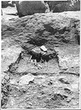
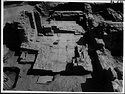
A well behind the Stoa of Zeus. Noted as the finding place of the bronze head of Nike, B 30.
Two Rhodian stamped amphora handles. Fragments of only two bowls ... 260-210 B.C ... Noted as the finding place of the bronze head of Nike, B 30.
|
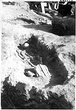
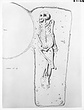
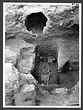
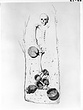
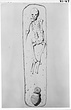
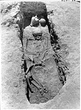
| Shallow cutting into bedrock (L. 1.70m, W. 0.55m.) oriented north and south, head at south. Skeleton stretched out , with head on left side. Southern top edge of grave projects to form protective niche ... 750-725 B.C ... Shallow cutting into bedrock (L. 1.70m, W. 0.55m.) oriented north and south, head at south. Skeleton stretched out , with head on left side. Southern top edge of grave projects to form protective niche for head. |
Grave 11 in notebook. Grave disturbed by diggers of pit A.
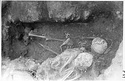
Only skull and left arm of man's skeleton remained in position, head toward N.E. Cover slabs were piled near head ... Late Geometric ... Only skull and left arm of man's skeleton remained in position, head toward N.E. Cover slabs were piled near head. |
Well L.
Use filling and well-head; abandonment filling chiefly of mud and stones, with a scattering of pottery ... ca. 575-550 B.C.-To early 5th c. B.C ... Use filling and well-head; abandonment filling chiefly of mud and stones, with a scattering of pottery. |
Grave in cella of Temple of Hephaisteion. Grave XLVII in notebook. Rotted bones, head to west (adult). Neg. KK 352 ... 9 March 1939 ... Rotted bones, head to west (adult). |
| Cut in bedrock (P.L. 0.50m, W. 0.57m). Head at east, looking west; skull stood upright when found. Lower part of skeleton missing. PD 435 ... 750-725 B.C ... Cut in bedrock (P.L. 0.50m, W. 0.57m). Head at east, looking west; skull stood upright when found. |
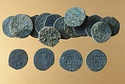
| Coin hoard. Room 2: soft soil north of floor surface. Coins:
23 July 1999 #924-#944. Anonymous folles with the head of Christ on the obverse dating between 770-1059 ... 23 July 1999 ... Anonymous folles with the head of Christ on the obverse dating between 770-1059. |
A pit running E-W under Holy Apostle St., about 1.20m. square and 0.90m. deep. Built with stones about the size of a man's head. Coins:
24 April 1935 #12-#13 ... 18th c ... Built with stones about the size of a man's head. |
| Eugene Vanderpool ... Grave. Bones discarded.
Burial lies over dromos of Mycenaean chamber tomb N 21-22:1. The roots of a tree had upturned the bones, but the head probably lay at the northeast ... Middle Geometric II ... The roots of a tree had upturned the bones, but the head probably lay at the northeast. |
| Susan Rotroff ... Grave 1. Burial of a child perhaps 6 years old, covered by broken amphora. Skeleton lay extended on its back, oriented N-S, with head at south. No grave gifts. PD 2207 ... Final Mycenaean/Submycenaean ... Skeleton lay extended on its back, oriented N-S, with head at south. No grave gifts. |
| Grave cut into bedrock (L. 2m, W. 0.58m), head toward E; offerings at south end. Skeleton of a male about 40 years old, laid out with knees slightly bent.
Brann. PD 434, PD 1058 ... 750-725 B.C ... Grave cut into bedrock (L. 2m, W. 0.58m), head toward E; offerings at south end. |
Early Roman well with four fills.
fill 1: well sealed 1st. c. A.D.
fill 2: more bones than pots.
fill 3: nothing later than 1st. c. B.C.=POU
fill 4: similar to fill 3, a little earlier? Coins:
7 May 1940 ... Early Roman ... Coins:
7 May 1940 #14 from fill around well head
29 July 1946 #1 said to be from well dump
SS 9562 from stone packing to west of well head |
Well in Stoa Terrace opposite Pier 2.
Diameter 1.10m. Well cut with steps on both sides. No water. was probably not much used, although part of a well head was found at 4.50m Estimated Grid ... Into 600-575 B.C ... No water. was probably not much used, although part of a well head was found at 4.50m |
| Grave 19 in notebook. Bones only AA 3.
Length 2.15m; width 0.63m; depth 0.52m.
Woman' skeleton with head at north. Cover slabs piled at foot of grave, probably by the diggers of Well J 18:8, who rifled ... Late Geometric ... Woman' skeleton with head at north. Cover slabs piled at foot of grave, probably by the diggers of Well J 18:8, who rifled grave. |
| Geometric Burial. Burial B in notebook.
Overlay E 14:13. Skeleton lay on smoothed bedrock, head southward, arms folded on chest, hands below chin. Legs, cut off by later disturbance, probably bent, with ... Late Geometric ... Skeleton lay on smoothed bedrock, head southward, arms folded on chest, hands below chin. |
Well A
Mostly uniform dumped fill. use level probably late. The well head (A 2753) had evidently been broken up and thrown in as soon as the well went out of use. Dumped filling, second quarter of 7th ... 7th century B.C ... The well head (A 2753) had evidently been broken up and thrown in as soon as the well went out of use. |
North of court F, around well head only. Deposit created by A.W. and first appears in his thesis (Biblio. below).
Cf. nbpp. 2204 and 2234 and lot 350 for court F and p. 2127 for north of court. Coins: ... 1st-2nd c. A.D ... North of court F, around well head only. Deposit created by A.W. and first appears in his thesis (Biblio. below).
|
Grave of 38 year-old female, head NW, legs drawn up. Apparently unlined cist in bedrock or hard-packed dug-bedrock, its outlines no longer distinguishable from surrounding fill. Above skeleton, a number ... Mycenaean? ... Grave of 38 year-old female, head NW, legs drawn up. ... If the offerings were at the feet they would have been disturbed by a late Turkish pit, and if at the head by the builders of the so-called "Burned Building".
|
| Well in Room 7 of Roman House H, partially covered by caldarium of added bath complex (Room 6). Stone well-head; 0.85m in diameter. Stpped because of danger of collapse. Cut through bedrock, water from ... 6th c. A.D ... Stone well-head; 0.85m in diameter. |
Tiled well, ca. 30m south of the Tholos. Associated with Building D. Hellenistic Group A with Late Roman fill in upper 3.00m. Objects A 245 and P 4597 are from fill on floor around well-head, contemporary ... 325-260 B.C ... Objects A 245 and P 4597 are from fill on floor around well-head, contemporary with upper fill but not in subdivision .1.
... Coins:
13 March 1933 #1 at well head (#2-#3)
21 March 1933 #1 (dump) (not a coin) |
| John Camp ... Protogeometric Grave about 0.60m to the southeast of T 15:2.
Unlined roughly rectangular-elliptical pit, oriented north-south, neatly cut into bedrock to a depth of 0.70m, with rounded corners. The pit ... Early-Developed Protogeometric ... Within the pit, the skeleton of a woman, aged about 40-44 years at death, within significant osteoarthritis and degenerative joint disease, was placed on the floor of the tomb, on her back, in a fully extended supine position, arms by the side of the body, head to the south. The head had rolled over onto its right side, facing northeast.
|
| Grave 7b in notebook. Inhumation in Tholos Cemetery; The skeleton positioned directly below the male in Grave 7, but with direction reversed, i.e., head at southeast end. Most grave offerings at lower ... 750-725 B.C ... Inhumation in Tholos Cemetery; The skeleton positioned directly below the male in Grave 7, but with direction reversed, i.e., head at southeast end. |
| Grave 14 in notebook.
Length of shaft 2.12m; width 0.46m; depth from cover 0.60m. Man's skeleton stretched NE-SW with head at NE. Offering at foot of shaft, with the skyphos in the mouth of the pitcher ... 750-725 B.C ... Man's skeleton stretched NE-SW with head at NE. Offering at foot of shaft, with the skyphos in the mouth of the pitcher.
|
| Mycenaean Burial.
The cutting was roughly rectangular (1.60 by 0.50m) and was once covered with rough stone slabs, two of which were found over the body. The skeleton, presumably that of a man, lay in ... Myc. III A-B ... The skeleton, presumably that of a man, lay in a somewhat contracted position with the head at the southeast and with the offerings, two pots and a bronze knife, at this end of the grave. |
This is associated with Building A. It had a circular marble well-head with a rectangular well slab beneath. The construction throughout was of well tiles. It produced little to a depth of -8.60m. Between ... 4th c. A.D ... It had a circular marble well-head with a rectangular well slab beneath. |
Mycenaean Grave inside NW corner of N extension of Stoa.
It was set deeply down, ca. 1.50m below the surface. Excavation revealed a single skeleton, extended, with head to east, and legs bent up at the ... Myc. III B ... Excavation revealed a single skeleton, extended, with head to east, and legs bent up at the knees, the arms folded over the abdomen. |
| Herm head deliberately buried in a pit with coins of the 2nd half of the 4th c. Head found at an elevation of 51.907. Bottom of the pit at 51.637 m. Coins:
27 June 1972 #199-#205
Bits of bronze, iron ... 2nd half 4th c. B.C ... Herm head deliberately buried in a pit with coins of the 2nd half of the 4th c. Head found at an elevation of 51.907. |
| Susan I. Rotroff ... Grave 4 under Royal Stoa. Cist Grave cut into bedrock and lined with limestone and schist slabs. There were two layers of cover slabs with a layer of dirt between. Grave measured 0.98x0,25-0,32x0,25-0,30 ... Final Mycenaean/Submycenaean ... Apparently extended on back. Head to south, grave oriented ne-sw. |
Well dug through N 18:1 (cistern at 79/ΜΗ) on the lower north slopes of Areopagus; the cistern was the northern chamber of a system; the southern chamber is at 84/ΝΣΤ (N 19:1).
A single dumped deposit ... 3rd-4th c. A.D ... It included marbles, a window tile, a millstone, and a well-head as well as pottery and other objects: destruction debris. |
| Mycenaean Grave.
One of the first Mycenaean burials found in the Agora. It consisted of a regular cist, carefully cut with vertical sides and a flat bottom, measuring 1.90m by 0.55m. There were apparently ... LH III (c. 1200) ... The skeleton was well preserved from the head to the pelvis, but the feet and lower legs were disarranged and the thigh bones apparently removed by the Romans. The skeleton lay on its back with the head turned to the left and the right arm flexed across the chest, the fingers clutching the left upper arm. |
| Laura Gawlinski ... Burial of a woman (young adult female ca. 18-20); precise dating difficult due to disturbance by later features, but the amount of Neolithic and Geometric pottery extracted from the trench is significant ... Prehistoric ... Body partially rests on bedrock, tightly contracted position with head at east. |
Well at 115/ΜΘ.
Careful stone curbing around the upper walls, the presence of footholds in the sides, an adequate water supply and the fragments of a terracotta well-head in the filling indicate that the ... 600-550 B.C ... Careful stone curbing around the upper walls, the presence of footholds in the sides, an adequate water supply and the fragments of a terracotta well-head in the filling indicate that the well served as a water source, but only a few fragments of water jars give any direct evidence of a period of use. |
| Grave 8 in notebook.
Inhumation in Tholos Cemetery. Length of shaft 1.75m; Width at upper end 0.95m; Depth from cover 0.70m.
One end cut into sloping rock.
Skeleton of a woman, with head southeast. Most ... 750-725 B.C ... Skeleton of a woman, with head southeast. Most offerings near upper body. |
Well 2: archaic. Diameter, top ca. 1.00; bottom ca. 0.90m.
Water level:ca -7.00m In the use filling, along with the plain water pots was a black-figured neck amphora assigned to the Edinburgh painter ... Last quarter of the 6th c. B.C ... Dumped filling consisting largely of mudbrick, broken rooftiles and other debris, along with a pithos-top well head.
An upper filling was not a dump, but a washed-in filling, containing a scattering of figured fragments. |
| Eugene Vanderpool ... Grave (E.L. Smithson: Grave II: SM).
Unlined trench, roughly the size of the deceased, cut into bedrock to a depth of just over 1.50m. Oriented north-south, the tomb pit measured 1.69m in length (length ... Late Mycenaean/Submycenaean-Earliest Protogeometric ... A roughly rectangular stone slab rested on the ledges above the head of the deceased, while fragments of a pithos (or pithoi), also resting on the ledges, covered the deceased down to the thighs. ... Within the tomb pit, the body of a middle-aged 45-49 years at death was placed in an extended position, on her back, head to the south. The body of the deceased was roughly the size of the tomb pit, and the head, turned toward the west, facing west-northwest, lay right up against the cutting of the tomb pit. |
| Eugene Vanderpool ... Infant grave near Phaidon street cistern. No offerings.
Roughly rectangular, almost elliptical cutting in bedrock, measuring 0.70m long, 0.35m wide, and 0.40m deep, oriented south-southwest to north-northeast ... Late Helladic III C/Early Protogeometric (date uncertain) ... The skeleton of what was stated to be a "newborn infant," head to the south-southwest, was laid out within the pit and covered by a stone slab.
|
| Grave 16 in notebook.
Length of shaft 1.81m; width 0.64m; depth from cover 0.54m.
Skeleton of a woman , head at northwest end. Most of pots piled over feet and legs of skeleton at southeast end.
An iron ... 750 B.C ... Skeleton of a woman , head at northwest end. |
Mycenaean Grave W. of Circular Building. Measuring 1.40m by 0.55m and it was covered with a few rough stone covering slabs, under which lay the skeleton of an adult with the head to the north and the knees ... Myc. III A2-B ... Measuring 1.40m by 0.55m and it was covered with a few rough stone covering slabs, under which lay the skeleton of an adult with the head to the north and the knees up. |
| Well in West Colonnade of Roman House H. Covered by a large handsome marble well-head, apparently reused. Cut through bedrock. Diameter ca. 1.20m, water at -3.60m.
Two distinct POU fills. One at ca. -4.50m ... June-August 1970 ... Covered by a large handsome marble well-head, apparently reused. |
Mycenaean Chamber Tomb W. of Circular Building (at Σ:30/ΛΕ?)
It had been badly disturbed by a fourth-century B.C. pit which cut into the northeast part of the chamber (rectangular, ca. 1.80m by 1.30m) ... Myc. III A 2 ... Only the one lying along the west edge of the chamber was well-preserved, with its head to the south, knees up, and with the pots at its feet. two more pots were found lying between this skeleton and the chamber wall. |
|
|