|
|
| Fine, p. 4, no. 8. Finley, Chap. IV at note 63 and pp. 192-193, commentary on no. 175 A. Fine, p. 118, note 20. B.D. Meritt, Hesperia 37, 1968, p. 292, no. 34, photograph pl. 84. Fine, p. 4, no. 7, photograph ... Agora 19 49 I 7021 I 5629 I 273 I 5698 I 5639 ... 7 September 1966 ... Fine, p. 4, no. 8 ... Fine, p. 4, no. 7, photograph pl. 2 ... Fine, p. 4, no. 8, photograph pl. 2 |
| Fine, pp. 6-7, no. 12, photograph pl. 2. Finley, p. 183, no. 21 A. Fine, pp. 9-10, no. 18, photograph pl. 4. Finley, p. 186, no. 85B. Fine, p. 7, no. 13, photograph pl. 3. Finley, p. 187, no. 101 B. Fine, ... Agora 19 45 I 4134 I 2728 I 3701 I 4231 ... 6 May 1936 ... Fine, pp. 9-10, no. 18, photograph pl. 4 ... Fine, p. 7, no. 13, photograph pl. 3 ... Fine, p. 10, no. 19, photograph pl. 4 |
| IG II², 2742 and 2496, lines 9-12. C. Vatin, Jardins et services de voirie, BCH 100, 1976, pp. 555-564. Fine, pp. 10-11, no. 20, photographs pl. 4. Finley, p. 186, no. 85 C. Fine, pp. 7-8, no. 15, photograph ... Agora 19 46 I 4245 I 3647 I 7498 I 3682 ... 10 June 1936 ... Fine, pp. 10-11, no. 20, photographs pl. 4 ... Fine, pp. 7-8, no. 15, photograph pl. 3 ... Fine, p. 8, no. 16, photograph pl. 3 |
Well by Stoa Pier 8.
Mouth of well discovered in 1950 (p. 2287).
Dumped filling in the 4th c. B.C. but the bulk of the material of the 5th c. B.C. Fill contained much wood, bones, Mycenaean, Geometric, ... 5th c. B.C. |
Neck.
Base of neck.
Concave neck. Brown band around base of neck. Hard, fine, only slightly micaceous, light red fabric (2.5YR 6/6); hard, dull, very pale brown slip (10YR 8/4) ... Context of 160-130 |
Small Jug.
Fragment of wall.
Sloping shoulder, curving in to fairly wide neck. Groove on shoulder.
Fairly hard, fine, micaceous, pink fabric (7.5YR 7/4) with a few dark red inclusions; very pale brown ... Context of before ca. 150 |
Plate Or Bowl.
Part of foot and floor.
Low, thick foot, concave to outside; rounded resting surface. Kiln support embedded in floor, with trace of another on underside. Hard, very pale brown fabric (10YR ... 2nd-century to early Roman context |
P 18548 a, b
Body (a) mended from eight fragments and partly restored; lid (b) mended from nine fragments.
Flat underside with string marks. Very slightly concave lower wall.
Rim concave on inside, ... 325-300 ... P 18548 a, b
Body (a) mended from eight fragments and partly restored; lid (b) mended from nine fragments.
... Soft, reddish yellow to pink household fabric (5YR 7/6--7.5YR 7/4) with much fine mica.
Shape as P 18549 a (Young 1951b, no. 8:12, p. 125, pl. 52:b, from same pyre, there joined with lid of cooking fabric). |
Neck.
Base of neck and top of shoulder.
Neck made separately and inserted into body. Decoration in orange-brown to brown glaze: band at base of neck; part of square bow on shoulder below. Hard, fine, ... Context of 225-165 |
Complete but slightly cracked.
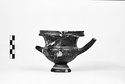
Rounded bottom. Unusually low and squat profile. Handle arches high above rim. Red cooking fabric (2.5YR 4/8) with fine mica, coarse sand-size quartz and lime, and voids ... 325-300 ... Red cooking fabric (2.5YR 4/8) with fine mica, coarse sand-size quartz and lime, and voids.
Others in cooking fabric from contemporary contexts:P 17697 (from same pyre), P 16741 (Young 1951b, no. 10:9, p. 126 [B 22:3]). |
Lid.
Broken all around, with knob missing.
Knob or stem made separately, with two square moldings at base.
Decoration in red glaze: lotus petals with dotted ribs alternate with plain petals on wall ... Disturbed 4th-century context |
P 28560 a, b
Body (a) mended from twelve fragments, lid (b) from seven fragments; trace of burning on part of outer rim of body.
Rounded bottom. Fairly deep body with flaring rim. Rim slightly concave ... 325-300 |
Chytra.
Lower body missing.
Slightly outturned rim. Strap handle from rim to shoulder, arching above rim. Hard, fine, light brown fabric (7.5YR 6/4) with very little mica; thin brown glaze used as glue ... 3rd-century context ... Strap handle from rim to shoulder, arching above rim. Hard, fine, light brown fabric (7.5YR 6/4) with very little mica; thin brown glaze used as glue for handle.
A complete example: P 27979 (Stella G. Miller 1974, no. 64, p. 238, pl. 34 [F 16:8]). |
Beaker?
P 19850 a, b, c
Three nonjoining wall fragments.
Vertical wall with groups of four vertical gouges. Thin, horizontal groove at bottom of gouges. Hard, fine, somewhat micaceous, reddish yellow ... |
P 19053 a, b
Bowl (b) mended from thirty-eight fragments; lid (a) from eighteen fragments, with small areas restored; burned.
Rounded bottom. Broad shallow body with steep wall, slightly concave below ... 325-300 |
Shoulder And Neck.
Part of shoulder and base of neck.
Slightly convex shoulder runs smoothly into neck. Decoration in brown glaze: row of dots around base of neck; rays alternate with dots on shoulder ... Mixed early and late Roman context ... Decoration in brown glaze: row of dots around base of neck; rays alternate with dots on shoulder. Fine, hard, somewhat micaceous, reddish yellow fabric (5YR 7/6); slightly lustrous, pink slip (7.5YR 8/4).
... For dot borders see BCH 91, 1967, no. 10, p. 298, fig. 60 and BCH 108, 1984, pp. 952--953, fig. 152 (Cyprus). |
Lagynos.
Underside, parts of body, and most of handle restored.
Flaring ring foot; flat resting surface. Flattened globular body.
Fairly long, tubular neck. Flaring rim, flat on top and undercut on ... Second half of 1st century (context of 110 to early 1st century after Christ) |
Bowl: Pergamene Sigillata?
Foot preserved, some chips missing.
Flaring foot with groove and ridge at top; broad, beveled resting surface with two grooves at inner edge. Concave underside. Graffito ΚΥ ... Context of 110-75 |
Deep Bowl: Gnathia Ware.
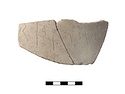
Single wall fragment, broken all around; inner surface pitted.
Large, open vase with nearly vertical wall. At top, an ivy vine with white stem and dot rosettes, yellow sponged ... Early 3rd century ... To left, a thin white fillet with double fringe. Hard, fine, very micaceous, pink fabric (ca. 7.5YR 8/4) with small black inclusions, partly mottled gray; black glaze.
... For the pattern on deep bowls and kraters see Langlotz 1932, no. 833, p. 149, pl. 241. ... XVIII:a, XXVIII:d and Webster 1951, no. 20, p. 223, fig. 1. |
Bowl and lower part of stand missing; much of flange chipped away.
Hollow, vertically grooved stand, flaring widely to bottom. Molded flange at base of bowl decorated with incised cable above dotted ovolo ... Late 2nd to 1st century? ... Break below flange on opposite sides suggests that there were handles or rings. Fine, hard, micaceous, light brown fabric (7.5YR 6/4); traces of white paint, some thin glaze under flange.
... Tarsus I, no. 549, p. 376, fig. 252; Albania Antica III, no. 8, p. 132, pl. ... Cf. also metal thymiateria: Pfrommer 1987, KT 2, KT 3, KT 52, pp. 202, 207, pls. 2, 4, 32. |
Emblem and about one-fourth of wall preserved; rimmissing.
Phiale rests on ridge surrounded by two scraped grooves. Shallow bowl with glazed groove at top of preserved area. Irregular indentations radiate ... 225-200 |
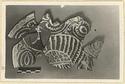
| a) and b) preserve parts of rim; c) the complete foot and parts of walls. A plate of very fine fabric; ring foot, inturned rim. Restored in plaster. An elaborate conventional design, possibly a bird surrounded ... 22 March 1937 |
Plate With Upturned Rim: Campana A?
Center of floor, small part of foot, and three-fourths of rim and wall missing.
Low, slightly flaring ring foot; flat, reserved resting surface; nearly flat underside ... Context of 250-165 ... On floor, four palmettes within rouletting. Fine, hard, light reddish brown fabric (2.5YR 6/4) with white inclusions; very smooth, metallic black glaze, brown on stacking circle and underneath; finger marks on foot and lower wall.
Closely similar shape in Italian black glaze: Morel 1981, Type 2233b, p. 150, pl. 36 (second half of 3rd century); for similar stamped palmettes cf. Morel 1986, no. 38, p. 467, fig. 8 (Campana A ware, ca. 175). |
| Household Hydria. Lip chipped. Vertical handle broken but preserved. Very rotund shape. Ring foot, flat projecting rim. Fine slip much worn.
Reddish-brown micaceous clay. Well L, box 6. Context ca. 575-550 ... 16 July 1959 |
Head of figurine. Fine work. Lacking back of head, hair over right brow. Perhaps ephebic (?) type. Reddish clay. Munsell (fabric) 5 YR 6/4 light reddish brown; (slip) 8/N white Oscar Broneer, Nb. No. 2 ... 18 October 1933 |
| Rim flares to heavy, profiled edge; remains of large, rising, horizontally set handles attached to the swelling body of the vase. Foot, 0.018 high, two concave mouldings set on a convex one, the central ... 16 February 1932 |
| Disk with slightly raised rounded rim. Cracked.
Scratched letters:
Fine pinkish-buff clay. Remains of black glaze on upper part of rim. Shiny brown smears on top, within rim.
Stand?
Cf. Agora XII, ... 13 June 1932 |
Mouth, handle, and pieces of body missing.
Low foot; flat resting surface; slightly convex underside. Straight lower body of equal height with convex shoulder. Slight sinking at base of neck. Strap handle ... Context of 115-86 |
Plate Or Bowl: Central Italian.
Foot and part of floor preserved.
Angular ring foot; rounded resting surface; pointed underside. Three circles on floor: four stamps within inner two circles; very fine ... Context of 150-86 ... Three circles on floor: four stamps within inner two circles; very fine rouletting between outer two. ... Micaceous, pink fabric (7.5YR 7/4); lustrous black glaze with one large spall on surface.
This form of stamp is typical of central Italy and, according to Morel, is often found at Arezzo, Volterra, Cosa, Cerveteri, Rome, and Alba Fucens (Morel 1963, p. 50). For some similar stamps, arranged in approximately the same manner, see Morel 1965, no. 24, p. 38, pls. 3, 39 ( possibly Campana B, ca. 100), and no. 157, p. 81, pl. 12 (Campana B, first half of 1st century); Lambogila 1952, p. 155, fig. 8 (Tarragona: Campana B, 1st century); Bocci 1965, no. 1721, p. 147, fig. 20, no. 1372, p. 158, fig. 25 (from Roselle). |
Handles restored; preserved only at the attachments.
Thick body on flaring ring foot; heavy rolled rim with a groove and a sharp ridge below it. Slightly gritty red clay with some fine mica, neatly self-surfaced ... Context ca. 490-450 B.C. |
Most of handle and parts of foot, underside, and body restored.
Low foot; flat resting surface; flat underside with some string marks still visible. Straight lower body, convex shoulder. Tapering neck ... 150-110? (Roman context) ... Fairly hard, fine, pink fabric (7.5YR 8/4) with mica and a few small white inclusions; no slip. ... Leroux 1913, no. 9, pp. 18--19 (Delos); Dent, Lloyd, and Riley 1976--1977, no. 24, p. 151, fig. 7 (Benghazi); and perhaps Konstantinopoulos 1986, p. 151, fig. 168. |
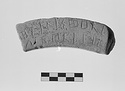
| Rim fragment of a lekane preserving brown glaze on the interior, but having a reserved top and exterior. Most of the candidate's name is preserved, save for the last couple of letters.
The inscription ... 23 June 1994 |
| Mended from ten pieces and restored in plaster. High ring foot; angled wall; rim projecting outward. Decoration inside: ring of unevenly positioned palmettes around rosette of stamped ovules; ring of ovules ... 21 July 1970 |
Body And Lid.
P 4077 a, b
Small segment of rim and flange of lid (a) and about one-third of circumference of pyxis rim (b).
Lid has vertical rim and domed top offset from flange. Trace of inwardly projecting ... Context of 160-130 |
Rim and three-fourths of body restored.
Low foot; curved resting surface; nearly flat underside with spiral marks. Upper and lower body of equal height, both slightly curved.
Smooth transition to neck ... Late 2nd to early 1st century? (3rd-century context,disturbed) ... Soft, coarse, porous, reddish yellow fabric (5YR 6/6) with fine mica, many red and white inclusions, some large pieces of quartz; pink slip (7.5YR 8/4) now almost totally missing.
... For other lagynoi of this same general shape and decoration see Kaltsas 1990, no. 13, p. 12, pl. 14:η (Pylos); Délos XXVII, D 110, p. 252, pl. 45 and Zapheiropoulou and Hatzidakis 1994, pp. 244--245, pl. 199:α (Delos, in late-2nd- to early-1st-century contexts); Priene, no. 19, p. 401, fig. 539:2 on p. 422 (with different mouth); Giannikouri, Patsiada, and Philimonos 1990, p. 175, pl. 90:d (Rhodes); BCH 90, 1966, p. 335, fig. 89:b (Cyprus); Paphos III, series 6, nos. 16, 17, pp. 20--21, figs. ... V:6; [Kourouniotes] 1902, col. 161, pl. Η:8 (Antikythera). |
Center of floor, part of rim, and large parts of body restored.
Low, angular foot; curved resting surface; nearly flat underside.
Lower body nearly straight, shoulder slightly convex. Smooth transition ... Context of 115-86 |
| Two joining fragments of shoulder.
Coarse, gritty pink clay, buff on surface, with red and white inclusions and fine mica.
On exterior incised: Inventoried 27 July 1998. Well. in zip lock bag 1889, 1909 ... 28 July 1994 |
Lid.
Knob missing; about one-fifth of wall and rim restored.
Domed lid with offset above horizontal flange and around knob. Rim slopes slightly inward. Decoration in orange glaze. Band on offset below ... 115-50 |
| Nearly complete; missing two handles, minor chipping at rim, cracked at body and base, paint badly worn.
Short, cylindrical, straight-sided body; sloping shoulder; very low neck; small mouth with flaring ... Mycenaean LHIIIA1 |
Unguentarium: Italian?
Nonjoining sections of neck and lower body preserved; one handle, much of body, and half of rim restored. Lower body missing.
Scraped groove below greatest diameter, at handle ... Context of 115-90 ... Neck (below scraped groove): row of double hoops with vertical lines between them. Hard, fine, very pale brown fabric (10YR 8/3) with little mica and a few white inclusions; shiny to dull glaze, mottled from black to brown, much missing.
For plain or banded unguentaria with similar handles see Mercando 1976, p. 183, fig. 12, p. 186, fig. 20, from Ancona; CVA, Capua, Museo Campano 4 [Italy 44], pl. 9 [1982]:3, with reference to others on p. 16; Forti 1965, pl. XVI:a (Taranto); Jehasse and Jehasse 1973, no. 1190, p. 343, pl. 142 (Corsica); Ampurias I, nos. 21, 22, p. 397. |
|
|
.png.icon.jpg)
.png.icon.jpg)
.png.icon.jpg)