|
|
Coins:
1 June 1935 #1-#11
3 June 1935 #1-#14 Estimated Grid ... 1-3 June 1935 ... Well 7, earth |
Well Y, in area North of the West end of the Yellow Poros Foundation. The shaft had cut through the wall of an earlier well and the cavity had been packed with stones by the diggers of the new well. In ... Earth 5th c. B.C ... Earth 5th c. B.C. |
Well at the southeast foot of Kolonos Agoraios.
Use filling of 1st c. A.D.; dumped fillings of 3rd c. and of early Byz. times. Coins:
15 June 1937 #1-#2 (earth)
16 June 1937 #14-#20 (earth)
17 June 1937 ... 1st c. A.D.=POU ... Coins:
15 June 1937 #1-#2 (earth)
16 June 1937 #14-#20 (earth)
17 June 1937 #1-#11 (earth)
18 June 1937 #4-#5 (earth)
19 June 1937 #4-#6 (earth) |
Stratified well with POU first half of 1st c. - mid 3rd c. A.D. and dumped fills of 4th and 5th-6th c. A.D.
Finds from upper fills "earth": BI 315, L 2549.
Finds from lower fills "earth": BI 302, BI 316, ... 1st to 3rd century and late 3rd to 6th century ... Finds from upper fills "earth": BI 315, L 2549.
Finds from lower fills "earth": BI 302, BI 316, L 2460, L 2498, L2499,
L 2501, G 73, P 21113, T 1218 ... Coins:
20 May 1936 #1
21 May 1936 #1-#9 [#1-#2 in 18 May baskets, #3-#8 in 20 May baskets]
22 May 1936 #1-#4 [#1-#3 found in 20 May baskets]
29 May 1936 #5-#18 [earth, lower fills]
30 May 1936 #1-#9 [earth, lower fills]
1 June 1936 #2-#4 [#2 in 24 May basket, #3-#4 in earth, lower fill]
2 June 1936 #2 [earth, lower fill]
9 June 1936 #1 [earth, above water]
11 June 1936 #20 [earth, above water] |
Grave in cella of Hephaisteion. Grave XXVI in notebook. Loose earth with bones. Coins:
14 March 1939 #1 ... 25 February 1939
18 March 1939 ... Grave XXVI in notebook. Loose earth with bones. |
Grave in cella of Hephaisteion. Grave XXX in notebook.
Filling: loose earth. No mention of bones. Lot 401b ... 8 March 1939 ... Filling: loose earth. No mention of bones. |
Grave in north peristyle of Hephaisteion. Grave XXXIII in notebook.
Filling: loose earth and bones. Lot 404 (a) Neg. KK 377 ... 6 March 1939 ... Filling: loose earth and bones. |
Grave in cella of Hephaisteion. Grave XXXV in notebook.
Filling: loose earth and confused bones. Coins:
6 March 1939 #11-#13 ... 8 March 1939 ... Filling: loose earth and confused bones. |
Containers 24-72.
Masses of pottery; including many BHWJ's; lamps XVIII and XXIV
Coins:
12 June 1937 #14-#53
13 June 1937 #1-#7 (from earth of 12 June)
13 June 1937 #8
14 June 1937 #1-#3
15 June 1937 ... First half 1st c. A.D ... Masses of pottery; including many BHWJ's; lamps XVIII and XXIV
Coins:
12 June 1937 #14-#53
13 June 1937 #1-#7 (from earth of 12 June)
13 June 1937 #8
14 June 1937 #1-#3
15 June 1937 #2-#13 (earth from lower part)
16 June 1937 #21-#22 (bottom, found 15 June) |
Coins:
9 June 1937 #1
10 June 1937 #1-#11
11 June 1937 #1-#30
12 June 1937 #1-#13 (from earth of 11 June) ... 2nd c. A.D ... Coins:
9 June 1937 #1
10 June 1937 #1-#11
11 June 1937 #1-#30
12 June 1937 #1-#13 (from earth of 11 June) |
Green Earth at 03-04-05/ΚΑ-ΚΔ, to at least -3.50m. near the southwest corner of the market square. Terracotta figurines; lamps; fragmentary pottery ... Ca. 500-475 B.C. and later ... Green Earth at 03-04-05/ΚΑ-ΚΔ, to at least -3.50m. near the southwest corner of the market square. |
Two periods of use.
Outside the SW corner of the market square, to the west of the north-south road; lower use of filling, of 1st to early 2nd c. A.D. Coins:
26 May 1937 #1 [to 8.30m.]
9 June 1937 #2-#4 ... 10 -11 June 1935
20 May-20 June 1937 ... Coins:
26 May 1937 #1 [to 8.30m.]
9 June 1937 #2-#4 [to 16.00m]
11 June 1937 #31 [to 17.60m]
12 June 1937 #54-#55 [to 18.10]
14 June 1937 #4-#5
15 June 1937 #1
17 June 1937 #12 (earth)
18 June 1937 #1-#3 (earth)
19 June 1937 #1-#3 (earth) |
Red sandy earth at inner corner of heavy late wall at 12/ΛΖ.
A. Walker coin deposit. Coins:
27 March 1934 #1-#12
28 March 1934 #1-#2 ... 2nd-3rd c. A.D ... Red sandy earth at inner corner of heavy late wall at 12/ΛΖ.
|
"Red earth": Herulian destruction debris over Roman House and east of cistern B. Coins:
30 May 1935 #1-#8
31 May 1935 #1-#15 Sherds stored in container Lot ΠΘ 4b ... 27 May 1935
31 May 1935
3 June 1935 ... "Red earth": Herulian destruction debris over Roman House and east of cistern B. |
| Terracotta deposit in SW corner of Room K and E of Roman Wall L. Roman layer of red, compact earth.
Baskets 50,52,54. Coins:
18 July 2002 #1282
19 July 2003 #1295 ... 4th c. A.D ... Roman layer of red, compact earth.
Baskets 50,52,54. |
Grave in north peristyle of Hephaisteion. Grave XXXII in notebook.
Loose earth and bones filling. Coins:
25 February 1939 #5-#6
6 March 1939 #2-#4
15 March 1939 #1 Neg. 378 ... 25 February 1939
6 March 1939 ... Grave XXXII in notebook.
Loose earth and bones filling. |
Roman Group L.
Layer I (cont. 59-64) Pre-Herulian second half of 3rd c. (bottom, 15.95-13.90).
Layer II (cont. 42-58) 4th c.-first quarter of 4th c. (11.90-13.90).
Layer III (cont. 17-41) -4th c. (10.00 ... Second half 3rd c.-early 5th c. A.D ... p. 2424.
24 May 1939 #1-#3
25 May 1939 #1
12 June 1939 #1(dump)
13 June 1939 #3(dump)
16 June 1939 #2-#3(found 8 & 9 June 1939)
21 June 1939 #1-#14(sifting earth)
22 June 1939 #7-#18(#7 found 5 June 1939, #8-#18 from earth)
23 June 1939 #9-#13(earth) |
Evidence of stratification into five layers, although joins between the layers. Layer VI added when the construction of the Roman building above required it. No subdivisions assigned.
Flask-shaped cistern ... Early 3rd-late 2nd c. B.C ... Layer I: red earth in the central depression, probably the accumulation of the last period of use of the cistern as a source of water. ... Layer III: fine red earth. It was put in to fill the cistern immediately after Layer II, and having settled, was later supplemented with layers IV and V, in close succession ... Layer IV: Dug bedrock and earth. |
| Grave 8 in notebook.
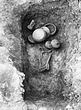
Inhumation in Tholos Cemetery. Length of shaft 1.75m; Width at upper end 0.95m; Depth from cover 0.70m.
One end cut into sloping rock.
Skeleton of a woman, with head southeast. Most ... 750-725 B.C ... Over body, earth fill; above fill of ashes and cinders of ca. 0.10m; on top fine earth which had sifted through slabs. |
Well cut through cistern at 40/Θ on Kolonos Agoraios (E 11:1). Two use periods plus an upper dumped fill from which the following objects: B 319, I 3994, SS 5745, T 1235. Coins:
6 April 1936 #18-#21
7 ... First half of 1st c. A.D.
4th-early 5th c. A.D ... Coins:
6 April 1936 #18-#21
7 April 1936 #1-#7
28 May 1936 #1
6 June 1936 #3
12 June 1936 #1-#22 (dump, lower earth)
12 June 1936 #28-#30 (dump, upper earth) |
| Pit, partly cleared; dumped filling of first half of 3rd. c. B.C., but with considerable material of the 4th. c. Hellenistic.
Its rotten schist walls collapsed some time near then and it was filled up ... 4th-3rd c. B.C ... Its rotten schist walls collapsed some time near then and it was filled up with pottery, ashes and earth, and abandoned. ... There was still soft earth in the bottom (at ca. 6m.), but we had stopped getting pottery at 4.20m.
|
| Dorothy Burr Thompson ... Grave 25 in notebook. (E.L. Smithson: Grave I: SM). Bones discarded. In some records as Grve XIV (JP)?
Notebook says (p. 947) contents: hard earth, no bones. Lisa's list says bones discarded.
Negs. X-75, ... Final Mycenaean/Submycenaean ... Notebook says (p. 947) contents: hard earth, no bones. Lisa's list says bones discarded.
|
Early Roman pit at P/7-6/4,6
layer Ia in Room 7 of Greek House δ. Black earth fill with much carbon.
Plaster, nails, glass, bones (also bones from deposit P 6:4).
Coin
5 June 1971 #395 ... Early Roman ... Black earth fill with much carbon.
|
Brown earth with occasiional small stones, quite distinct from upper and lower fills. Pottery mostly Hellenistic with an occasional late Roman sherd scattered through it at all levels. [nbp. 3112] Coins: ... Mostly 1st c. with some Roman ... Brown earth with occasiional small stones, quite distinct from upper and lower fills. |
Roman well, stratified.
Finds from the earth (not recorded in a subdivision):
P 7995, P 8036, P 21834, SS 6338, IL 483, IL 486, BI 309, BI 310,
BI 314.
According to the excavator the shaft had been cleaned ... 2nd-4th c. A.D ... Finds from the earth (not recorded in a subdivision):
P 7995, P 8036, P 21834, SS 6338, IL 483, IL 486, BI 309, BI 310,
BI 314.
... Coins:
5 June 1936 #1-#2 (from earth)
6 June 1936 #1 (from earth) |
Destruction fill in "Storeroom" south of fish mosaic., outside SW corner of Roman House H. In SW corner of room an area of broken jars. heavy deposit (ca. 0.45m thick) of destruction fill over whole room ... 3rd c. A.D ... Reddish sandy earth with numerous large pieces of broken roof tiles. |
Nbp. 3104: When dug, the fill of the well divided itself into 3 deposits.
Objects catalogued from the "earth" are: L 4838, P 21602, P 21603, P 21604. Dumped filling of Turkish times. Coins:
17 May 1937 ... Late 6th-7th c. A.D ... Objects catalogued from the "earth" are: L 4838, P 21602, P 21603, P 21604. |
Nbpp. 3104-3105: Represents well deposit; the [baskets] from this layer showed no stratification. Containers marked "earth" presumably represent primarily Layer II.
... it is presumed that the sherds of ... Late 6th-7th c ... Containers marked "earth" presumably represent primarily Layer II.
... it is presumed that the sherds of Layer III, not differing appreciably from the heavy well deposit above were put into the well deposit container. |
Dump, 4th c. Cut through a cistern which was probably constructed in the 4th c. B.C, near the southwest corner of the market square. Coins:
25 May 1935 #1 (with L 1809) (disintegrated) Subdivisions:
.1=Upper ... Second half 1st c.-end 2nd c ... Subdivisions:
.1=Upper fill
.2=Transitional fill
.3=Middle fill
.4=Lower fill
.5=Earth |
Lined with small stones.
Difference noted between the pottery from the top and that from the bottom. Coins:
11 April 1933 #13 (disintegrated)
12 April 1933 #1-#6 (disintegrated) (Coin no. 1. N 18194 found ... Turkish ... N 18194 found in red earth above stoa foundations, not sure if it belongs in this deposit). |
| Rodney S. Young ... Grave 6 in notebook (E.L. Smithson: Grave XXII: PG). Bones discarded. Urn cremation (trench-and-hole).
JP
Roughly rectangular trench cut through hard earth into bedrock to a depth of about 0.35m, approximately ... Late Protogeometric ... JP
Roughly rectangular trench cut through hard earth into bedrock to a depth of about 0.35m, approximately 1m long and 0.50m wide. ... The uppermost layer , to a depth of 0.20m, was characterized by loose blackened earth mixed with ash and charcoal. The lower stratum, 0.15m deep, comprised hard burned earth with pieces of cremated bone and carbonized matter. |
Cistern at the southeast foot of Kolonos Agoraios.
Nbp. 2369: Two chamber cisterns, 88/ΛΔ and 100/ΚΘ, united by a long straight passage running almost due N-S. A draw shaft at 95/ΚΘ is set just off the ... Use filling of late 4th-early 3rd c. B.C.
Accumulative fillings of late 3rd-early 2nd and late 1st c. B.C.
Upper dumped filling of 3rd c. A.D ... Coins:
21 May 1935 #6-#9 (from 95/ΚΘ, N passage upper fill, therefore here) (no 6 was reassigned to E 14:3 Nbpp 3082-3083).
22 May 1935 #1-#3 (ditto) (no 2 was reassigned to E 14:3 Nbpp 3082-3083).
23 May 1935 #11-#12 (ditto) (no 12 was reassigned to E 14:3 Nbpp 3082-3083).
25 May 1935 #5-#10
27 May 1935 #1-#3
28 May 1935 #1-#3
29 May 1935 #1-#4
30 May 1935 #1-#5
31 May 1935 #1-#2
1 June 1935 #1-#6
3 June 1935 #1-#4 (#3-#4 from earth)
4 June 1935 #1-#3 (from earth)
5 June 1935 #1-#8 (from earth)
7 June 1935 #14-#18 (from earth)
8 June 1935 #2-#3 (from earth) ... Subdivisions:
.1=Upper Roman fill
.2=Lower Hellenistic fill
.3=Red earth at bottom=POU |
Coins:
10 April #68-#78
12 April 1937 #1-#6, #9-#65 (found 10 April 1937)
13 April 1937 #2-#13 (found 10 April 1937)
13 April 1937 #14-#24 (found 12 April 1937)
19 April 1937 #1-#5 (found 10 and 12 April ... Early Roman, 1st c. A.D ... Coins:
10 April #68-#78
12 April 1937 #1-#6, #9-#65 (found 10 April 1937)
13 April 1937 #2-#13 (found 10 April 1937)
13 April 1937 #14-#24 (found 12 April 1937)
19 April 1937 #1-#5 (found 10 and 12 April 1937)
20 April 1937 #1 (from bottom earth) |
Original filling completely removed by construction of well dug through it. Filling eliminated by digging of E 11:2. Dumped filling. Coins:
28 March 1936 #1
31 March 1936 # 4-#5
2 April 1936 #2-#6
3 April ... 4th c. A.D ... Coins:
28 March 1936 #1
31 March 1936 # 4-#5
2 April 1936 #2-#6
3 April 1936 #1-#3
4 April 1936 #1-#10
6 April 1936 #2-#5 (earth) |
| Pyre in House T, Room 1, Layer 5-6 (RSY=Pyre 3) in the industrial area west of the Areopagus.
First quarter 4th. c. B.C.
Artifacts, bone, and cinders in pit in floor sequence. The pyre was found in digging ... 400-375 B.C.(?) ... The hard red earth under the pyre indicates that it was burnt in situ, but a few centimeters of earth between the floor of the pit and the vessels suggests vessels were cleaned out and then thrown back in. |
Digging abandoned at 17.10m.
Nbp. 2863: The fill in the mouth to -6.50 was a dump of mixed hellenistic and late roman sherds. From -6.50 to -11.00m. small stones with a few late roman sherds 4th-5th c ... 4th-5th c. A.D ... Coins:
17 May 1935 #1-#6
20 May 1937 #1
22 May 1937 #1
27 May 1937 #2
28 May 1937 #1-#26
29 May 1937 #1-#6
3 June 1937 #1-#6 (earth of 1-2 June)
4 June 1937 #1-#3 (earth) |
| Grave 7b in notebook. Inhumation in Tholos Cemetery; The skeleton positioned directly below the male in Grave 7, but with direction reversed, i.e., head at southeast end. Most grave offerings at lower ... 750-725 B.C ... Body covered with earth 0.25m thick, then ca. 0.10m ashes and cinders.
|
Coins:
5 April 1937 #1
8 April 1937 #3 (disintegrated)
9 April 1937 #1
10 April 1937 #9-#67
12 April 1937 #3-#6
13 April 1937 #1, (found 7 April 1937), # 24
14 April 1937 #1-#2 (found 8 April 1937)
16 ... Late Roman, 4th-early 5th. c. A.D ... Coins:
5 April 1937 #1
8 April 1937 #3 (disintegrated)
9 April 1937 #1
10 April 1937 #9-#67
12 April 1937 #3-#6
13 April 1937 #1, (found 7 April 1937), # 24
14 April 1937 #1-#2 (found 8 April 1937)
16 April 1937 #1-#4 (from Roman earth)
17 April 1937 #1 (found 10 April 1937) |
| Circular pit and irregular cutting north of it. Diam. of pit ca. 0.80m; Dimension of irregular cutting ca. 1.00x1.20m. The pit was dug into bedrock and filled with red earth which was packed with undisturbed ... Second half of 7th c. B.C ... The pit was dug into bedrock and filled with red earth which was packed with undisturbed pottery. ... At the bottom was a filling of earth and small stones. |
Early Roman pit at P/3-6/6,7
Layer 4a in Room 6 of Greek House δ, area P/2,3-6/6,8.
Pit in NW corner of Room 6 bounded by walls of Room to North and West, cut into preexisting layers to east, cutoff by ... 17 May 1971 ... Loose earth, red and black earth (especially black toward bottom); tiles, bones, carbon, glass, unidentifiable bronze pieces, very large iron nails with round heads, small iron nails, iron staples, plaster, some pieces of vitrified pottery.
|
|
|