|
|
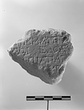
| Inscribed fragment.
Inscribed face only preserved.
Five lines of the inscription preserved.
Pentelic marble. Found in an early Byzantine well, on the north slope of the Acropolis. Leica, LXX-58 ... 29 April 1937 ... Found in an early Byzantine well, on the north slope of the Acropolis. |
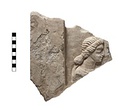
| Left side preserved.
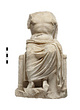
Seated woman, wearing hair in long club knot. Pier at left.
Early Roman grave relief.
Pentelic marble.
Cf. Berytus 10 (1952), pl. X, 1, 4. Well B, upper filling with Early Byzantine ... First half of 1st c. A.D ... Pier at left.
Early Roman grave relief.
... Well B, upper filling with Early Byzantine. |
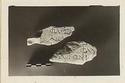
| Inscribed fragments.
Inscribed face only preserved.
On fragment a), mere chips, with a raised band along its left side.
On each, four lines of the inscription preserved, the top and bottom lines traces ... 7 June 1937 ... Found in early Byzantine context in a well, outside the Market Square to the southeast. |
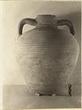
| Body shaped like an inverted pear, and rounded on the bottom; short wide neck. Ribbing on upper body and bottom.
Coarseware. Light slip on body. Neck and handles added afterward of pink clay, unslipped ... Early Byzantine ... Neck and handles added afterward of pink clay, unslipped.
Early Byzantine ... Well. |
| Inscribed fragment of early Christian Epitaph.
The left edge preserved; other edges broken.
Part of three lines of the inscription preserved.
Pentelic marble. Found in Turkish well, east of the Southwest ... 21 April 1934 |
| Assembled from many fragments; mouth, handle, and pieces from side missing; restored in plaster. Rounded bottom. Narrow wheelrun grooves around the body.
Coarse brownish-buff clay. Hole. (Well at 19/ΙΑ, ... 1 May 1934 |
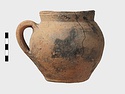
| Cracked but whole. Flat bottom; roundish body; low nearly straight rim; single handle. Grooves on shoulder.
Coarse reddish to brown clay. Unglazed. Blackened. Μόνωτο κύπελλο. Στο ύψος του ώμου, φέρει ... 18 March 1937 |
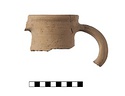
| Whole neck, with upper part of one handle and stump of the other, mended from three pieces (new breaks).
Short near-vertical neck with faint ribbing, slightly thickened at rim; stump of a sloping shoulder ... 1-14 June 1939 ... Thin brown ware, "Ermioni " type, with small white lumps, hard-fired.
Early Byzantine? ... Well |
| Two joining fragments; head and arms missing, minor fractures. The attachment hole for the head, and the lower half of the iron pin in it, preserved on the upper surface of the neck.
A male figure draped ... 16 May 1938 ... Well, latest Roman to early Byzantine. |
| Most of neck, one handle, and much of lower body, missing. Part of an amphora with narrow neck and grooved body.
Incised on front:
Incised on back:
Traces of a dipinto in black ink under the preserved ... Early Byzantine |
| Preserved are upper right corner (BE 103) and joining section to lower left (BE 61). Broken diagonally above, at left side, and below.
Votive relief with simple fillet and ovolo molding above. Narrow frame ... Late 5th c. B.C. (410-400 B.C. ?) ... Similar representations on vases of the early and middle fourth century (cf. ... BE 61: Area III, Byzantine levels.
BE 103: Area III, from fill between Well J 3:1 and N. |
| Intact save for end of nose and ancient chip from right ear and recent chips from hair and left ear.
Socket for fitting into body rough-picked; carried up high in back of neck.
Hair in marked waves above ... Julio-Claudian period ... The eyeballs are well rounded; the tear duct is emphasized by a small drill hole but there is no plastic indication of pupil or iris and no surviving trace of color. ... The hair is parted in a well defined line from front to back. ... With this head is probably to be associated the right hand, life-size in scale, of a woman holding a phiale mesomphalos which was found in an early Byzantine foundation near the east of the South Stoa (S 1627). |
|
|