|
|
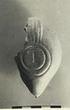
| Nozzle, most of front part, and most of the base missing.
Rows of raised dots on rim and on lower body; a ring of dots also around the discus. Volutes at base of nozzle. Triple grooved handle, carelessly ... 22 May 1935 |
Collar rim. Corinthian tile fabric; mouldmade.
For an example in Corinth see, e.g. C-37-2050: Hesperia, VII, 1938, p. 604, fig. 26, 176 ... Context ca. 520-490 B.C ... For an example in Corinth see, e.g. C-37-2050: Hesperia, VII, 1938, p. 604, fig. 26, 176. |
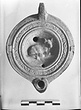
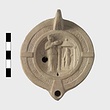
| Left side preserved, and all of reverse.
Herringbone pattern on rim, rosette on discus; solid grooved handle; circular reverse with double grooved lines enclosing letter "T".
Red clay and wash.
Type XXVIII ... 4 June 1936 |
Rim fragment.
Overhanging rim. Impressed slanting leaves. Corinthian tile fabric; pinkish buff surfacing.
The finish much less fine than on 1863. Close, from Corinth C-37-2079: Hesperia, VII, 1938, p ... late archaic context ... Close, from Corinth C-37-2079: Hesperia, VII, 1938, p. 602, fig. 24, 177, late archaic context. |
Flaring rim.
1926 and 1927 stand for the chytrai in common use in the decades just before and just after 500 B.C. See also, from Corinth, C-37-2058, -2060: Hesperia, VII, 1938, p. 597, fig. 21, 159, 161 ... Context ca. 520-480 B.C ... See also, from Corinth, C-37-2058, -2060: Hesperia, VII, 1938, p. 597, fig. 21, 159, 161. |
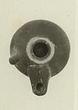
| Left side missing, with most of nozzle.
Pierced grooved handle. Vine on rim; five rays on discus.
Pale buff clay.
Type XXVII of Corinth collection. Shaft to Channel F. Water deposit. Leica ... 13 February 1937 |
Open bowl, the rim flanged outside to take a lid with downturned edge. Two rolled horizontal handles, projecting. On one side, two small holes bored through the rim after firing, each a short distance ... Context ca. 500-480 B.C ... A pair also from Corinth, C-37-2062, -2063: Hesperia, VII, 1938, p. 597, fig. 21, 163-164, the rim broad and depressed on top to hold the lid. |
Lower part only.
Massive steep-walled basin with flat underside, the bottom pierced before firing with many round holes, 5 mm. in diameter. Corinthian tile fabric with smooth creamy slip, the inside fresh, ... Context 4th c. B.C ... For the shape in Corinth, cf. a late 6th century basin, C-37-2048: Hesperia, VII, 1938, p. 601, fig. 23, 172.
|
Rounded rim marked off by a groove outside. Pale sandy fabric; Corinthian mouldmade. Weight 2.760 kilos.
Similar, slightly larger: ST 216 D 15:1. A fragment with a light ridge below the rim was used as ... Context ca. 520-490 B.C ... For a fragment of a 6th century example with a groove on the outer wall below the rim see, from Corinth, C-37-2085: Hesperia, VII, 1938, p. 603, fig. 25, 183. |
Globular body on high base, flat beneath; straight neck, flaring trefoil rim; rolled handle from rim. Corinthian tile fabric, handbuilt.
The high foot and bulbous body are traditional in Corinth in this ... Context ca. 600-575 B.C ... The high foot and bulbous body are traditional in Corinth in this fabric for hydriai, amphorae and jugs; see for example the long jug series such as
C-40-375, 373, 380: Hesperia, XVII, 1948, pl. 76, C 20, 22, 21 (late Geometric);
C-37-934, 935: Corinth, VII, i, pl. 23, 170 and pl. 24, 171 (third quarter of 7th century);
C-37-2052, 2053: Hesperia, VII, 1938, p. 601, fig. 23, 166- 167 (context of ca. 500-480 B.C.). |
| Intact.
Scrolls on ridged panelled rim. Grooved, pierced handle. On the discus, a cow sitting, right. On reverse, ring foot enclosing signature in relief.
Raised leaf at base of handle.
Greenish-buff ... 13 February 1937 |
Rim and wall fragment.
From a large deep basin. Plain rim, rolled horizontal handle; around wall at level of handle-attachment a sharp raised ridge. Cooking ware fired very hard and somewhat blackened ... Context ca. 575-540 B.C ... Probably flat-bottomed; see 1742; also, from Corinth, C-37-2061: Hesperia, VII, 1938, p. 597, fig. 21, 162 and text, p. 599. |
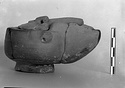
| Flattened double convex body, sharp angle around center.
On top, filling hole 0.016m. in diameter, surrounded by narrow rim, set off from body by groove of the same width.
Nozzle slightly uptilted. Pared ... 2 March 1932 ... Type IX of Corinth collection, type 29A of Agora collection.
ADDENDA Not found from January 1938. |
| Body mended from many pieces; complete except for fragments of top, and chips. Lid complete except for tip, and chips.
Deep bodied lamp on high base; walls nearly vertical; broad rim slightly insloping, ... 5 April 1937 |
| Intact.
On rim, panelled guilloche enclosing leaves.
On discus, Hermes left, a cloak over his left shoulder, the caduceus in his left hand, leading a ram by the horns. Stele at left crowned by cap. Altar ... 17 March 1937 |
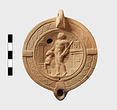
| Intact.
Scrolls on panelled rim; grooved pierced handle. On the discus, at left, a draped female figure, standing three-quarters right, holds a large tray with cakes (?), and looks toward a small naiskos ... 13 February 1937 |
Domed askos. Low ring foot, broad plain-rimmed spout; strap handle concave in section; around lip a wheelrun groove, another partway down the spout and a pair around top of wall. Pinkish clay, gray at ... Context ca. 500-480 B.C ... Similar to 1726, but slightly more squat, in Corinth, C-37-2046: Hesperia, VII, 1938, p. 598, fig. 22, 154, also non-Attic. |
Part of bowl and lip.
Convex lip, short upper wall, low wide bowl. Scraped groove just above foot. Decoration inside: palmettes within two incised lines.
The shape, lacking the foot, is uncertain, but ... 390-380 B.C ... The shape, lacking the foot, is uncertain, but the fragment, found in Corinth, comes most likely from a stemmed cup made in Olympia, the local shape best called the Olympia- cup from the examples found there and published by Eil- mann and Schiering (cf. p. 11, note 14). ... One of these, Olympia-Bericht, III, 1941 (for 1938-39) p. 46, fig. 36, gives a close parallel for 650. |
|
|