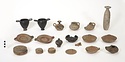
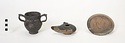
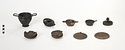
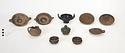
|
|
Accumulated debris on the west side of the market square.
Related layers added 1999/2000 (JWH), e.g. "Gravelly layer above burning", "Clearing Classical floor", "Lowest level above bedrock", "Below burning", ... First half of 5th c. A.D ... "Burnt Layer" |
The following objects may be from this level or from the 'Mixed Classical Level at 10/Δ: SS 449, SS 450, SS 451 (nbp. 186, 2819). Coins:
4 March 1933 #1-#6 (cf. #7-#13)
7 March 1933 #39 ... 150-86 B.C ... Burnt Layer |
Burnt Layer inside retaining wall of Middle Stoa Terrace (Θ) and NW Corner of Middle Stoa, burnt debris inside terrace retaining wall (Ζ). Coins Ζ: Coins Θ:
1 June 1951 ... Mid-3rd c. A.D ... Burnt Layer inside retaining wall of Middle Stoa Terrace (Θ) and NW Corner of Middle Stoa, burnt debris inside terrace retaining wall (Ζ). |
| Identified as pyre by SIR.
In room E. Burnt "pocket" found while digging red earth that contained late Hellenistic pottery, including a fragment of Pergamene (discarded). No pit was discerned, but concentration ... 3rd quarter 4th c. B.C ... In room E. Burnt "pocket" found while digging red earth that contained late Hellenistic pottery, including a fragment of Pergamene (discarded). No pit was discerned, but concentration in a "pocket" suggests that the pyre was in its original position and the layer in which it was buried contained late Hellenistic intrusions. |
A burnt deposit set down into Hellenistic fill in a shaft dug into bedrock. A consistent dumped fill [post AD 150, with Group G, layer III, JWH]. Coins:
27 January 1936 #1-#3
28 January 1936 #1-#7
29 January ... First half of A.D. 2nd c ... A burnt deposit set down into Hellenistic fill in a shaft dug into bedrock. A consistent dumped fill [post AD 150, with Group G, layer III, JWH]. |
Lamps all found together at the southeast corner of the excavated area, in a deposit running in part under the dike of earth which has been left against the wall of the street.
Includes 10 lamps in Section ... 17-18 June 1931
15 May 1933 ... Includes 10 lamps in Section Η' from the burnt layer, ca. 0.60m. above bedding for S foundation of Stoa of Zeus at 19/ΝΕ, see nbp. 568 ... L 955-L 965 are also listed in deposit H-I 7-8:1 because they fall within the burnt layers of that deposit. |
| Pyre in House C, Room 8 (RSY=Pyre 6).
Near east corner of room 8. Artifacts, burnt bone, burnt sticks, and large cinders in a shallow pit dug into surface of layer 3, and covered by layer 2. Some cinders ... 350-325 B.C.-end of 4th c. B.C ... Artifacts, burnt bone, burnt sticks, and large cinders in a shallow pit dug into surface of layer 3, and covered by layer 2. Some cinders from pyre in layer 2. These strata lay above the first floor of the third phase of the house. The hard baked floor of the pit indicated burning in situ, with charred sticks 0.06 and 0.10m in diameter preserved; some of the pottery is burnt. |
| Artifacts, burnt bone, ash, cinders and charcoal in pit in bedrock. The pyre lay directly under mosaic floor A. the deposit is not badly disturbed, however, and it is possible that it was laid immediately ... Early second quarter of 4th c. B.C ... Artifacts, burnt bone, ash, cinders and charcoal in pit in bedrock. ... The pyre was probably burnt in situ; pots rested on a thick layer of burning, and fragments of burnt earth were found in the pit. some charcoal as large as ca. 0.03m in diameter is preserved, and bits of burnt matter were found in the lekanis. |
| Pyre in north central room of house, measuring 0.50m east-west by 0.35m north-south. Pottery, bone, and burnt material in pit dug into layer IIb (crushed bedrock floor: lot Ω 464, 4th c.) and covered by ... 350-325 B.C ... Pottery, bone, and burnt material in pit dug into layer IIb (crushed bedrock floor: lot Ω 464, 4th c.) and covered by layer Ia (lot Ω 462, second half of 4th c., possibly into 3rd c., containing more fragments of pyre pottery probably from this pyre). ... There were extensive traces of burning, and teh pottery has been burnt. |
| Pyre in House N, room 2, layer 5 (RSY=Pyre 8).
Near northern corner of room 6. Artifacts, bone, burnt logs, and cinders in square pit dug from level of layer 5, through layers 5 and 6; thin clay floor ... 325-300 B.C ... Pyre in House N, room 2, layer 5 (RSY=Pyre 8).
... Artifacts, bone, burnt logs, and cinders in square pit dug from level of layer 5, through layers 5 and 6; thin clay floor laid over it. ... Coins from layer 4:
18 September 1947 # 7-#11 |
| Pyre in House T, Room 2 through floor of second period (RSY=Pyre 5) in the industrial area west of the Areopagus.
4th. c. BC.
Concentration of artifacts, burnt bone, and charcoal in floor makeup consisting ... 375-350 B.C ... Concentration of artifacts, burnt bone, and charcoal in floor makeup consisting of earth, dug bedrock, and marble chips, no pit discerned. ... The artifacts rest on a heavy layer of charcoal and ash, with burnt bone throughout, suggesting burning in situ. |
| Pyre in Room 1, area west of street (RSY=Pyre 11).
Early in the third quarter of the 4th. c. B.C.
In courtyard. Artifacts, bone, and cinders in irregular pit in floor sequence. The pit had been dug into ... 350-330 B.C ... The pit had been dug into a marble-and limestone-chip layer over bedrock, and was covered by a Late Hellenistic layer with tile fragments. It may be associated with the abandonment of the house, since the marble-and limestone-chip layer was laid down during the structure's last phase. The pyre was burnt in situ (earth surface reddened). |
| Disturbed Pyre at 59/ΚΗ (ΚΖ), in the area of the Poros Building west of the Areopagus.
Against east wall of room 5 west. concentration of artifacts, ash, carbon and a few bones in stratum, no pit discerned ... 3rd c. B.C ... It was probably burnt in situ , though it is badly disturbed. The concentration of burning, burnt bone, and pottery suggests a pyre. ... Coins:
19 April 1949 #8-#9
Organic material: one small burnt fragment of bone extant. |
| Pyre in House D, Room 4 (RSY=Pyre 4) in the industrial area west of the Areopagus.
Notebook refers to House N.
Pottery belongs late in third quarter of the 4th. c. BC. Pyre burned near beginning of last ... 350-300 B.C ... Artifacts, burnt bone, and cinders in round pit. ... The pyre pit was dug through layer 1 and into layer 2, both of which overlay the foundation of the wall between rooms 3 and 4. ... The hardened and reddened floor of the pit and the location of cinders under the pottery indicate the pyre was burnt in situ. |
| Pyre in cut in E-W street, layer 7 (Pyre 14). North edge of Piraeus street, west of the Great Drain Bridge, in the area west of Areopagus.
RSY-Pyre.
Pottery, a little burnt bone, and patches of charcoal ... 250-240 B.C ... Pyre in cut in E-W street, layer 7 (Pyre 14). ... The pyre was uncovered in digging a thin layer rich in marble chips. Cinders were found spread through layer 7 beyond the shallow pit, demonstrating that they were somewhat dispersed before the pit was covered over by that layer. |
| Pyre in House T, Room 1, Layer 5-6 (RSY=Pyre 3) in the industrial area west of the Areopagus.
First quarter 4th. c. B.C.
Artifacts, bone, and cinders in pit in floor sequence. The pyre was found in digging ... 400-375 B.C.(?) ... Pyre in House T, Room 1, Layer 5-6 (RSY=Pyre 3) in the industrial area west of the Areopagus.
... The pyre was found in digging layer 7, probably the floor associated with the second phase of the house. ... The hard red earth under the pyre indicates that it was burnt in situ, but a few centimeters of earth between the floor of the pit and the vessels suggests vessels were cleaned out and then thrown back in. |
| Sacrificial pyre in Poros Building, NW Room (RSY= Pyre 1).
Against east wall of room 5 west. artifacts, bone, carbon and ash in pit in floor sequence. the pyre lay below a floor covered with marble dust, ... Middle of 4th c. B.C ... The pit extends down into a layer with marbleworking waste. ... It contained scattered carbon and there was a heavy ash deposit in the chytridion. some of the pottery is burnt; there were also fragments of burnt mudbrick or clay. |
| Pyre /Burial (?) disturbed, in the area of the Poros Building west of the Areopagus. In northeast corner of room 4 west.
Concentration of artifacts, tiny slivers of bone, and burning in a layer of fill ... Early 4th c. B.C ... Concentration of artifacts, tiny slivers of bone, and burning in a layer of fill 0.25m thick below a pebble mosaic (ΟΟ 651). ... The original floor of the room lies another 0.15-0.20m below the surface of the tile layer. The fill topped by roof-tiles represents tile fall from the late 5th c. B.C. destruction of the building, which if the pyre was found more or less in situ, was in the past by the time the pyre was burnt. It is probably to early to be associated with the laying of the pebble of the mosaic, but rather was disturbed when the mosaic was laid. |
|
|