|
|
Fillings in and to the north of Building A/Poros Building/Greek Building ("Strategeion"), the accumulation mostly a late archaic dump, but not deposited till near the middle of the century. Most of the ... First half of 5th c. to ca. 460-450 B.C. |
Fillings associated with reuse of walls in north part of area.
Red fill under and in North Building ... 5th c. B.C. with Hellenistic/ Roman disturbance as late as 3rd c. A.D. |
Fillings behind retaining wall and in road.
SW Building, rooms 3, north, south. Coins:
13 March 1934 #1, #2
14 March 1934 #37
15 March 1934 #37-#38
24 March 1934 #31 ... 6th c. B.C. and earlier |
Dumped fillings probably to be associated with the construction of the Great Drain in this area.
Green fill under North Building ... Ca. 400 B.C. |
P 5302 may be from disturbed fill ("soft spot", container B 57, nbp. 1246) ... 12 March-6 April 1935
7 May 1935 |
See I 870, a piece of which was found in disturbed red fill in Β' southeast of Tholos.
Although apparently from the same context as P 5339 (tins 24-26, undisturbed fill), P 5336-P 5338 are recorded from ... 27 February-8 April 1935 |
Cistern System #3: East Chamber at 69/Λ, joined by a crooked passage to 69/ΛΣΤ. Under the southwest corner of the Hellenistic Building to the north of the Temple of Hephaistos ... 175-125 B.C. |
Some objects listed in deposit nb. V are not on this list because they in fact come from disturbed fills or are part of the material from above well 2 (G 12:21) ... 20 February-1 March 1935
6 March 1935
11 March 1935
20 March 1935
25 March 1935 |
Cistern System #3: West Chamber at 69/ΛΣΤ, joined by a crooked passage to 69/Λ. Under the southwest corner of the Hellenistic Building to the north of the Temple of Hephaistos. Upper fill of early 1st ... 175-125 B.C ... Under the southwest corner of the Hellenistic Building to the north of the Temple of Hephaistos. Upper fill of early 1st c.
E 6:2 (upper fill): Three Knidian amphora handles; type 51 C lamp; long-petal bowls.
E 6:1 and E 6:2 (lower fill): Joins between objects in both chambers and tunnel between them indicate fill the same. |
Double Well by E. Entrance to Square Building (Well A) (formely a O 8:1) Coin
21 April 1951 #1 (disintegrated) Carefull there is two O 8:1, the actual one is a filling around rubble wall at 35/ KE.
Estimated ... 750 to early 7th century B.C ... Double Well by E. Entrance to Square Building (Well A) |
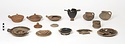
| Sacrificial Pyre = Pit in floor (identified as pyre by SIR); with the characteristic small plates and saucers. "Saucer Grave" at 12/ΚΑ.
Dimensions: 2m (length)x 0.70 (width).
North of north wall of building ... First half 4th c. B.C ... North of north wall of building. Long, narrow pit containing pottery and ash dug into a hard floor or surface and aligned with north wall of Building E. ... The alignment of the pit suggests a connection with Building E, and the pyre dates in the generation after its reconstruction. |
Rectangular pit over bedrock in north part of E. Building. Broken jars and household basins with a few black glazed and black-figured fragments (uninventoried). The figured pieces indicate the lower limit ... Late 6th-ca. 480 B.C ... Rectangular pit over bedrock in north part of E. Building. |
Dug as Tholos Trench V, Room E, burnt filling of plundered wall trench of S wall of court. See also lot Ζ 484 ... Late 6th c. B.C. |
| Pocket, identified as sacrificial pyre by SIR. Possibly disturbed. Outside south wall of building. Concentration of pottery in a small pocket below a "Hellenistic" fill. There is no mention of bone or ... First quarter 4th c. B.C ... Outside south wall of building. Concentration of pottery in a small pocket below a "Hellenistic" fill. ... The pyre dates shortly after the proposed date for the beginning of the second phase of Building E; the chronology may be sufficiently flexible to allow association with this reconstruction of the building. |
| Marcie Handler ... Located in the south section of Room E in the Byzantine Building east of the North-South Road. The uppermost 1.5 meters of well lining was built of well-coursed stones (some reused marble blocks) and tiles ... 12th c. A.D ... Well in the South Section of Room E in the Byzantine Building East of the North-South Road |
| Laura Gawlinski ... Fill excavated south and west of Early Building Ii, Room E latrine, with a high concentration of votive material, such as pyre saucers, miniature loom weights, and ribbon handled plates. Some traces of ... 400-350 B.C ... Fill excavated south and west of Early Building Ii, Room E latrine, with a high concentration of votive material, such as pyre saucers, miniature loom weights, and ribbon handled plates. |
Construction fill below floor of Brick Building.
Areas involved:
a) Western portion of Room A: packing below floor.
b) Room B: packing below floor of northern,larger room.
c) Fill over water channel in ... First quarter 2nd century, before its end ... Construction fill below floor of Brick Building.
Areas involved:
a) Western portion of Room A: packing below floor.
b) Room B: packing below floor of northern,larger room.
c) Fill over water channel in smaller, southern room B; channel discovered by builders of Brick Building,rebuilt by them and covered over.
d) Foundation trench of earlier building beneath Brick Building, filled and covered by builders of Brick Building.
e) "Apparently from below floor of building" (nb.p. 1282).
... It was believed to antedate the construction of the building since the wall of the building seemed to cut it. However, HAT digging in the same area in 1950 (p. 2245), describes what appears to be the same stratum (he does not specifically mention the earlier excavations) as lying on the floor of Brick Building here. The material dug in 1936 should be used with caution. |
Chamber of water system with one blind tunnel and two cisterns connected by tunnel. Pottery consistent throughout, late Hellenistic. Late 2nd c. B.C.
Ten stamped amphora handles. Most of bowls long-petal ... 100-75 B.C. |
| Pyre in cut in E-W street, layer 7 (Pyre 14). North edge of Piraeus street, west of the Great Drain Bridge, in the area west of Areopagus.
RSY-Pyre.
Pottery, a little burnt bone, and patches of charcoal ... 250-240 B.C ... Pyre in cut in E-W street, layer 7 (Pyre 14). ... The excavator interpreted the successive thin layers of marble chips as road-building material. Possibly, however, marbleworking took place just outside a house to the north, against the wall of which these layers run. hardened earth beneath the pyre indicates burning in situ. |
Filling of Middle Drain (Tr. H+F in Section Ζ). Sand and gravel filling of the old course of the west branch of the Great Drain, a large (ca. 1.00m. deep and 1.30m. wide) underground channel in the area ... 150-100 B.C. |
Brian Martens ... This deep stratum (ca. 030m) is delayed Persian destruction cleanup deposited in the 470s B.C. it contains about one generation's worth of pottery, almost exclusively dating between about 500-470 B.C ... 29 June-19 July 2017
12–15 July 2022 ... The stratum abutted E-W polygonal Wall 8 and was laid down for Post-Persian renovations of the building. The dump of pottery raised the floor level of the building; atop J 1:18 was a layer of crushed bedrock and a renewed floor surface.
|
| Identified as pyre by SIR.
In room E. Burnt "pocket" found while digging red earth that contained late Hellenistic pottery, including a fragment of Pergamene (discarded). No pit was discerned, but concentration ... 3rd quarter 4th c. B.C ... In room E. Burnt "pocket" found while digging red earth that contained late Hellenistic pottery, including a fragment of Pergamene (discarded). ... There is no evidence for the relationship of the pyre to building phases. No bone was recorded. |
"Symbolon Pit" (Rectangular Pit in bedrock E of Stoa, Room 5). Preserved depth 0.45m, original depth estimated at ca. 1.65m., the upper part having been cut away by successive building operations in the ... Third quarter of 5th c. B.C ... "Symbolon Pit" (Rectangular Pit in bedrock E of Stoa, Room 5). Preserved depth 0.45m, original depth estimated at ca. 1.65m., the upper part having been cut away by successive building operations in the area. |
| Marcie Handler ... It was situated in the NW corner of Room 3 in the Classical Commercial Building, just S of Wall 11, the cross-wall that divides Room 3 from Room 4 to the north. The pyre pots were found surrounded by ... Late 4th c. B.C ... It was situated in the NW corner of Room 3 in the Classical Commercial Building, just S of Wall 11, the cross-wall that divides Room 3 from Room 4 to the north. The pyre pots were found surrounded by fill with charcoal and burnt bone below a floor surface preserved immediately to the E (J/13,14-2/7,8; 52.20 masl.).
|
| Laura Gawlinski ... Circular pit uncovered in Early Building II, south of Room E latrine, adjacent to the preserved latrine floor surface. Continues beneath the latrine surface and the western scarp (unexcavated). Fill relatively ... Late 5th c. B.C ... Circular pit uncovered in Early Building II, south of Room E latrine, adjacent to the preserved latrine floor surface. |
Cistern-chamber on the northwest side of Kolonos Agoraios, 10 to 12m west of the end of the Hellenistic Building. Dimensions at bottom 2.50m x 2.75m.
The west chamber of a cistern system composed of two ... Use filling early 1st-2nd c. B.C ... Cistern-chamber on the northwest side of Kolonos Agoraios, 10 to 12m west of the end of the Hellenistic Building. Dimensions at bottom 2.50m x 2.75m.
The west chamber of a cistern system composed of two chambers connected by a passage (91/Ν); the east chamber at 91/Ν (E 5:1) retained little or no traces of its original period of use. |
|
|