|
|
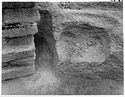
Water channel in north part of section. Hellenistic and Early Roman pottery. No inventoried finds ... 13-14 March 1936 |
Water channel in north part of section. Pottery late 2nd.-1st. c. B.C. Coins:
14 March 1936 #8 ... Late 2nd.-1st. c. B.C. |
Some objects listed in deposit nb. V are not on this list because they in fact come from disturbed fills or are part of the material from above well 2 (G 12:21) ... 20 February-1 March 1935
6 March 1935
11 March 1935
20 March 1935
25 March 1935 ... b) Undisturbed fill to north of the building |
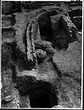
Pit (= collapsed cistern). Fill mixed, late Hellenistic to early Roman. The cistern floor has an E-W channel, no doubt running from the pit at 107/Ζ to the well at 107/ΙΓ (B 21:24). Coins:
10 June 1939 ... 150-100 B.C ... The cistern floor has an E-W channel, no doubt running from the pit at 107/Ζ to the well at 107/ΙΓ (B 21:24) ... Also from cistern passage north, leading to well B 21:24 (107/ΙΓ: ΝΝ 1694 (SS 9510), ΝΝ 701 ( SS9512), ΝΝ 1863 (B 760), ΝΝ 2316 (P 17408), ΝΝ 2317 (P 17409), ΝΝ 2318 (P 17410). |
| A flask-shaped storage pit or cellar, cut in the rock at the south edge of the levelled top of Kolonos Agoraios. Filled late in first quarter of 6th. c. B.C. (2.95m from east to west by 2.70m from north ... First quarter 6th. c. B.C. |
| Thamneus' Cellar, a storage cellar on the north slope of the Areopagus. Lower filling of mid-6th c. B.C., upper filling of last quarter of 6th c. B.C ... 6th c. B.C. |
Great Drain South (ca. 70-113, from SW edge of section as far north as the Roman Bath) Hellenistic Sand Fill. Silted-up filling of the southern branch of the Great Drain, abandoned due to some damage at ... 4th. c.-86 B.C. |
Fillings in and to the north of Building A/Poros Building/Greek Building ("Strategeion"), the accumulation mostly a late archaic dump, but not deposited till near the middle of the century. Most of the ... First half of 5th c. to ca. 460-450 B.C ... Fillings in and to the north of Building A/Poros Building/Greek Building ("Strategeion"), the accumulation mostly a late archaic dump, but not deposited till near the middle of the century. ... Excavated areas were kept separate as follows but "LT is uncertain if useful or desirable to keep any or all of these areas separate ... the inventoried material from c is of the same sort as that from a and b." (LT, 12 April 1964, Deposit nb. ... Subdivisions:
.1=a) Undisturbed filling of the building.
.2=b) Undisturbed filling to north of the building.
.3=c) Building fill in disturbed places. |
Great Drain sand fill under Roman bath including small area at north end under tiles that was excavated separately.
See also A-B 19-20:1 for additional Great Drain sand fill at ca. 70-113/* Subdivisions: ... 30 July-11 August 1947 ... Great Drain sand fill under Roman bath including small area at north end under tiles that was excavated separately.
See also A-B 19-20:1 for additional Great Drain sand fill at ca. 70-113/* ... Subdivisions:
.1=55-58/*, sand fill north end, under tiles.
.2=sand fill south end continuing to north.
55-58/* |
Cistern system West of Bouleuterion: (see also B: cistern system to West of Tholos). Third Chamber from North. A well was dug through the bottom in Byz. times. Cf. deposit F 9:2. Coins:
3 May 1934 #1 ... 160-140 B.C., with Byz. disturbance
Early 3rd to late 2nd c. B.C. POU ... Cistern system West of Bouleuterion: (see also B: cistern system to West of Tholos). Third Chamber from North. A well was dug through the bottom in Byz. times. |
| Marcie Handler ... Fill within the drain from the basin on the west side of Roman Room B through Wall A.
After we removed the fill within the basin on the west side of Roman Room B (BZ XXVII p. 5325), we began excavating ... Late Roman ... Fill within the drain from the basin on the west side of Roman Room B through Wall A.
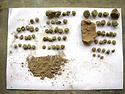
After we removed the fill within the basin on the west side of Roman Room B (BZ XXVII p. 5325), we began excavating in the cutting on the east face of a conglomerate block that is part of Wall A. ... The cutting is probably a drain that carried water from the basin through Wall A and onto the North-South Road. Seventy-eight coins were found in the fill, of varying sizes but all badly corroded. |
Mycenaean Tomb under Valerian wall (Burial 12).
It was impossible to fix the limits of the tomb in any direction, since at the north and south it was cut by the wall, an operations could not be extended ... Myc. III B |
| Eugene Vanderpool Homer A. Thompson ... Mycenaean Grave to W. of "Court Room" below Stoa Terrace with "Ballot Box" (Grave XXIX).
Unusual type, conforming neither to our pit nor to our cist graves, and consisted of two parts. The outer part was ... Mycenaean III A-B |
Investigations within the Stoa of Zeus, the north part, various levels.
Notebook references: Stoa Trench E Layers IV and V, Stoa Pits A, B and C, and Layers I and II of area between back wall and retaining ... 5th c. B.C ... Investigations within the Stoa of Zeus, the north part, various levels.
Notebook references: Stoa Trench E Layers IV and V, Stoa Pits A, B and C, and Layers I and II of area between back wall and retaining wall of Stoa. ... Subdivisions: (from the deepest layers to the top):
.1=a) (Pre-)Persian
.2=b) Post-Persian Pre-Stoa
.3=c) Stoa and Stoa Annex filling |
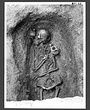
Mycenaean Grave W. of Circular Building. Measuring 1.40m by 0.55m and it was covered with a few rough stone covering slabs, under which lay the skeleton of an adult with the head to the north and the knees ... Myc. III A2-B |
Cistern system West of Bouleuterion: (see also B: cistern system to West of Tholos). First Chamber from North.
Part of three-chamber cistern system, including also G 11:1, with Byzantine and modern disturbance ... 150-ca. 75 B.C., with Byz. disturbance ... Cistern system West of Bouleuterion: (see also B: cistern system to West of Tholos). First Chamber from North.
Part of three-chamber cistern system, including also G 11:1, with Byzantine and modern disturbance throughout; The uppermost fill-modern. |
Mycenaean Deposit (Gully) in front of NE Stoa (corrected from P 7:1).
It consisted of a series of irregular pits, some gradually linked up with one another to form what seemed a natural gully. The largest ... Mycenaean IIIA-B |
| Eugene Vanderpool ... Mycenaean Chamber Tomb.
Although badly disturbed at various times in antiquity, it was clearly a chamber tomb with the chamber little more than a cubby-hole at the end of a steep dromos, entered at the ... Myc. III A-B |
| Pyre in cut in E-W street, layer 7 (Pyre 14). North edge of Piraeus street, west of the Great Drain Bridge, in the area west of Areopagus.
RSY-Pyre.
Pottery, a little burnt bone, and patches of charcoal ... 250-240 B.C. |
| Mycenaean Grave to W of Pier 12 (Burial 11).
The northern part of the tomb had been cut away by the foundation trench for the south stylobate of the Square Building that preceded the Stoa, and the dromos, ... Myc. IIB-IIIA:1 |
The deposit notebook lists S 1439 here, but the following information on that card indicates that D 18:4 could be considered with D 18:3 and not as a separate deposit.
"Excavation of pit, which partly ... Other mixed fragments, so far removed, stored in B 155, cf. vol. VI, p. 1030-1033. See also XVIII, nb. pp. 3583-3584 and container B 603. T 604 for other fragments possibly of bronze workers molds from street to north of Poros Building. 4th. century context; XV, nb.p. 2866, for mold fragments from southwest room stored in T 732."
|
| Eugene Vanderpool ... Infant grave near Phaidon street cistern. No offerings.
Roughly rectangular, almost elliptical cutting in bedrock, measuring 0.70m long, 0.35m wide, and 0.40m deep, oriented south-southwest to north-northeast ... Late Helladic III C/Early Protogeometric (date uncertain) ... Roughly rectangular, almost elliptical cutting in bedrock, measuring 0.70m long, 0.35m wide, and 0.40m deep, oriented south-southwest to north-northeast. The skeleton of what was stated to be a "newborn infant," head to the south-southwest, was laid out within the pit and covered by a stone slab.
Reanalysis of the bone identified the presence of two infant inhumations, which were subsequently labeled AA 289 a,b |
| Mycenaean Double Grave (Graves A and B).
Grave A was in Layer II. We laid a skull and a few other bones, three vases and a stone bead. We have dug to a maximum of about 0.06m below the top of Layer II ... Myc. IIIA/B ... Mycenaean Double Grave (Graves A and B).
Grave A was in Layer II. ... The skeletal material (AA 177) ... does not agree with the evidence of the plan and the excavator’s description since AA 177 consisted of bones of a M. about 40 to the north, and a F.(?) |
| John Camp ... Protogeometric grave (female inhumation) located about 0.60m northwest of T 15:1. It consisted of a roughly rectangular pit, with the corners slightly rounded, oriented approximately north-south. The pit ... "Submycenaean"/Early Protogeometric |
| An extensive cistern system on the lower north slope of the Areopagus, south chamber with blind tunnel extending further south (south tunnel); north chamber; drawshaft further north, extends to north tunnel ... Ca. 320-240 B.C ... An extensive cistern system on the lower north slope of the Areopagus, south chamber with blind tunnel extending further south (south tunnel); north chamber; drawshaft further north, extends to north tunnel. With exception of north tunnel (which contains nothing later than 300), all parts seem to have been filled at the same time.
... Cistern System, 45/Β and 45/ΙΑ (Hell. Group B) (ΣΤ = 45/Β, 45/Ζ, 46/Ζ, cf. |
Well 15: Mycenaean. It was situated about 35 meters down the slope northwest of the exit of the Mycenaean Fountain.
Well circular or roughly oval in section.
Diameter max. width to -4.0: ca. 1.50, below ... Late Mycenaean ... About 0.30m below, a late Roman pit which cut into the north side sherds occurred in fair quantity and the fill seemed to be pure.
... Seems to constitute a dump fill from neighboring houses of the Mycenaean III B period, and is somewhat earlier than the major part of the dump fill of the Fountain. |
Fillings associated with early houses on the lower north slopes of the Areopagus; various levels and dates.
Both houses were built in the 6th century B.C. and destroyed by the Persians; both also have ... 6rd c. B.C.-3rd c. A.D ... Fillings associated with early houses on the lower north slopes of the Areopagus; various levels and dates.
... Southwest House, Rooms I-VIII, 42-55/ΚΖ-ΜΖ:
The earliest house had a court on the west with a Well (B) and two small rooms at the north. |
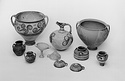
| Mycenaean Chamber Tomb occupies a considerable part of the western half of section ΕΕ; lies about half way up the north slope of the Areopagus towards its eastern end, just below the highest point of the ... Myc. III A:1 ... Mycenaean Chamber Tomb occupies a considerable part of the western half of section ΕΕ; lies about half way up the north slope of the Areopagus towards its eastern end, just below the highest point of the hill. ... Its roof has entirely caved in, except for a small bit projecting at the north end of the west side; probably was not flat but slightly concave (all along the north side it seems that it rises from the sides toward the center).
... Group of objects:
a) on the east bench, a little north of its center (BI 511, P 15234-15239)
b) on the floor in the northeast corner of the chamber just to the left of the door (B 704, P 15358-15359)
c) on the floor of the chamber, about 0.40m from the south wall, near its mid-point (B 705, BI 513, BI 514, BI 530
d) on the floor in the northwest part of the chamber, at the foot of the bench about midway between the grave and the north wall of the chamber (J 64, J 65, J 68) |
| Mycenaean Chamber Tomb below Middle Stoa Terrace.
The tomb was entered from the west by a stepped dromos, at least 4.20m long by 1.10 to 1.50m. wide, splaying slightly toward the doorway, which was 1.26m ... Myc. IIIA:1 ... The doorway was found blocked with a stone packing, which included near its top a broken conglomerate grave marker, and which proved to have been erected at least three times; during one of the occasions of reopening, the doorway was widened 0.20m to the north. The chamber, while described as a "small irregular trapezoid", is of about average size and actually quite rectangular by Agora standards. ... Although there were four burials, these must have taken place within a generation of a single family: The father (burial C) and son (burial D), were buried at the same time, having died in battle or the hunt and "brought home from the field in hastily constructed boxes" or possibly the victims of a disease " which made it desirable that they be kept in coffins until a tomb could be excavated for them", then, after a slight fall of the roof, the mother (burial A) at the opposite side of the doorway, and finally, after a more serious slide, the adolescent boy (burial B) in front of the doorway. |
|
|