|
|
Filling in Classical Floor of Agora, to the north of the Temple of Ares; possibly a disturbed pyre ... Early 4th c. B.C. |
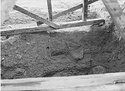
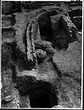
| Pyre in layer 2a in Room 9 SE of Greek House δ. Sand, gravel, ashes, iron nails, carbon, some bones partially cut away by foundation trench of SYPE wall.
Coin
1 July 1971 #459 ... 260-200 B.C. |
Indicated as "Grave 6" in notebook but recognized as not a grave: "probably a rubbish pit" [deposit notebook summary]. Concentration of pottery, burning, animal bones, snail shells and seashells, probably ... Late 4th-early 3rd c B.C ... Indicated as "Grave 6" in notebook but recognized as not a grave: "probably a rubbish pit" [deposit notebook summary]. Concentration of pottery, burning, animal bones, snail shells and seashells, probably a refuse pit [Agora XXIX, p. 453). |
| Dorothy Burr Thompson ... Grave 27. In some records as Grave I bis. Bones discarded; nothing catalogued.
Notebook says: few burned bones, few burned sherds. Cf. negs. KK 228, KK 237 ... Probably Late Geometric or Early Geometric I |
The West Chamber of a double cistern lying between the northeast corner of the Theseion and the Annex to the Stoa of Zeus Eleftherios. ... Both chambers went out of use as water containers simultaneously ... 225-165 B.C ... Agora IV, p. 239 ... Agora X, p. 67 ... Agora XXIX, pp. 448, 452-453 under G 6:2. |
Cut down through the west back foundation of the Royal Stoa immediately to the east of the 'Cave' ... Byzantine |
The East Chamber of a double cistern lying between the northeast corner of the Theseion and the Annex to the Stoa of Zeus Eleftherios. ... Both chambers went out of use as water containers simultaneously ... Ca. 200 B.C ... Agora IV, p. 239 ... Agora X, p. 67 ... Agora XXIX, pp. 452-453 under G 6:2. |
Cistern at 60/ΙΕ; bell-shaped cistern with a channel 1.65m high and 4.60m long, leading to a dead end against bedrock. This channel runs north with a slight curve to the east and looks as though it was ... Second half of 3rd c. B.C.-Early 2nd c. B.C. |
Rectangular shaft at northwest foot of Areopagus; dumped filling of second half of 4th c. B.C. Pit at 16/Δ-Ε recorded one time as an extension of shaft 17/Δ-Ε (see L 506 and nb.p. 395), but items from ... Ca. 325-275 B.C. |
Pocket in bedrock 35/Ε. The filling consisting chiefly of coarse ware and roof tiles; some of the material Archaic, but the deposit as late as the mid-5th c. B.C ... Ca. 500-450 B.C. |
Fillings in a well on south slope of Kolonos Agoraios. The shaft reached a depth of 20.28m., but produced no use filling. The lower part, from water level at 12.60m. to bottom, provided only mud and gravel ... Ca. 425-400 B.C. |
West Chamber of Cistern System #2. This chamber filled earlier than the East Chamber. No stratification but at 3.80m. considerable pottery of the late 5th c. B.C., as in 60/ΛΗ cistern, presumably a portion ... First half of 3rd c. A.D. |
| Unfinished well-shaft with debris filling (apparently of the Sullan sack), on the lower NW slopes off the Areopagus. Abandoned due to poor quality of bedrock.
Three closely contemporary fills, considered ... End 2nd c. B.C.-second quarter 1st c. B.C. |
Fifth century Pit E of Stoa Room 11 with coarse pottery and a few black-glazed, some with stamping and red-figured pieces ... Ca. 450-425 B.C. |
East Chamber of Cistern System #2. The fill in layers, but probably a destruction fill with layering not significant. Coins:
4 May 1936 #1-#6
5 May 1936 #1-#7
6 May 1936 #2-#6
LRD pottery and gouged ware ... Late 5th-early 6th c. A.D. |
Two narrow trenches at right angles to each other.
Small deposit in bedrock cutting Good black glaze ware ... 430-420 B.C. |
Filling on bedrock.; accumulation extending to about the middle of the 6th c. with earlier material. Some later intrusions to late Roman (?) ... Ca. 600-550 B.C. |
A dumped filling including red figured fragments of the second quarter of the 4th c. B.C. Coins:
25 June 1931 #12 (in strosis above pottery deposit) 15 November 1952, going through the containers Tin 59-Box ... Ca. 375-350 B.C. |
Flask-shaped cistern (1959) (Cistern under Room 4 in NE corner of Section). Upper filling soft silt with a little pottery. Lower filling hard silt, almost no pottery.
1.35m in diameter at the floor with ... End of the 4th c. B.C. |
| Cistern with dumped filling, second quarter of 4th c. B.C. Also Lot Φ 187bis (selected coarse).
No coins ... Ca. 375-350 B.C. |
Pocket in bedrock, 50/Λ (= Trench, 50-54/Λ), measuring 4.00x0.60m, 0.60-0.90m deep; possibly cutting for wall foundation Coins:
22 April 1932 #1 ... 330-300 B.C. |
Scanty dumped filling in an abandoned well cutting ... Ca. 425-420 B.C. |
Pits in area 96-100/ΝΕ-ΝΘ (lower east slopes of Hill of the Nymphs, near extreme west edge of excavated area).
Shallow pit in bedrock against N. face of wall. dMax. depth 0.20m.d.
Many fills in areas ... Ca. 325-300 B.C. |
Pit along house wall foundations to south = footing trench. Uncertain context, possibly no later than ca. 425 B.C ... 450-400 B.C. |
Early Roman pit at P/7-6/4,6
layer Ia in Room 7 of Greek House δ. Black earth fill with much carbon.
Plaster, nails, glass, bones (also bones from deposit P 6:4).
Coin
5 June 1971 #395 ... Early Roman |
Layer 7 in South Peristyle of court of Roman House Ε. Irregular cutting in bedrock with sand, gravel, fallen bedrock. Some burning ... 275-250 B.C. |
Upper fill was early Roman dated by AWP to the 1st c. A transitional fill was later assigned to the upper level.
Nbp. 2913: The history may have been that the well was cleaned out at the time that it was ... 3rd-2nd century B.C and Roman date. |
Cistern System #3: West Chamber at 69/ΛΣΤ, joined by a crooked passage to 69/Λ. Under the southwest corner of the Hellenistic Building to the north of the Temple of Hephaistos. Upper fill of early 1st ... 175-125 B.C. |
Within the precinct of the Hephaisteion, about 10m. north of the north stylobate of the temple.
Flask-shaped pit (W. (bottom) 3.14 x 2.73m) probably originally intended as a cistern; used for dumping ... Ca. 375-310 B.C.-Byzantine |
(now O 9:1) Asterisk: O 8:6* |
A well (diameter 1.10m) at the east edge of the valley road leading from the SW corner of the Agora, about 90m SW of the Tholos. The mouth of the well was subsequently covered by the east wall of the Great ... Ca. 500-480 B.C. |
Plaster dump at Q/2,5-6/7,9.
Layer 5 in "Wall Painted Room" of Roman House ε. Layer resting on bedrock and covered partially by good strosis (55.26m.). Fill was red with mudbricks, tiles, much plaster ... Late 1st-early 2nd c. A.D. |
Nb page 5044: Great shapeless pit with a well (62/Ξ) at its bottom which we were unable to dig because it was too dangerous. Fill in the pit was of sand and white ash. The finds and pottery 4th. and perhaps ... Late 4th.-early 3rd. c. |
| Rubbish Dump in mouth of abandoned well in Tholos Trench F, Kitchen. Filled with ash, charcoal, broken pottery, roof tiles.
Also from Trench L.
13 March 2014 by Ann Steiner
The deposit has four components ... Ca. 425-400 B.C. |
Well dug through bedrock-settling basin of cistern at 69/ΜΗ. Coins:
21 May 1936 #24-#26
22 May 1936 #14
29 May 1936 #2-#4
2 June 1936 #1-#3
3 June 1936 #2-#4
4 June 1936 #4-#6 Cf. also container ΚΚ 336 ... 3rd c. A.D. |
Investigations within the Stoa of Zeus, the north part, various levels.
Notebook references: Stoa Trench E Layers IV and V, Stoa Pits A, B and C, and Layers I and II of area between back wall and retaining ... 5th c. B.C ... Agora IV, p. 240 ... Agora XII, p. 392. ... Agora XXI, p. 98. |
Found while excavating Stoa Pit E in 1933. See also I 849 (Ε 329) found in the North Well in Stoa Pit E (Deposit H 9:1). Fragment Ε 496 of this inscription, listed with the finds of H 10:6, is likely from ... 8-10 May 1933
17 May 1935
18-26 May 1937 |
Well at 9/ΛΔ, left unfinished. Coins
27 May 1938 #1 (sand at top) M.C. suggests date as second half of 6th c. (March 1956), p. 1052.
No containers ... 550-500 A.D. |
| Phaidon Street Cistern: South Chamber.
Connected by tunnel to O 17:5.
Knidian stamped amphora handle; fragments of five long-petal bowls, one made in worn mold. Type 35 A lamp. Coins
9 August 1957 #1-#3 ... Late 2nd c. B.C. |
Pit with marble chips (disturbed); working chips of the Hephaisteion construction. A few vases apparently contemporary with the building of the temple ... 5th c. B.C. to ca. 450 but disturbed. |
|
|