|
|
Wall fragment from just below start of return. Thin reddish brown glaze on inside. Max. dim. 0.038.
Man or youth (face, top of head with woolen fillet), perhaps a komast, to right. At the far right, a ... Ca. 470-460 B.C. |
Collar rim squared off on top; shallow spout; strap handles at sides, at back a triple reel lug. Coarse brown clay with considerable mica and black and white grit; traces of brown surfacing; mouldmade ... Context ca. 420-400 B.C. |
One handle and chips of rim missing.
Broad, beveled resting surface (worn); pointed underside.
Glazed groove just below lower handle attachment. Rim concave above molding, concave inside. Plain handle ... Ca. 260? |
Parts of inner and outer wall and of floor.
Double-walled.
Similar but inner wall higher than outer and channel between somewhat lower than wall of pan: P 21946 N 7:3 Hesperia, XXII, 1953, pl. 35, fig ... Context ca. 490-450 B.C. |
Small lid, shallow domed; neatly pointed knob.
Similar, slightly larger, P 21952 N 7:3 Hesperia, XXII, 1953, pl. 35, 114, mid 5th century; also close, Corinth C-34-945: VI, 1937, p. 305, fig. 36, 209, ... Context ca. 480-450 B.C. |
Lower part only.
The bottom of a kados like 1601, from the same deposit, view of inside, showing the accidental cuts made by the anvil used in hand-finishing; also traces of the circle where the foot ... Context ca. 520-480 B.C. |
Five fragments make up to four:
a) Spouted mouth, neck and upper stubs of handles.
b) Lower handle stub.
c) Part of body.
d) Uncertain; probably not belonging.
Buff clay, unglazed inside; fired purplish-gray ... 2 May 1950 ... Agora XIII, no. 35:4. |
Small parts of rim and foot restored.
Slightly flaring foot; grooved resting surface; flat underside running into inner face of foot. Reserved band at junction of foot and body.
Upper body flares slightly ... 325-300 ... Thompson 1934, A 6, p. 316 [G 13:4, lower fill]), P 22201 (Agora XXVII, no. 106, p. 180, ill. 35, pl. 40 [O--R 7--10]), P 6196 (D 15:3), P 6214 (G 11:4), P 7735 (E 3:1). |
Rim and wall fragment. P.H. 0.052; est. diam. at rim 0.10.
Owl (feet missing). To left and right, part of an olive sprig. Dilute glaze: dots on face.
Johnson (AJA 59, 1955 [ pp. 119--124], p. 121) suggests ... Third quarter of the 5th century B.C. |
Lid missing.
Handle-zone sharply offset. Deep inset rim inclines in- wards. Reserved: resting surface, edge of underside, center of underside with circle and dot, and top of rim.
Perhaps slightly earlier ... 450-425 B.C. |
Slightly flaring thickened rim; deep shoulder. Red wash.
Transitional from the globular variety to the bag-shaped Hellenistic; close, from the Kerameikos, Weststrasse Graben B: Arch. Anz. 1963, col. 339, ... Context ca. 330-305 B.C. |
Small parts of rim restored; handles missing.
Resting surface grooved and reserved; concave underside.
Low stem, thinner than 127. Thin, streaky red glaze.
Similar: P 14800, P 15864 (E 14:10), P 29188 ... 325-315 ... Agora XII, p. 285, under no. 689 ... Thompson 1954, p. 89, no. 4 in note 6, pl. 20:d ... Miller 1974, p. 196, pl. 35. |
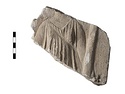
Red figured sherd with figure of a nude male ( from hips down ) moving to right.
Reverse glazed. Oscar Broneer, Nb. No. 1, same place as AP 34. 91 ... 4 May 1931 |
no information in notebook except storage. |
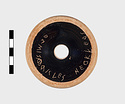
| Kylix base with black glaze. Inscribed on bottom. Βάση μελαμβαφούς κύλικος, χείρ. Ε. (Θεμιστοκλής Νεοκλέους). Oscar Broneer, Nb. No. 4. 178 88-398 ... 31 May 1937 |
Half of rim, bases of handles, and a few fragments of lower body preserved; heavily restored.
Stubs of horizontal handles, round in section, joining just below rim and rising slightly. Two pairs of opposing ... 325-300? |
Mended from four pieces; slightly burned.
Slightly concave underside with string marks. Wall concave near base.
Reddish yellow fabric (ca. 7.5YR 6/6); unglazed.
Similar: P 18461--P 18463 (Young 1951b, ... 300-250 |
Fish-plate: Ionian?
One-fourth of rim and floor preserved.
Overhanging rim. Two scraped grooves at outer edge of floor and two around central depression; rouletting on floor. Hard fabric with white inclusions ... Context of before ca. 150 |
Lower body and less than half of foot preserved.
Foot: variety 1. Medallion: double rosette with four petals inside, eight outside, within two ridges, surrounded by palmettes.
Wall divided into four ... 225-200 ... From same mold as P 10877 (Agora XXII, no. 189, p. 67, pl. 35 [D 11:4, lower fill]). |
One handle, part of the other, and one-fourth of rim and upper wall restored.
Underside and resting surface as 150. Shiny, dark brown glaze.
Similar, from same deposit: P 28071, P 29289.
Cf. P 318 (D ... 300-275 |
Three-fourths of wall and rim missing.
Lightly molded ring foot; beveled resting surface; pointed underside.
Scraped groove below rim. Dull black glaze, red to brown below stacking line and inside.
... 200-175 |
Fragment of wall.
Nearly flat wall, with stamp within irregular sunken area with curved end: Φιλ̣[. Micaceous, light reddish brown fabric (5YR 6/4); metallic black glaze outside, with some dribbled on ... 200-150 |
| The foot and the vertical band handles missing, together with much of the body and rim. The lower body ribbed; on the upper body, a hanging wreath, with a ribbon hanging at each side, in terracotta paint ... May 1937 ... Agora XXIX, no. 35, pl. 4. |
Handle, upper part of neck, and parts of wall missing.
Low, irregular foot; flat resting surface; convex, irregular underside. Lower body with nearly vertical wall, irregularly pared at bottom. Convex ... Context of 100-50? |
Several nonjoining sections, preserving one-fourth of rim, a few fragments of upper wall, one handle and half of the other; partially restored. Made in very fresh mold.
Scraped groove and ridge at top ... 225-200 ... P 10877 [Agora XXII, no. 189, p. 67, pl. 35, detail 3 (D 11:4, lower fill)]; G. ... Edwards 1956, no. 120, p. 107, pl. 50 [where other instances from the Agora are listed]). ... Chariot similar (but not from same stamp) to that on P 401 (Agora XXII, no. 152, p. 62, pl. 78 [H 6:4]). |
Ten non-joining fragments, f with start of handle, i part of handle (not illustrated). Max. dim. a) 0.42, b) 0.232, c) 0.239, d) 0.243, e) 0.085, f) 0.10, g) 0.149, h) 0.068, i) 0.057, j) 0.077. P.H. of ... Ca. 440 B.C. |
One-fourth of body restored; foot, stem, and handlesmissing.
Thin stem. Elongated body with glazed groove at base and scraped groove below handle attachment. Two pairs of antithetical leaping dolphins ... Ca. 275 |
Plakettenvase: Crete Or Alexandria.
Broken all around.
Fragment of wall of large closed vessel, probably amphora or hydria; traces of ribbing at left and right edges of fragment. Nike with left leg forward ... 310-275 |
Stamped Plate.
Part of foot and floor.
Ring foot. Stamp on floor, not centered: ligature of the letters ΘΕΟΥ in oval field. Light brown fabric (7.5YR 6/4) with very little mica; metallic black glaze ... Context of late 1st century B.C. to early 1st century after Christ |
Cup With Moldmade Feet: Imitation Pergamene?
One foot, most of rim, and half of body restored.
Three moldmade feet: grinning satyr mask with bald head, full, curly beard, and bunches of grapes over ears ... Context of 115-50 |
Stamped Plate.
Center of floor preserved.
Convex underside, with trace of groove around edge. At center of floor, six-petaled rosette within hexagon with concave sides, all within circular field. Reddish ... Late Hellenistic? (Roman context) |
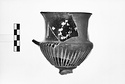
Mouth, most of neck, part of foot missing. Mended from many fragments with missing pieces of the body restored in plaster. Some of the white has abraded as has the black glaze below the figures. Traces ... Late 5th century B.C. |
Floor fragment with start of stem on underside. Glaze misfired grayish on inside, especially contour line. Max. dim. 0.078; est. diam. of tondo 0.101.
Archer (legs, right bent sharply back), moving to ... Ca. 510-500 B.C. |
Five non-joining fragments, d of floor with ring base, a of body with start of neck, the rest, body fragments. Glazed black on inside, streaked in places. Max. dim. a) 0.129, b) 0.057, c) 0.11, e) 0.063; ... Ca. 410-400 B.C. |
Krater: Asia Minor?
Two nonjoining sections: one wall fragment (b: P 3229 b) and part of wall and rim (a: P 3229 a+ P 20593).
Upper body of calyx krater with widely flaring, molded, overhanging rim ... Context of 150 to early 1st century |
Two non-joining wall fragments, a with turn of shoulder. Max. dim. a) 0.20, b) 0.069.
A (illustrated), komast ("Anacreontic") standing to right, playing the barbiton. Fragment a preserves the end of his ... Ca. 470-460 B.C. |
Fifteen non-joining fragments of wall, P 18278 b--c and P 19582 a--d of torus rim with zone of ornament below. Glaze mottled here and there; has a greenish cast in places; abraded in part on rim. Max ... Ca. 480 B.C. |
Preserved is a fragment from the right side, with nearly half the broad flat projecting rim, part of the sharply bulging side wall, and a trace of the nozzle.
Black glaze on rim nozzle and inside; side ... 12 May 1938 ... Agora IV, no. 117, p. 35, pls. 4, 32. |
Mended from several pieces; floor, with about half of wall and rim, and part of nozzle preserved.
Flat, slightly projecting rim; the center of the floor rises to a high point.
Very worn black glaze.
Corinthian ... 14 April 1948 ... Agora IV, no. 118, p. 35, pls. 4, 32. |
| Back rough-picked; back edge and side preserved; other edges broken.
The upper torso of a female figure, probably Artemis, facing front, in low relief, is preserved. She is wearing a chiton held in place ... 10 July 1931 ... Agora XXXVIII, no. 14, p. 35, pl. 4. |
|
|