|
|
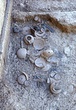
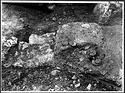
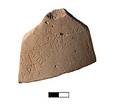
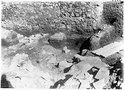
Soft Trench behind Stoa Stylobate, opposite Piers 21 and 22, along W face of Shop front wall. Herulian destruction debris at the north end of the Stoa of Attalos. Coins:
20 February 1954 #1-#2
22 February ... Late 3rd c. A.D. |
Trial trench IV. A thin strip of undisturbed fill excavated on the north side of the upper terrace, just inside the line of the Archaic peribolos wall.
Probably this small patch of clay represents part ... Protoattic |
Well with 4th. c. fill, no well deposit at the bottom. Coins:
2 April 1936 #1
3 April 1936 #8-#19
4 April 1936 #11
8 April 1936 #3-#4
22 May 1936 #5
25 May 1936 #2
27 May 1936 #2
28 May 1936 #2-#5
29 May ... Second half A.D. 4th. c. |
Well dug through cistern at 64/Γ. Seems to have been stratified; four fills recorded but here treated as one as divisions are rather "arbitrary".
Agora V, p. 126: Constructed in late 1st c.; use filling ... 3rd c. A.D. POU (before 267 A.D.) |
Well in Stoa Shop 6 (5th century).
No evidence for period of use. Considerable dumped filling of fragmentary black and plain vases; no figured fragments are preserved, but the small amount of impressed ... 450-425 B.C. |
Cistern at 65/ΚΗ (and Channel). Cistern in the northwest room of the annex to the Poros Building west of the Areopagus. Part of the same system as D 17:4 and D 17:5, the chambers connected by long tunnels ... 300-250 B.C ... Part of the same system as D 17:4 and D 17:5, the chambers connected by long tunnels. ... [Agora XXIX] ... Coins:
22 June 1950 #4
23 June 1950 #1-#3, #5-#6
24 June 1950 #1 |
Part of the cistern system 44/ΙΓ - 46/ΙΑ - 42/Θ.
Objects with context as "cistern 44ΙΓ, mouth of 46/ΙΑ" are listed with D 12:2.
The following objects are from "earth", i.e. no context layer:
SS 5334, ... Late Hellenistic-Early Roman |
Well by Stoa Pier 8.
Mouth of well discovered in 1950 (p. 2287).
Dumped filling in the 4th c. B.C. but the bulk of the material of the 5th c. B.C. Fill contained much wood, bones, Mycenaean, Geometric, ... 5th c. B.C. |
| Cistern at 77/Μ on lower north slopes of the Areopagus. Bottom diameter of 2m connected by tunnel to cistern M-N 18:1.
Only stamped amphora handle dates slightly after 240. Latest coin dates about 200 ... 3rd c. B.C.-196/190 B.C. |
Grave in north peristyle of Temple of Hephaisteion. Grave XXXI in notebook. No mention of bones. Coins:
25 February 1939 #4
27 February 1939 #5-#11
6 March 1939 #1 Negs. KK 376, KK 379 ... 25-27 February 1939
6 March 1939 |
Well (stone-curbed shaft) near middle of Tholos which served the prior building.
Period of Use dated to ca. 500-480(?) B.C., Upper fill dated to ca. 480-470 B.C. or soon after in Agora XXX (a gradual ... Ca. 500-480 B.C. |
| Evelyn Lord Smithson ... Grave 3: (Grave XXVII: EG). Urn cremation (trench-and-hole), adult male. Carbonized figs and grapes included in inventoried objects (no number). [JP]
"Craftsman-Warrior" tomb: combination of weapons and ... Early Geometric I |
Cistern at 70/ΚΕ and channels. Part of same system as D 17:3 and D 17:5. It was set against a corner of the lowest foundation block. Thus one is forced to assume that enough of the wall remained at least ... Ca. 200-150 B.C. |
Tiled well, ca. 30m south of the Tholos. Associated with Building D. Hellenistic Group A with Late Roman fill in upper 3.00m. Objects A 245 and P 4597 are from fill on floor around well-head, contemporary ... 325-260 B.C. |
| Pyre in layer 8a in SW corner of Room 7 of Greek House δ.
Oval pyre; 0.60 (n-s)x 0.35 (e-w).
The pyre was covered by the surface of layer 8 and extended slightly into layer 9 below it. Small bone fragments, ... 325-300 B.C. |
Well at 15/ΙΕ = Pocket in side of Turkish Pit at 15/ΙΔ.
Shallow well on the lower slopes of the Acropolis, east of the Panathenaic Way, in the area later occupied by the Archaic Building.
Located 3.5m ... 700-675 B.C. with intrusions |
| Julia Shear ... Burial. Roman Temple south half, in fill south of temple crosswall and norh of polygonal wall, layer 37a.
Small, roughly circular pit. The diameter of the pit appeared to be only slightly greater than ... Late Helladic IIIC Late-Final Mycenaean/Submycenaean |
| David Scahill ... Beneath toichobate floor level in Room 1 of Classical Building II, against the south ashlar wall, ca. 1.50m. east of the southwest corner of the building. Deposit of broken pyre pots in small pit, 1.00m ... Ca. 325 B.C. |
Dumped fillings thrown in during second quarter of 1st c. B.C. containing mostly debris resulting from Sulla's sack in 86 B.C.
Agora XXIX, p. 464: Four fills distinguished during excavations ... but seemingly ... Late 2nd c. and early 1st c. B.C. POU; 110-75 B.C. |
| Pyre 1 in Central House, Room XI, strosis 3. Sacrificial pyre with characteristic small vases amid carbonized twigs and bone.
Near north side of courtyard. This pit was cut slightly into strosis 3 (lot ... 1st quarter 4th c. B.C. |
| Burned deposit: Middle Terrace, south of Archaic cemetery.
RSY: Pyre 10.
Pottery, burnt bone, charred logs, and heavy burning, recovered by tunneling under the cement floor of a Late Hellenistic workshop, ... Ca. 325-300 B.C. |
| Pyre in House T, Room 1, Layer 5-6 (RSY=Pyre 3) in the industrial area west of the Areopagus.
First quarter 4th. c. B.C.
Artifacts, bone, and cinders in pit in floor sequence. The pyre was found in digging ... 400-375 B.C.(?) |
Sand fill N of Base A.
... Because of the uncertainty of ground level contemporary with Base A and of the possibility of missing a continuous strosis or disturbance in this soft sandy fill, I have kept ... Last quarter 2nd-first quareter 3rd c. A.D. |
Cistern-chamber on the northwest side of Kolonos Agoraios, 10 to 12m west of the end of the Hellenistic Building. Dimensions at bottom 2.50m x 2.75m.
The west chamber of a cistern system composed of two ... Use filling early 1st-2nd c. B.C. |
| This filling is the largest deposit of its time found in the Agora. It may be compared with H 6:5 and with N 7:3.
Dug in soft bedrock to a depth of 11.40m; footholds cut on opposite sides of the shaft ... Ca. 490-450 B.C. |
| Dorothy Burr Thompson ... Grave 2. Urn cremation (trench-and-hole). In some records as XXIII.
Variously labeled as grid 7/Δ, 7/Γ and 7/Γ-Δ.
Rectangular pyre trench cut through earth into bedrock, with only the lowest 0.04m surviving ... Transitional Late Protogeometric/Early Geometric I |
N-S Cut on 50m. line (area of Road, area of Stoa, area N of Stoa) various levels and dates over the three areas.
Investigations to the northwest of the market square in the area of the road running out ... Prehistoric to Roman |
Cistern with two tunnels, the one entering its neck cut off by an early Roman well, the other, at the bottom not excavated.
Chamber conical in shape, with a depressed draw basin in the center of the floor ... Early Roman-3rd c. B.C. |
| Second century B.C. fill with early 13th c. A.D. fill in mouth.
The Byzantine objects from the mouth are P 13713-P 13718, L 3585.
Lower fill contained bones of many infants and dogs.
The bones from this ... Mid-2nd c. B.C. |
| Sacrificial pyre, disturbed; a small pyxis (P 14864) is close to that from B 18:4. First half of 4th. c. B.C., perhaps first quarter.
West of House C. Pottery and cinders in pit in stratum. The pyre was ... First half 4th. c. B.C. |
| An extensive cistern system on the lower north slope of the Areopagus, south chamber with blind tunnel extending further south (south tunnel); north chamber; drawshaft further north, extends to north tunnel ... Ca. 320-240 B.C. |
| Anne McCabe ... Enchytrismos burial of an infant in Byzantine Room C, L/15-2/13, at 52.915m. Although disturbed by roots, the skeleton (AA 373) was articulated and lay parallel to Wall 1, with head at the NW and feet ... 14-15 June 2007 |
| James H. Oliver ... (E.L. Smithson: Grave IX: PG). Two children's skeletons one on top of the other. Cf. PD 329 for PD 430 for second skeleton, same deposit.
PG grave about 25m. SW of Cistern A at 46/ΜΔ.
[In some records, ... Developed Protogeometric |
Well East of Stoa Room 11; no appreciable change in pottery top to bottom; dumped fill of Augustan times. Coins:
4 May 1950 #1-#3
15 May 1950 #1 Estimated Grid ... Late 1st c. B.C.-early 1st c. A.D. |
Beneath layer 11. "Despite its extreme irregularity this pit may be an early well, for it would seem definitely to be an artificial cutting and sherds were found in its lowest part," (Nbp. 2095).
Contemporary ... SubMycenaean |
Roman use fill in lowest 6.70m; Byz upper fill (dump). Notebook lists eight fills; subdivisions based on shelf groupings.
Subdivisions:
.1=Dumped fills 1-2, Byzantine
.2=Fill 3 (baskets 18-37)
.3=Fill ... 50-150 A.D. to Early Byz. |
| Pyre in House N, room 4 (RSY=Pyre 7), in the industrial area west of the Areopagus.
Pottery, mall pieces of calcined bone, log, wood cinders, and charcoal in diamond-shaped pit in floor sequence. The pyre ... Late 4th-early 3rd c. B.C. |
Cistern at the southeast foot of Kolonos Agoraios.
Nbp. 2369: Two chamber cisterns, 88/ΛΔ and 100/ΚΘ, united by a long straight passage running almost due N-S. A draw shaft at 95/ΚΘ is set just off the ... Use filling of late 4th-early 3rd c. B.C.
Accumulative fillings of late 3rd-early 2nd and late 1st c. B.C.
Upper dumped filling of 3rd c. A.D. |
| Cistern in the valley between the Areopagus and the Hill of the Nymphs. Simple, flask-shaped chamber withdraw-shaft; no tunnels. Mouth cut away in Byzantine times. Lower filling, 3rd c. B.C. Coins:
25 ... 25-30 April 1947 |
| Grave in west peristyle of Hephaisteion. Grave XXXIX in notebook.
No mention of bones. Coins:
7 March 1939 #12-#13
8 March 1939 #4-#5
10 March 1939 #3-#9 Neg. KK 367 ... 7-10 March 1939 |
|
|