|
|
I. Head of a dog, right.
Reserved and glazed circles beneath. Very little of beginning of foot present. No relief contours.
As Campana Fragments, Pl. 20, 13. Assembly Place, Filling of Period III ... 1931 |
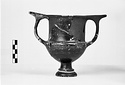
Handles missing.
High moulded ring foot; rim offset inside. Scraped circles on underside. Decoration inside: four palmettes within rouletting.
Same stamp as cup-kantharos 655, Pl. 28.
Restored in plaster ... Ca. 375 B.C. |
Handles and parts of wall and foot restored.
Underside and resting surface as 150. Shiny black glaze.
Cf. P 26109 (Agora XII, no. 352, p. 260, fig. 4, pl. 17 [F 17:3, lower fill]) ... Ca. 325 ... Agora XII, p. 260, under no. 352 ... Thompson 1954, no. 5, p. 73, pl. 24:e |
Intact.
Scraped groove in resting surface; concave underside with nipple.
Low, concave stem. Ribbed body. Rising, very slightly flaring spurs with very square ends. Slightly lustrous, mottled black-to-red ... 325-300 |
Rim chipped; little wear on resting surface.
Broad groove in resting surface; nippled underside. Shiny black-to-brown glaze. Graffito Μ on underside.
Similar: P 19050 (Young 1951b, no. 4:5, p. 118, pl ... 325-300 |
| Half of one handle and half of body and rim missing.
Two flat-topped vertical handles. Slightly out-turned rim. Stout stem. Moulded base.
Black glaze, metallic. Reserved band on and under base. Three ... April 1934 ... Agora XXIX, no. 24, fig. 5, pl. 3. |
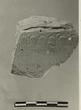
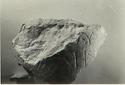
| Inscribed fragment.
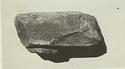
Traces of rough picking on top; the bottom reworked; the back and sides broken.
Part of two lines of the inscription preserved.
White marble. Found in a modern wall, over the Panathenaic ... 14 June 1933 ... Agora XVII, no. 24, p. 33, pl. 5. |
Base fragment.
From bottom of fenestrated stand. Impressed tongues on vertical face and on finished surface at left; running spiral on the sloping upper part. Red pithos fabric, brown at surfaces.
Also ... Context ca. 600-575 B.C. |
Low ring foot with concave moulding beneath. Slightly convex lid with flat-topped knob. Glaze fired mostly red and peeled. Dipped.
Cf. Athens Kerameikos HS 57 (better quality than most) and HS 171; Ferrara, ... Ca. 430 B.C. |
Torus ring foot; triangular handles. Reserved: underside with two circles, and resting surface. Glaze fired red and worn from upper part. Scratched cross on underside.
Contemporary, P 318 F 16:1 Hesperia, ... Ca. 330 B.C. |
Parts of edge of knob, wall, and rim missing.
Slightly convex wall with one scraped and one glazed groove at bottom, two scraped grooves at top. Low, solid stem. Beveled ridge with scraped groove at inner ... 270-215 |
Half of rim and upper body, pieces of lower body, most of one handle, and part of the other missing.
Scraped groove in resting surface; concave underside. Scraped groove at junction of stem and body ... Ca. 300 |
Small parts of rim restored; handles missing.
Resting surface grooved and reserved; concave underside.
Low stem, thinner than 127. Thin, streaky red glaze.
Similar: P 14800, P 15864 (E 14:10), P 29188 ... 325-315 |
All of one handle and top of the other missing; rim chipped.
Reserved stripe on flat resting surface and at junction of moldings; concave underside. No stem. Lustrous black glaze with some metallic patches ... 325-315 |
Foot flat on top, outer face concave. Projecting lip, sharply undercut. Raised ring at the base of the stem with an incised line above and below it. Reserved: outer face of foot, resting surface and top ... Ca. 500 B.C. |
Flat projecting rim; high flaring ring foot. Glaze wash inside; a band around the wall and on the foot outside; rim unglazed.
The same foot and system of glazing appear on a larger, fragmentary, lekane ... Context, ca. 525-500 B.C. |
| Part of the rim preserved.
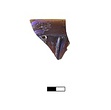
Moulded. Plain vertical lip with two shallow grooves inside; below the lip the wall thickens, and there remain part of two vertical rays in relief, blunt ended.
Purplish indigo ... 17 April 1934 |
Rim and spurs chipped.
Scraped groove in resting surface; concave underside. Cylindrical stem. Pointed lower body. Rising, flaring spurs. Shiny black glaze; miltos.
Nearly identical to P 28789, from ... Ca. 300 |
Half of upper body and one-third of lower body restored; foot, stem, and handles missing.
Ribbed lower body with scraped groove and square molding at base. Projecting, overhanging flange below rim. Grapevine ... 275-260 |
Rim and foot chipped.
Scraped groove in resting surface; nippled underside. Low, slightly pointed body. Rim slightly thickened inwardly. Bolster handle is plain. Ivy garland running right, with single ... Ca. 300 |
Fragment of cul and body. Max. dim. 0.09.
On cul, chain of double lotuses and encircled palmettes.
The only painter to favor the chain of double lotuses and palmettes on the culs of his calyx-kraters ... Ca. 450 B.C. |
Moulded foot, concave beneath, in several degrees, with reserved groove in resting surface. The two lowest mouldings of the foot are irregularly reserved. Short stem. Rouletting inside. Glaze fired slightly ... 350-325 B.C. |
About half of body restored.
Beveled resting surface; concave underside. Comic-mask thumb rests: slave with pointed beard. No decoration preserved.
Pale, soft, slightly micaceous fabric (7.5YR 7/4); ... 225-210 ... Agora XII, p. 123, note 71 ... Thompson 1934, A 30, p. 319, fig. 5 ... Rotroff 1990a, p. 177, pl. 24:2, left. |
| Knob, part of top surface and rim preserved. Eros to right holding pyxis and sash moves toward woman, nude from waist up, seated to left, holding box and sash. Behind her, heads and arms of two more women ... July 1964 |
Ring foot with two torus mouldings at the edge. Straight stem. Mouth flanged to receive a lid, the vertical projecting edge bevelled. The handles are double tubes, vertically pierced for string. Reserved: ... Ca. 500 B.C. |
Shoulder rounded directly into plain rim. On outside, shied and bird (apparently). Inside glazed as far as preserved.
Brown glaze.
Probably like Kerameikos V, 1, pl. 88, inv. nos. 323, 324; a similar ... LG IIB |
Vertical section of handle and over half of body, foot, and underside restored.
Low, flaring foot; flat resting surface; well-formed, slightly convex underside. Lower body very high and nearly straight ... Context of 150-110 |
Flat bottom; flaring rim pinched to trefoil mouth. Elongated sigmas on outside; row of dots on outer face of lip. Lip reserved inside and decorated with elongated dots linked by tangents; otherwise glazed ... LG IIB |
| Broken all around. A tongue pattern in low relief.
Clay pink at core, buff at surface.
Cf. Agora XII, no. 1854. Well, main fill. 750 Leica, XXVI-53 ... June-July 1932 ... Agora XII, no. 1854 ... Hesperia 15 (1946), p. 136, no. 33, pl. 24:5. |
Fragment of slightly domed lid with knob and part of rim. Glazed on underside. Est. diam. 0.13; H. 0.055.
Heads of woman (two pairs: all of one head, back of another missing) facing, each with a sakkos ... Second quarter of the 4th century B.C. |
Mended with missing pieces restored in plaster and painted. Two concentric circles with central dot on underside of floor. H. 0.082; diam. at rim 0.178; width with handles 0.252; diam. of tondo 0.078; ... Ca. 510 B.C ... Thompson, Hesperia 24, 1955, pp. 64--65, fig. 3, pl. 28:d; Ginouvès, Balaneutikè , p. 63, pl. 12:36; D. ... Lang, Graffiti in the Athenian Agora (Agora Picture Book 14), Princeton 1974, fig. 36; R. ... Roberts, Hesperia 55, 1986, p. 10, cat. no. 2, p. 5, fig. 2, p. 23, fig. 13, pl. 1.
|
Skyphos: Imitation Of Pergamene Sigillata?
One handle and part of wall and rim.
Nearly vertical wall turning in toward bottom. Inwardly beveled rim.
Strap handle with added strip of clay around arch ... Context of 200 to late 1st century |
Floor fragment with start of lip, root of one handle, and part of molded ring base. Lip offset on inside. Band and three concentric circles with central dot on underside of floor. Glaze abraded in part ... Probably second quarter of the 4th century B.C. |
P 10900 a
Neck and about half of shoulder preserved; partiallyrestored.
Convex shoulder with smooth transition to long, cylindrical neck.
Torus rim. Decoration in brown glaze: band on rim and at base ... 1st-century context |
| Inscribed fragment of columnar grave monument.
Inscribed face only preserved.
Two lines of the inscription preserved.
Hymettian marble. Found in the wall of the modern house 637β/5 (637b/5), west of the ... 8 November 1935 |
Three non-joining fragments of top side, a with grooves setting it off from the side. Max. dim. a) 0.066, b) 0.067, c) 0.037.
On each side, head of woman, one to left, the other to right, probably facing ... Probably first quarter of the 4th century B.C. |
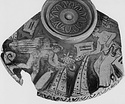
Bowl fragment. Max. dim. 0.082; est. diam. of tondo 0.16.
I, jockey (head with long hair streaming behind him; shoulder) to right. Around tondo, stopped-maeander pattern. A, horse race. At the left, one ... Ca. 470-460 B.C ... During his visit to the Agora in June 1988, Bothmer noted the similarity between 1429 and the work of the Stieglitz and Pistoxenos Painters. Not enough remains of 1429 to offer a firm attribution, but the character of the horses recalls those on three cups by the Pistoxenos Painter: Berlin inv. 4982.19 (ARV2 860, 5; CVA, Berlin 3 [Deutschland 22], pl. 104 [1033]); Louvre G 108 (ARV2 860, 9; Addenda 298); Louvre C 235 (ARV2 862, 24). |
Most of shoulder with stub of handle and body with part of fillet between it and the foot. Strengthened with plaster. Glaze misfired in places; abraded here and there. P.H. 0.138; diam. 0.081. H. A. Thompson, ... Ca. 510 B.C ... Thompson, Hesperia 24, 1955, pl. 28:c; D. ... Thompson, An Ancient Shopping Center (Agora Picture Book 12), Princeton 1971, fig. 54; Kurtz, Athenian White Lekythoi, pl. 5:2; S. ... For plumes on helmets, see Agora XXIII, p. 128, cat. no. 206, pl. 24.
|
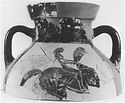
| Parts of both panels, lip and both handles preserved in many fragments. A horseman right on either side. Red for rider's hair, and horses' manes, and stripes on flanks. Well 8, containers 10-13. Leica ... 3-6 June 1938 |
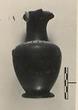
| Handle missing (restored) and small chips from lip; otherwise intact. Spreading foot, slender egg-shaped body; tall neck set off from trefoil lip by a light ridge. Band of tongues, alternating black and ... 21 May 1938 |
|
|