|
|
Exploration in the peristyle of the Heliaea (1960); evidence for rebuilding in the third quarter of the 4th c. B.C. with some disturbance as late as 1st-2nd c. A.D. Date of reconstruction ca. 325 B.C ... Ca. 350- 325 B.C. |
Destruction fill in octagonal room of Gymnasium and Rooms to North; also basement room F of late Roman Gymnasium ... Late Roman ... Agora XXXIV, pp. 14-15, 184. |
Great Drain and Pit at 55-56/ΙΗ-ΙΖ (Roman Group K). Coins
8 June 1933 #4
9 June 1933 #5-#6
10 June 1933 #1-#12, #13-#16
13 June 1933 #1-#25, #26-#29
14 June 1933 #3-#4
15 June 1933 #1-#5, #6-#8
17 June ... Mid 3rd century |
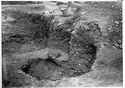
Well at 96/Ι in arm of cistern at 94/Θ (F 15:2). Probably the rebuilding of an earlier well.
P 3149, P 3150, P 3154 are jars from packing in cistern arm; construction fill - early Roman.
P 4588 is listed ... Second half of 3rd c. A.D.=POU |
Cistern at the southeast foot of Kolonos Agoraios.
Nbp. 2369: Two chamber cisterns, 88/ΛΔ and 100/ΚΘ, united by a long straight passage running almost due N-S. A draw shaft at 95/ΚΘ is set just off the ... Late 2nd-early 1st c. B.C.-86 B.C. |
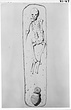
| Grave 14 in notebook.
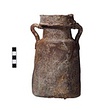
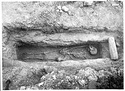
Length of shaft 2.12m; width 0.46m; depth from cover 0.60m. Man's skeleton stretched NE-SW with head at NE. Offering at foot of shaft, with the skyphos in the mouth of the pitcher ... 750-725 B.C. |
| A well at the northeast corner of Classical Building, behind back wall. Dumped fill appears to have occurred as a single event as there are joining sherds throughout.
POU date ca. first half 5th c. B.C.; ... 5th c. B.C. |
Filling on original floor of Primitive Bouleuterion = Building D.
Metroon pit η. H 10:2 is also contemporary with the construction of the building ... Third quarter 6th c. B.C ... Agora IV, p. 241 ... Hesperia Suppl. 4, pp. 14-15. |
Well at the southeast foot of Kolonos Agoraios.
Use filling of 1st c. A.D.; dumped fillings of 3rd c. and of early Byz. times. Coins:
15 June 1937 #1-#2 (earth)
16 June 1937 #14-#20 (earth)
17 June 1937 ... 1st c. A.D.=POU |
Cistern-shaft at the southeast foot of Kolonos Agoraios.
Nbp. 2369: Two chamber cisterns, 88/ΛΔ and 100/ΚΘ, united by a long straight passage running almost due N-S. A draw shaft at 95/ΚΘ is set just ... Upper fill, Late Roman with some Hellenistic.
Middle fill, Sullan debris to last quarter of 1st c. B.C.
Lower fill, 4th-3rd c. B.C.=POU and abandonment |
Middle Stoa Building Fill (with filling to S) (See also Κ: H-I-J 14-15 and Λ: K-M 13-14)
This deposit is not definitive and must be considered with the above deposits before details are entered into database; ... To ca. 180 B.C. |
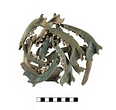
Listed in nb. as 15/ΞΤ. Pit with bronze casting debris ... To 3rd quarter of 5th c. B.C. |
| Rodney S. Young ... Grave 5 in notebook.
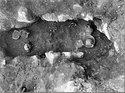
The grave had been somewhat disturbed by the digging of Well B. The hydria lay on its side; in it was found the skeleton of a small child lying on its side with the knees drawn up ... Late 8th-early 7th c. B.C ... Hesperia Suppl. 2 (1939), pp. 26-28, figs. 1, 14-15 (Grave V) ... Agora VIII, p. 127. |
Middle Stoa Building Fill.
Cf. also H-I-J 14-15, H-K 12-14 (ask SIR) (unsolved)
This deposit is not definitive and must be considered with the above deposits before details are entered into database; ... Before ca. 150 B.C. |
Cistern at the southeast foot of Kolonos Agoraios.
Nbp. 2369: Two chamber cisterns, 88/ΛΔ and 100/ΚΘ, united by a long straight passage running almost due N-S. A draw shaft at 95/ΚΘ is set just off the ... Use filling of late 4th-early 3rd c. B.C.
Accumulative fillings of late 3rd-early 2nd and late 1st c. B.C.
Upper dumped filling of 3rd c. A.D. |
Essentially uniform fill of III-IV c. A.D. with a Byzantine upper fill. Coins:
14 June 1937 #1-#3
15 June 1937 #2
16 June 1937 #1
17 June 1937 #1-#2
18 June 1937 #1-#4
19 June 1937 #1-#4
9 June 1938 #1-#3 ... Late 3rd-mid-4th c. A.D. |
At 67/ΙΗ, at the northeast slope of the Areopagus.
Cistern with drawshaft, 4.60m deep. The drawshaft had been cleared to bottom in the eighteenth or nineteenth century, and some of the fill in the main ... Most second half of 3rd c. B.C. |
| Anne McCabe ... Adjacent to the SW face of Byzantine Wall 14. The circular cutting, 0.90m in diameter, appeared at 53.504m under a layer of loose rubble (Lot 481). Wall of the well roughly built, consisting at the top ... 11-19 July 2006
24 June-21 July 2009 |
| Extract from notebook ΠΘ XIX, pp. 3644-3646. Well at 105/ΝΗ (report on sorting of pottery, July 19, 1951 - H.S. Robinson).
"Not a useful well" HSR.
Well dug to 1.50m., vi/9/36; dug from 1.50m. to bottom ... Early Roman; use fillings of 2nd. c. B.C. and 1st. and 4th. c. A.D.; dumped filling of late 4th. c. (HSR)
Fill I: 2nd. c. B.C.
Fill II-V: to second half of 4th. c. A.D.
Fill VI: mixed to Byzantine. |
| Evelyn L. Smithson ... Submycenaean grave (E.L. Smithson: Grave XXXIV). The skeleton of a 30 year's old female ... Submycenaean |
| Dorothy Burr Thompson ... Grave 15 in notebook. Burial of child (E.L. Smithson: Grave XIV: PG). Single bone. Nb. says: few bones.
Skull fragment, few ribs and fingers (bones discarded). Negs. KK 24 and KK 30 431 ... Developed to Late Protogeometric |
| Mycenaean Grave.
One of the first Mycenaean burials found in the Agora. It consisted of a regular cist, carefully cut with vertical sides and a flat bottom, measuring 1.90m by 0.55m. There were apparently ... LH III (c. 1200) ... Hesperia Suppl. 50 (2018), pp. 73, 100, nn. 15, 116 ... Hesperia 14 (1945), pp. 296-297 (no. 37) ... Agora XIII, pp. 240, 247, pls. 58, 76, 82 (Grave XXXVII). |
Cistern with considerable dumped fill at the north foot of Kolonos Agoraios. It may have been abandoned ca. 295-295 B.C.; it will have been filled by 280 B.C.
Multiple vessels share same stamps, and painted ... Ca. 325-250 B.C. |
Well on south slope of Kolonos Agoraios. Coins:
23 March 1936 #5-#6
31 March 1936 #3
30 April 1936 #1
1 May 1936 #6
2 May 1936 #2
5 May 1936 #8
6 May 1936 #15-#16
14 May 1936 #5-#8 (#6 N 51520 is from ... 50 B.C-3rd c. A.D. |
Great Drain South (ca. 70-113, from SW edge of section as far north as the Roman Bath) Hellenistic Sand Fill. Silted-up filling of the southern branch of the Great Drain, abandoned due to some damage at ... 4th. c.-86 B.C. |
| Cistern at 77/Μ on lower north slopes of the Areopagus. Bottom diameter of 2m connected by tunnel to cistern M-N 18:1.
Only stamped amphora handle dates slightly after 240. Latest coin dates about 200 ... 3rd c. B.C.-196/190 B.C. |
| Komos Cistern at 66/Κ, on the north slope of the Areopagus. Homogeneous fill.
Thirty-four stamped amphora handles. Eight Histiaian tetrobols, dating 170-160 at the earliest, found near top, possibly an ... Last quarter of 3rd c. B.C.-Early 2nd century B.C. |
| Tiled Well at S edge of E-W Road, 73/ΜΗ. Contemporary upper and lower fills separated by layer of sterile mud.
Latest coin dates ca. 200. Koan amphora handle with stamped handle dates slightly after 200 ... 210-160 |
Filling of Middle Drain (Tr. H+F in Section Ζ). Sand and gravel filling of the old course of the west branch of the Great Drain, a large (ca. 1.00m. deep and 1.30m. wide) underground channel in the area ... 150-100 B.C. |
| Evelyn Lord Smithson ... Grave 3: (Grave XXVII: EG). Urn cremation (trench-and-hole), adult male. Carbonized figs and grapes included in inventoried objects (no number). [JP]
"Craftsman-Warrior" tomb: combination of weapons and ... Early Geometric I ... AgoraPicBk 24 (1998), pp. 10-11, figs. 14, 15 ... Agora XXXVI, Tomb 13, pp. 104-118, 531-533, figs. 2.55-2.64, 3.18-3.20, pl. |
| Second century B.C. fill with early 13th c. A.D. fill in mouth.
The Byzantine objects from the mouth are P 13713-P 13718, L 3585.
Lower fill contained bones of many infants and dogs.
The bones from this ... Mid-2nd c. B.C. |
| Use filling of middle of 1st to late 6th c. (Roman Group M); dumped filling of 9th and 10th c. Down to a depth of about 21.00m. the fill of the well contained very few objects, the latest of them being ... 1st-6th c. A.D. |
A 3rd. c. B.C. cistern and an unfinished rectangular cutting of the 2nd c. B.C. which destroyed some of its upper part. These two features are combined in this deposit; the following objects are identified ... 3rd-2nd c. B.C. |
West Road and Drain. (Road, drain and closely related cuts.) Packing in line of ancient road running along the northwest shoulder of the Areopagus. Includes excavation of 1957 titled "Road Area to North", ... Late 6th c. B.C. - Roman |
Destruction debris in Late Roman Buildings on Lower N slope of Areopagus (see summaries under M-Q 17-21).
Over 130 coins came from this filling, of which some 51 survived in a condition to permit accurate ... 6th c. A.D. |
| An extensive cistern system on the lower north slope of the Areopagus, south chamber with blind tunnel extending further south (south tunnel); north chamber; drawshaft further north, extends to north tunnel ... Ca. 320-240 B.C. |
|
|