|
|
| Section X
Miscellaneous Notes Compiled in Summer of 1946 ... Margaret Crosby ... This report is a summary of the excavations taken place in 1937 as well as in 1946.
Some pottery indicate habitation in the area from the Geometric period. Two shallow graves of the 6th and 5th centuries ... 27 May-21 Jun 1946 ... Two shallow graves of the 6th and 5th centuries B.C. were found, probably children's graves set under the house floor. A small circular pit (6th-5th c. B.C.), a rectangular refuse pit (ca. 480 B.C), and a well (ca. 420 B.C.) ... The lower part of another 5th century B.C. well was also found.
|
| Section ΟΟ 1949
Grave Area ... Margaret Crosby ... A report on the excavation in the immediate vicinity of the Early Geometric burial found in 1948 in Section ΟΟ. Two Geometric graves were uncovered, and also walls and drainage systems belonging to the ... 28 Mar-9 Nov 1949 ... Two Geometric graves were uncovered, and also walls and drainage systems belonging to the industrial establishments of the later 6th and 5th B.C. centuries, as well as sporadic remains from later periods, such as a 4th B.C. century pit and a Hellenistic cistern. |
| Section Χ 1937 ... Margaret Crosby ... The area signified as Section Χ lays outside the Agora proper and no signs of any public buildings were found. The area seems to have been used for private houses from the end of the 6th c. B.C. Apart ... 25 Jan-18 May 1937 ... The area seems to have been used for private houses from the end of the 6th c. B.C. Apart from few scattered sherd from the Geometric period, the earliest remains indicating habitation were two graves of the late 6th or early 5th c. B.C. Close by the graves was a garbage pit from about 480 B.C., one well from ca. 420 B.C, and another well from ca. 375 B.C.
... A late Roman well was partly excavated.
|
| Section Φ Season of 1937 ... Eugene Vanderpool ... In antiquity the area included in Section Φ lay outside the Agora proper and were apparently occupied only by houses and small buildings. The earliest period of which any considerable remains were found ... 25 Jan-17 Jun 1937 ... The earliest period of which any considerable remains were found was the Geometric: three Protogeometic graves and one well, as well as one Geometric grave and one disturbed well, were discovered and excavated.
... Some of the objects from the well belong to the early years of the 5th century B.C.
In the northeast corner fragments of terracotta water pipes were found, some in situ, dating from the late 6th or the 5th century B.C.. |
| Preliminary Report on the 2000 Excavation Season ... John McK. Camp II ... Excavations were carried out in three sections, two to the northwest, (ΒΖ and ΒΕ) and one to the southeast of the Agora square (ΕΛ).
In Section ΒΖ the investigation of the remains of the 11th century settlement ... 6 Jun-28 Jul 2000 ... Several pithoi were more fully exposed and one tile-lined well was uncovered and partially excavated. ... The last of the fill containing ostraka was cleared adding another dozen or so to the total number of ostraka found, and the excavation of the 5th century B.C. well was completed.
|
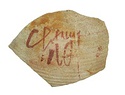
| ΚΚ Excavation Report 1936 ... Dorothy Burr Thompson ... Section ΚΚ, the area inside the modern fence around the so-called Theseion, was cleared to bedrock in order to determine the entire history of that portion of Kolonos Agoraios. Excavation revealed that ... 10 Feb-13 Mar 1936 ... It was discovered that the area in earlier times was used for burials, and down to the early fifth century B.C. the hill must have been uninhabited. ... The filling of a pit provided extremely fine fragments from red figure and black figure vases, as well as ostraka.
The foundations of the temple were entirely exposed. Dumps of working chips of poros and marble from the time of the of construction of the temple, and the pottery found within them, suggest that work must have begun about the middle of the 5th century. B.C., while the work on the terrace continued well down into the 5th century B.C.
|
| Sections Rho and Eta 1937 ... James H. Oliver ... Byzantine settlements in Sections Η and Ρ were removed and the foundations of the Temple of Ares exposed.
The most noticeable feature was the road serving as the main thoroughfare in the neighborhood from ... 24 Feb 1937 ... A vast amount of road filling was removed as well as a series of rooms. ... These fragments show that the temple was from the 5th c. B.C. and moved to the Agora in the early Imperial times. Parts of the foundations, together with cuttings for the complete rectangular outline of the temple, are well preserved. |
| Agora Excavations 1995 Preliminary Report ... John McK. Camp II ... Excavations continued in the areas of the Panathenaic Way, west of the Stoa Poikile, and in and around the Classical commercial building north of the Stoa Poikile.
In the Panathenaic way the exploration ... 12 Jun-4 Aug 1995 ... In the second half of the 5th century B.C. the road surfaces were carefully prepared, perhaps to then serve as a race track.
... West of Stoa Poikile, the clearing of a late Archaic well was completed. It produced pottery for domestic use, dating to 510-480 B.C. |
| Preliminary Report on the 1999 Excavation Season ... John McK. Camp II ... Most of the work this season was concentrated in the northern half of Section ΒΖ where the Byzantine levels were further explored. Street walls along both sides of the north-south road were revealed and ... 7 Jun-30 Jul 1999 ... In Section ΒΕ excavation continued in the Classical commercial building where another pyre was discovered. A well was uncovered and was partly dug. It was filled with debris dating to the 2nd and 3rd quarter of the 5th c. B.C. More work was also done on two Mycenaean tombs. |
| Section ΛΛ 193
Excavation Summary ... Dorothy Burr Thompson ... Excavations in Section ΛΛ revealed that the original contour of Kolonos Agoraios had been much sharper than in modern times. No traces of early graves were found in the area; first sign of habitation is ... 1 Feb-23 Jun 1937 ... No traces of early graves were found in the area; first sign of habitation is pottery from the last half of the 5th century B.C. found in metal working pits in connection with a drain and a road. The best preserved material belongs to the 4th century B.C. The area was probably covered with houses of which five establishments were well preserved, several others less preserved.
|
| Preliminary Report on the 2011 Excavation Season ... John McK. Camp II ... Excavations were carried out in three sections, two of them overlying the Painted Stoa (ΒΗ and ΒΘ) and one in the Panathenaic Way (ΒΓ).
In Section ΒΓ, excavations were concentrated on the Panathenaic Way ... 13 Jun-5 Aug 2011 ... The excavated sequence dated from the 1st c. B.C./A.D. to 3rd century B.C. The post holes are excepted to lie a bit lower down in 5th century B.C. fills and should be exposed next season. ... In Section ΒΗ, overlying the east part of the Painted Stoa, a well was dug and over 100 pots were recovered. |
| Section Υ: 1958 Excavation Report ... Dorothy Burr Thompson ... Two areas at the north foot of the Areopagus were uncovered. The first area did not yield much of interest due to modern disturbances. Excavations of a well, three pits and a water channel produced however ... 3 Mar-3 May 1958 ... Excavations of a well, three pits and a water channel produced however ancients material.
... Evidence suggest it was laid out in the early 5th c. B.C. due to the reorganization after the Persian Wars. ... They were modest houses and built approximately at the same time, probably shortly after 479 B.C. Some time after 300 B.C. an extensive rebuilding took place and possibly second stories were erected. |
| Preliminary Report on the 2002 Excavation Season ... John McK. Camp II ... Excavations continued in the northwest corner of the Agora (sections ΒΕ and ΒΖ) and in the Eleusinion area (ΕΛ), and a trial trench was opened up in the Panathenaic Way (Σ).
In section ΒΖ, the exploration ... 10 Jun-2 Aug 2002 ... However, a shaft of a Protogeometric or early Geometric well was partially excavated.
... In the Eleusinion area there are no surviving architectural remains. A well from the late 6th to early 5th century B.C. was excavated, and while scraping bedrock, a marble portrait head was discovered. |
| Section Ω 1938 ... M. Crosby ... Section Ω lies in the east end of the north slope of the Areopagus, well to the southeast of the market square proper. Excavation showed, as expected, that the area was a residential district throughout ... 16 Jan-17 Jun 1938 ... Section Ω lies in the east end of the north slope of the Areopagus, well to the southeast of the market square proper. ... A few sherds of prehistoric date was found but there were no definite sign of habitation before the end of the 6th century B.C. By that time however, there was a street running diagonally up through the section, and remains of buildings, wells, cisterns, etc. from that period and onwards were found. Not until the end of the 4th or early 5th century A.D. are there any traces of buildings other than private houses. |
| Preliminary Report on the 2009 Excavation Season ... John McK. Camp II ... Excavations were conducted in four sections: Γ, ΒΘ, ΒΗ and ΒΖ.
In Section Γ, the investigation of the Classical buildings south of the Tholos continued with the aim to find out if they were civil, commercial ... 8 Jun-31 Jul 2009 ... The well is one of the earliest tile-lined wells found in the Agora, dating to the first half of the 4th century B.C.
... These rooms were built in the 5th and 6th centuries, and were probably used as shops. ... The lower one is temporary with the stoa (2nd quarter of the 5th century B.C.) and has also been traced further west.
|
| Preliminary Report on the 2007 Excavation Season ... John McK. Camp II ... Excavation continued this year in the sections ΒΖ, ΒΗ and Γ.
In Section ΒΖ South, two areas were investigated: the north-south road and the areas west of the road. In the road, hard-packed gravel surfaces ... 13 Jun-3 Aug 2007 ... All these channels were in use in the 4th or 5th centuries A.D. ... In Section Γ, the excavation of the building identified as the Strategeion continued. Well preserved floor levels in the eastern part of the building were excavated, including a pit full of marble chips overlying a pit filled with several amphorae. Excavation in other fills went down to late 8th and early 7th centuries B.C. Further east, the exploration of a series of small irregular buildings started.
|
|
|