|
|
Coins:
10 April 1937 #5 ... 4th-3rd c. B.C ... F 5:5 ... F 5:5 |
| Susan I. Rotroff ... Grave 5. Adult (female?) inhumation.
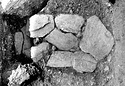
Cist grave lined and covered with slabs of limestone, sandstone and schist. Cut into virgin soil under Royal Stoa at I/12,13-5/3,4. Grave measures 1.79x0.39-0.49x ca ... Final Mycenaean/Submycenaean ... I/12,13-5/3,4 |
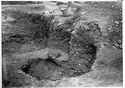
Pit at 79-83/ΜΒ-ΜΖ (or 81/ΜΣΤ=pit under floor of Room 11 in Roman Bldg. 2, 82/ΜΓ, 83/ΜΕ=well at 83/ΜΗ). Purpose of pit obscure. Evidently filled in Hellenistic times and disturbed in Roman times. Coins: ... 275-200 B.C. with later disturbance ... Coins:
26 February 1937 #1-#2
27 February 1937 #2-#3
1 March 1937 #1
3 March 1937 #1
6 March 1937 #1-#3
9 March 1937 #1-#4
29 March 1937 #4
3 April 1937 #4-#6
5 April 1937 #3-#4
6 April 1937 #4-#8
7 May 1937 #1(well dump) |
| Pyre in House N, room 2, layer 5 (RSY=Pyre 8).
Near northern corner of room 6. Artifacts, bone, burnt logs, and cinders in square pit dug from level of layer 5, through layers 5 and 6; thin clay floor ... 325-300 B.C ... B 19:5 ... B 19:5 |
Rubble and mortar pithos built over and into line of zig-zag drain. Excavated upside-down. Loose fill. No coins ... 18 A.D with mostly 16 A.D. c ... Q 5:1 ... Q 5:1 |
Represents excavated levels V-IX. Coins:
5 July 1971 #857 ... Late 5th c.-300 B.C ... J 5:1.4 ... J 5:1.4 |
| Grave in opisthodomos of Hephaisteion. Grave XLIX in notebook.
No mention of bones. Coins:
9 March 1939 #8-#13 Neg. KK 365 ... 9 March 1939
16 March 1939 ... Hesperia Suppl. 5 (1941), p. 5, fig. 1 (Grave 14). |
| Located at the bifurcation of the Panathenaic Way and West Road.Byzantine fill (9th-10th century) in upper 5.70m. with a series of Classical to Hellenistic accumulations below. Coins:
10 July 1971 #861 ... 14 June-27 July 1971 ... J 5:1 ... J 5:1 |
Now H 13:4. Asterisk: G 13:5* ... G 13:5 ... G 13:5 |
(now G 12:22) Asterisk: H 12:5* ... H 12:5 ... H 12:5 |
Cistern system, 88/ΝΓ (shaft and passages). Apparently a dumped filling of Roman times, drawn mostly from some Hellenistic deposit. Coins:
31 March 1937 #1-#5
1 April 1937 #4-#5
3 April 1937 #1-#2
5 April ... Hellenistic and Roman, 4th c. A.D ... D 5:2 ... D 5:2 |
| Enclosure within Roman Circular Building. The finds apparently reflect the entire area inside the enclosure. Pottery lot ΒΓ 515 identifies the deposit as layer 10 and coin #895 from layer 11 says "layer ... 12-18 August 1971
9-10 May 1972 ... Coins:
13 August 1971 #890
9 May 1972 #895 (layer 11, "layer below the deposit")
The Bone bags from J 5:2 were analyzed by Michael MacKinnon: there are domestic taxa represented by a mix of skeletal elements. |
Well at 18/ΜΑ. Not dug to bottom. Coin
9 May 1957 #5 Recorded in Ω Books, pp. 1874ff ... 30 April-14 May 1957 ... Coin
9 May 1957 #5 |
| Susan Rotroff ... Grave 1. Burial of a child perhaps 6 years old, covered by broken amphora. Skeleton lay extended on its back, oriented N-S, with head at south. No grave gifts. PD 2207 ... Final Mycenaean/Submycenaean ... I/16-5/5 |
Hellenistic cistern, part of the same system as 94/ΝΣΤ (D 4:1) and connected with it by a passage. Later cleaned out for reuse and filled with destruction debris of the late 4th c. A.D. Coins:
23 March ... Second half 4th c. A.D ... Coins:
23 March 1937 #2
24 March 1937 #1
27 March 1937 #1-#2
29 March 1937 #2-#3
30 March 1937 #1-#5
1 April 1937 #1 (passage)
7 April 1937 #3-#4
8 April 1937 #1-#7
9 April 1937 #5-#9
12 April 1937 #5-#7 |
Filling accumulated between the time of the Persian sack and the building of the Stoa.
Cf. Hesperia 6 (1937), pp. 14-18 and H 6:5 ... H 5-6.2 ... H 5-6.2 |
9th-10th c. A.D ... J/10-5/5 |
Represents excavated levels II-III ... 275-150 B.C ... J 5:1.2 ... J 5:1.2 |
Represents excavated level IV. Coins:
2 July 1971 #851-#856 ... 300-275 B.C ... J 5:1.3 ... J 5:1.3 |
A very homogeneous dumped filling and no period of use. Apparently a failure as a well.
T 263-T 289 resorted and reduced August 1967. Cf. BI 157 "from behind the curbing of the well by Stoa pier 3." Estimated ... Ca. 470-460 B.C ... Hesperia 5 (1936), pp. 333-354. |
"Debris Pit" beneath starting line in Panathenaic Way.
Dug as
Trench B (1971), pp. 1631-1649 (notebook not seen, PF);
finds record both Layer 28 and beneath Layer 28.
Trench I, pit 16a, (1973), pp. 3010-3022 ... 2 August 1971
4-6 July 1973
27 June-11 July 1980 ... L 5:2 ... L 5:2 |
Pit at 18-20/Λ-ΛΓ.
The cistern S 19:3 and the well S 19:8, together with a Roman well, S 19:1, had collapsed to form a large pit S 19:5. The upper part of the pit was dug to a depth of ca. -8m as deposit ... 7-8 April 1938
28 April-26 May 1938 ... The cistern S 19:3 and the well S 19:8, together with a Roman well, S 19:1, had collapsed to form a large pit S 19:5. The upper part of the pit was dug to a depth of ca. -8m as deposit S 19:5.
... Coins
3 March 1938 #7-#8
7 April 1938 #5-#6
9 April 1938 #1-#3
30 April 1938 #1-#2
2 May 1938 #1
10 June 1938 #1-#7 |
Turkish deposit of 28 gold coins inside a plain pot. Modern Context, just below basement level. Coins:
10 June 1971 #808-#835
In pot, fragments of cloth and bits of paper with Greek writing ... 1818-1819 ... L/16-5/20 |
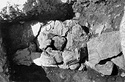
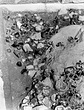
| Susan I. Rotroff ... Burial 3 beneath the floor of the Stoa Basileios. It consisted of a rectangular pit cut into bedrock to a depth of 0.44m, lined on all sides and covered with an admixture of narrow stone slabs of soft ... Final Mycenaean/Submycenaean ... I 5:3 ... I 5:3 |
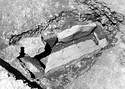
| Susan I. Rotroff ... Grave 4 under Royal Stoa. Cist Grave cut into bedrock and lined with limestone and schist slabs. There were two layers of cover slabs with a layer of dirt between. Grave measured 0.98x0,25-0,32x0,25-0,30 ... Final Mycenaean/Submycenaean ... I/5,6-5/1,2 |
| Susan I. Rotroff ... Grave 2. Adult female inhumation. Grave extending under the south retaining wall of the Temenos of the Royal Stoa. It is oriented ne-sw, with head at sw. Grave built of slabs of schist, with packing of ... Final Mycenaean/Submycenaean ... I 5:2 ... I 5:2 |
Well near west edge of level area south of the Hephaisteion. Dumped filling thrown in near end of 4th. c. but by far the greater part belonging to the 30 years before 350 B.C.
Diameter of shaft 0.98m ... Ca. 380-350 B.C ... B 12:5 ... B 12:5 |
| Rodney S. Young ... Grave 5 in notebook.
The grave had been somewhat disturbed by the digging of Well B. The hydria lay on its side; in it was found the skeleton of a small child lying on its side with the knees drawn up ... Late 8th-early 7th c. B.C ... G 12:5 ... G 12:5 |
Drain channel system along the line of an ancient north-south road, the channel in part at the surface and in part tunneled and accessible by shafts. Over a considerable part of this channel the hard water ... 2nd-early 3rd c. A.D ... E 5:4 ... E 5:4 |
Essentially uniform fill of III-IV c. A.D. with a Byzantine upper fill. Coins:
14 June 1937 #1-#3
15 June 1937 #2
16 June 1937 #1
17 June 1937 #1-#2
18 June 1937 #1-#4
19 June 1937 #1-#4
9 June 1938 #1-#3 ... Late 3rd-mid-4th c. A.D ... Coins:
14 June 1937 #1-#3
15 June 1937 #2
16 June 1937 #1
17 June 1937 #1-#2
18 June 1937 #1-#4
19 June 1937 #1-#4
9 June 1938 #1-#3
10 June 1938 #1
13 June 1938 #1
15 June 1938 #1-#4
5 July 1938 #1-#3 (dump) |
Cistern System #1e: Shaft at 11/ΞΑ.
Agora XXIX: "Well (not cistern shaft, as in Agora XII) ... Communicates with water system through small hole (see C 8:1) probably fortuitously. Single fill, mostly of ... 350-300 B.C ... Coins:
4 March 1936 #10-#11
5 March 1936 #2-#3
16 March 1936 #1-#1a |
| Pit in Layer 9, lined on the sides and bottom with small stones ... Late 5th c. B.C ... K/3-5/15,5/16 |
Actually 1 meter into section Δ, the well lies under a filling of primarily Hellenistic date which had been thrown in as underpinning for the support of a 2nd c. A.D. Roman tile-mosaic floor.
POU is 15.80-16.35m ... First half of 1st c. A.D ... Coins:
19 March 1934 #8
20 March 1934 #1-#3
21 March 1934 #3-#5
23 March 1934 #1-#3, #6-#8
30 March 1934 #39 |
Evidence of stratification into five layers, although joins between the layers. Layer VI added when the construction of the Roman building above required it. No subdivisions assigned.
Flask-shaped cistern ... Early 3rd-late 2nd c. B.C ... F 5:1 ... F 5:1 |
Patch of burned filling at 66-67/ΚΘ-Λ (or Λ-ΛΑ) Coin
18 May 1938 #10 P 34428 added from Lot Ω 102 ... Early 5 c. B.C. (?) ... O 20:5 ... O 20:5 |
Burial disturbed. Located in Middle Stoa, north aisle, "upper trench", piers 3 and 4. Two individuals: small child (ca. 5 yrs. old) and adult female.
In its disturbed state the burial was found (at elevation ... First half of 7th c. B.C ... I 13:5 ... I 13:5 |
| Pyre 2 in Central House, Room X, under strosis 9. Signs of burning, carbonized food, animal bone.
In room south of courtyard. concentration of artifacts, bone, and charred material in floor makeup, no ... 290-275 B.C ... Coins:
5 May 1958 #1 (above pyre) |
| Dorothy Burr Thompson ... Grave 4 in notebook. (E.L. Smithson: Grave XLIV). No remains (not really a grave, note on p. 331).
Roughly rectangular patch of unworked fieldstones, measuring about 1.20x0.80m neatly laid on bedrock, ... 19-21 March 1932 ... F 16:5 ... F 16:5 |
A well on the NW slope of the Areopagus; unfinished well-shaft dug to a depth of only 3.05m., and refilled with broken pottery and other debris. The shaft clearly was begun with the intention of digging ... Ca. 520-480 B.C ... F 19:5 ... F 19:5 |
The fill in this cistern is Byzantine with considerable admixture of Greek IV-III c. B.C. Coins:
7 March 1932 #9
9 March 1932 #1
10 March 1932 #1-#2
11 March 1932 #2
12 March 1932 #1 ... 11th-12th c. A.D ... G 5:1 ... G 5:1 |
|
|