|
|
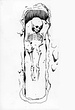
| James H. Oliver ... (E.L. Smithson: Grave IX: PG). Two children's skeletons one on top of the other. Cf. PD 329 for PD 430 for second skeleton, same deposit.
PG grave about 25m. SW of Cistern A at 46/ΜΔ.
[In some records, ... Developed Protogeometric ... The bedrock forming the edges of the tomb pit was stepped in to provide an irregular ledge, running round all four sizes. maximum width of the pit at the bottom was about 0.30m. a partial lining of fieldstones was bedded on the ledges; the uppermost stones were interrupted at the southeast corner by an irregular recessed pocket containing two lekythoi.
Skeletons fully extended, heads to the southeast. |
Deposit of fine table ware and lekythoi, both black-figured and red; the plain wares closely resemble those from the well H 6:5 ... 470-450 B.C ... Deposit of fine table ware and lekythoi, both black-figured and red; the plain wares closely resemble those from the well H 6:5. |
A rubbish pit at the foot of the northwest slope of the Areopagus. Black figured, plain glazed vases and several lamps. A pair of lekythoi recall both in make and in style the products of the Haimon Painter ... Ca. 480-475 B.C ... A pair of lekythoi recall both in make and in style the products of the Haimon Painter (about 480-475 B.C.) |
West Terrace, South End, Layers IV and V. Heavy dumped filling associated with terrace walls at the extreme south end of the excavations in the Areopagus industrial area. The proportion of figured and ... Ca. 420-390 B.C ... The proportion of figured and good glazed fragments is unusually high, including cups, squat lekythoi and other vases in greater part of the last two decades of the 5th. c. but with some material that goes back into the first quarter of the 5th. c. and a little that continues into the early years of the 4th. |
|
|