|
|
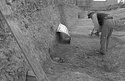
Enchytrismos burial of an infant at the E. corner of Byzantine Room G.
The burial was in brown fill flecked with charcoal and containing brown-glazed pottery (Lot ΒΗ 472). The pot was embedded upside ... Byzantine 10th/11th c. A.D ... Enchytrismos burial of an infant at the E. corner of Byzantine Room G.
The burial was in brown fill flecked with charcoal and containing brown-glazed pottery (Lot ΒΗ 472). The pot was embedded upside down in the corner formed by Walls 15 and 16. |
| Rodney S. Young ... Disturbed burial (no remains), probably an infant pot inhumation.
Inhumation grave 17 in notebook. (E.L. Smithson: Grave XIX: PG).
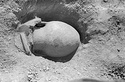
Shallow oval cutting containing a banded amphora on its side, mouth ... LPG ... Disturbed burial (no remains), probably an infant pot inhumation.
Inhumation grave 17 in notebook. (E.L. ... JP
Young: "It is possible that a baby whose bones have completely disappeared was placed in the larger coarse amphora, and that the other amphora was a Beigabe (offering)" The fact that no precedent exists in Athens at this time for a full-sized amphora as an offering in an infant or child grave renders such a suggestion unlikely.
|
| Eugene Vanderpool ... Grave (E.L. Smithson: Grave XXXVIII: PG)
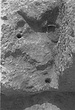
Shallow oval cutting in natural bedrock lintel of Mycenaean chamber tomb O 7:5, containing a large two-handled cooking pot. Within, the unburned bones of a foetal ... Developed-Later Protogeometric ... Smithson: Grave XXXVIII: PG)
Shallow oval cutting in natural bedrock lintel of Mycenaean chamber tomb O 7:5, containing a large two-handled cooking pot. Within, the unburned bones of a foetal six-months infant. The upper part of the cutting and one side of the jar sheared away in Classical times |
| Rodney S. Young ... Grave 9 (E.L. Smithson: Grave XVIII: PG). Bones discarded.
JP
Roughly circular pit, about 0.59m in diameter, cut into soft bedrock to a depth of 0.42m. Tomb encountered only about 0.12-0.15m below the ... Protogeometric |
|
|