|
|
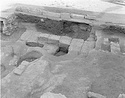
Cut down through the west back foundation of the Royal Stoa immediately to the east of the 'Cave' ... Byzantine ... Cut down through the west back foundation of the Royal Stoa immediately to the east of the 'Cave'. |
| Well South of Soft Yellow Poros Foundation. Dumped filling of a collapsed well, that, due to hazardous conditions, could not be cleared below- 2.50m. The well was partly cut on the east side by a Byzantine ... Protogeometric-Early Geometric II, ca. 850 B.C ... Well South of Soft Yellow Poros Foundation. Dumped filling of a collapsed well, that, due to hazardous conditions, could not be cleared below- 2.50m. The well was partly cut on the east side by a Byzantine storage pithos, and on the south side it was disturbed by another, tile-lined, well of the Roman period (U 19:4), which had been used for water and then as a cesspool inn the early 20th century.
|
Mycenaean Tomb to E of Stoa Shop 19 (ΣΑ 2).
Found while digging just east of Stoa Shop XIX, when came upon some bones, Mycenaean sherds and a pot. As the excavation was enlarged the legs of two skeletons ... Myc. III A:2 (2nd half of 14th c.) ... Found while digging just east of Stoa Shop XIX, when came upon some bones, Mycenaean sherds and a pot. ... The floor of the tomb was level with the seventh foundation course of the Stoa, and there was no great depth of bedrock fill above the bones, barely 0.20 to 0.30m before the Classical level. No sure limit to the tomb cold be fixed in any direction, although tunneling to the east the following year was done to a maximum penetration of 1.80m east of the Stoa Foundations. |
| RSY Grave 51.
The grave lay on the slope of the Areopagus in Roman house O, just east of the line where the hillside is scarped for the foundation of the west wall of the house.
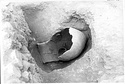
Cutting:the pit cut in ... Archaic period/6th or 7th c ... The grave lay on the slope of the Areopagus in Roman house O, just east of the line where the hillside is scarped for the foundation of the west wall of the house.
Cutting:the pit cut in bedrock into which the burial was set measured 0.95m from north to south and 0.55m from east to west. Its depth was 0.65m. The burial urn, a pithos, was laid in the pit on its side, the mouth toward the south. A foundation wall of the Roman house passed close to the mouth of the pithos, for which we found no cover; one may have been removed when the foundation was laid. |
|
|