|
|
Rodney S. Young ... (E.L. Smithson: Grave XXXVI:PG). Early fill over bedrock. No remains.
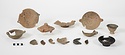
Two fragmentary unburned vases were found together on bedrock, beneath Roman and Byzantine fill. Disturbed earth over bedrock for several ... Early Protogeometric ... Smithson: Grave XXXVI:PG). Early fill over bedrock. No remains.
Two fragmentary unburned vases were found together on bedrock, beneath Roman and Byzantine fill. ... The excavator noted "cinders" among the Early Iron Age pottery in the fill in the immediate vicinity, which may further support the existence in the area of early tombs. |
Pit (Well?) under Building A, Room 2. Coins:
9 May 1949 #1-#2
11 May 1949 #4
12 May 1949 #3 (not a coin, bronze fragment in lotted metal tins ΠΠ 295). Estimated Grid
Remains of coloring matter found with ... Hellenistic-Early Roman |
| Mycenaean Small Chamber tomb.
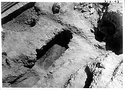
The cist measures 1,90m E to W, 0.75-0.90m N to S, max. depth -1.30m. Nothing was found in it; cleaned in modern times and used as a cesspool. Some of the SW part of it had ... Myc. IIIA, early 14th c. |
| Marcie Handler ... The pyre was revealed under a layer of mixed fill with pottery dating from the 3rd century B.C. to the 1st century A.D. Five pots were immediately visible (BZ 1318-1321, 1333) in a shallow pit surrounded ... 23 June-4 July 2006 ... The original floor surface above the pyre must have been disturbed some time in the early Roman period, and no floor surface was found between this pyre and the remains of pyre J 2:24, which was found lower down and slightly to the east. |
|
|