|
|
Burned filling over area of NW Temple (apparently Herulian destruction debris) = Trench I, 18-22/ΛΑ-ΜΣΤ and northwest trench, center at 15-19/ΛΣΤ-Μ Coins:
28 March 1933 #25-#28
29 March 1933 #16-#21
30 ... 28-30 March 1933
5-6 April 1933 ... Burned filling over area of NW Temple (apparently Herulian destruction debris) = Trench I, 18-22/ΛΑ-ΜΣΤ and northwest trench, center at 15-19/ΛΣΤ-Μ ... T 422-T 423, L 873-L 874, L 876, SS 1180-SS 1184, SS 1195-SS 1197, P 1849 are not identified as coming from the 'burned area' but generally match the grid coordinates. |
| Pyre in House D, Room 4 (RSY=Pyre 4) in the industrial area west of the Areopagus.
Notebook refers to House N.
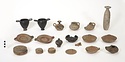
Pottery belongs late in third quarter of the 4th. c. BC. Pyre burned near beginning of last ... 350-300 B.C ... Pyre in House D, Room 4 (RSY=Pyre 4) in the industrial area west of the Areopagus.
... BC. Pyre burned near beginning of last quarter.
... Organic material: "a few fragments of burned bones" (missing). |
RSY Grave A.
Under the Roman House with three rooms floored with mosaic near the southwest side of the area. The burial consisted of a pot laid on its side over the bedrock, presumably containing a child ... 7 August 1947 ... Under the Roman House with three rooms floored with mosaic near the southwest side of the area. The burial consisted of a pot laid on its side over the bedrock, presumably containing a child. ... They were not burned. The grave had been disturbed in early times by the building of a wall (6th or 5th century B.C.) which in part overlay it; only the part of the pot immediately over the stereo was preserved. it was an amphora with banded body and conventional ornaments on the reserved neck, probably late 8th century. |
| Rodney S. Young ... Destroyed urn cremation. No remains. Originally assigned as part of Tomb C 9:14 (Grave 7)
JP
"Large fragments of an urn were found in the packing of a Hellenistic water channel which cut through a LPG ... Final Mycenaean/Submycenaean ... Originally assigned as part of Tomb C 9:14 (Grave 7)
JP
"Large fragments of an urn were found in the packing of a Hellenistic water channel which cut through a LPG burial area and obliterated the urn and urn-hole of LPG grave C 9:14." ... P 6723, although surely an urn, rust-stained inside from the iron jewelry and within a meter of Grave C 9:14, is much earlier than the offerings in that grave and must have come from still another burial trench in the line of the water channel; a narrow burned strip along the edge of the channel opposite the fragments may be part of that trench.
|
|
|