|
|
A drain pit with red gravely fill. Coins:
5 April 1939 #1-#8
Pottery continuing to at least 3rd c. A.D. ADDENDA: See also tins Lot ΝΝ 70, ΝΝ 71.
ADDENDA: P 14822 probably also belongs ... Mixed Hellenistic to Roman ... A 18:7 ... A 18:7 |
| Filling in eastern channel at W. end of casting pit A 16:1. Early Roman (1st c. A.D.) but with some later disturbances (3rd. and 4th. c. A.D. and Byz.). P 25747 (VG thinks strayed from A 16:1)
Estimated ... 1st. c. A.D ... A 16:2 ... A 16:2 |
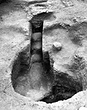
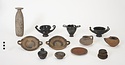
| Debris filling in a bronze casting pit and workshop, characterized by mold fragments but including also a few plain vases and fragments of wine jars. Third quarter of 4th. c. BC.
The pit was cut into the ... Ca. 350-325 B.C ... Debris filling in a bronze casting pit and workshop, characterized by mold fragments but including also a few plain vases and fragments of wine jars. ... The pit was cut into the soft bedrock to a depth of -1.43m and is 1.70m wide at its broadest extremity. The ground plan is that of a slightly lop-sided keyhole. |
| (RSY=Pyre 2). Pyre in the industrial area west of the Areopagus, in House B. In northern corner of room. No pit discerned. A deposit of small stones (a marker/) lay 0.30m above the level of the pyre, ... Third quarter of the 4th. century ... No pit discerned. A deposit of small stones (a marker/) lay 0.30m above the level of the pyre, in turn covered by a 4th c. fill. ... Concentration of artifacts, a little bone, charred wood, cinders, and a "large sea shell" in stratum. |
|
|