|
|
Foundry pit and shop.
Now Deposit E 2:3. Asterisk: F 2:1* |
A circular cutting in bedrock ... Late 6th-early 5th c. B.C. |
Pithos in NW corner (room) of Poros Building. Marble chips ... Mid-4th c.? |
Shallow pit in bedrock. NB fragment found in gravel to south of pit (ΟΟ 399=P18633) ... Second quarter 5th c. B.C. |
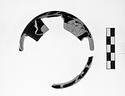
| Two fragments, both mended, both from the top and shoulder. The start of a handle remains at the back of the larger fragment.
A high-type askos with a reserved band just below the shoulder. On one side ... 21 March-16 April 1935 |
Rectangular shaft neighboring the well D 17:12. Dug only to a depth of 4.40m. and provided with two galleries or channels extending from it. Apparently never intended as a well. Refilled with the dug bedrock ... 4th c. B.C. |
Same filling as Theseion Street Deposit D 7:2 but separate list.
Perhaps also P 7904. Area disturbed by Turkish (50-56/ΜΓ-ΜΣΤ).
This is 3-4 m. west of Hephaisteion, and the hole was probably filled at ... Ca. 500-470 B.C. |
Pit in deep depression in bedrock. Also includes containers from early fill under late Roman floors down to bedrock at 81-83/ΚΗ-ΛΒ. Notebook cites early fill, ca. 6th. c., with some obviously late disturbance ... 7th c. to ca. 575 B.C. |
Well under Poros Building Drain at 62/ΛΣΤ, west of the Areopagus. Digging abandoned at 6.10m due to a collapse of the soft bedrock at the west. Small amount of supplementary filling was added in the upper ... Ca. 520-480 B.C. |
Well in the industrial area west of the Areopagus.
A flask-shaped cistern in House H with a dumped fill of the late fifth century brought from elsewhere and evidently deposited sometime in the 3rd c. B.C ... Ca. 420-400 B.C. |
Unfinished well, south of the annex to the Poros Building, west of the Areopagus. The shaft was apparently never used as a well. The lower dumped filling contained a quantity of clean red clay, as if from ... Ca. 350-325 B.C. |
Upper fill was early Roman dated by AWP to the 1st c. A transitional fill was later assigned to the upper level.
Nbp. 2913: The history may have been that the well was cleaned out at the time that it was ... 3rd-2nd century B.C and Roman date. |
Within the precinct of the Hephaisteion, about 10m. north of the north stylobate of the temple.
Flask-shaped pit (W. (bottom) 3.14 x 2.73m) probably originally intended as a cistern; used for dumping ... Ca. 375-310 B.C.-Byzantine |
Various layers and dates, primarily from Tholos Tr. L (area of early road drain), Q (area of road) and V (area of road).
Also Room G of Trench V listed with G-H 11-12 probably has road layers (no finds, ... 8th c.-ca. 480 B.C. |
Fillings associated with Southwest and North Buildings (78-99/ΙΣΤ-ΚΘ) and early walls to west of Great Drain.
pottery p. 1189, vol VII ... Subdivisions:
.1=Filling over bedrock.
.2=Fillings behind retaining ... Various levels and dates |
Packing under cobblestones 7 or 8 meters west of the Temple of Hephaistos. A similar filling found in a small hole in bedrock three or four meters north of the Temple. The high quality of the pottery from ... Ca. 500-440 B.C. |
"Foundry Pit": N-S Cut on 50m. line (area of Stoa, Layer VII, with slag). A foundry pit in the courtyard of a small metalworking establishment outside the Agora to the northwest.
Both the courtyard and ... Ca. 375-350 B.C. |
Cistern connected by tunnel to another chamber filled in Byzantine period. Small Hellenistic deposit on floor. somewhat contaminated by Byzantine fill above
No stamped amphora handles later than 3rd c.; ... 250-190 B.C. |
Cistern System #3: West Chamber at 69/ΛΣΤ, joined by a crooked passage to 69/Λ. Under the southwest corner of the Hellenistic Building to the north of the Temple of Hephaistos. Upper fill of early 1st ... 175-125 B.C. |
Carefully cut in bedrock with firm footholds on either side. The use filling is represented by a few fragments of water jars (uninventoried), indicating a short period of use. The dumped filling, below ... Ca. 470-425 B.C. |
|
|