|
|
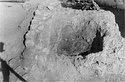
Rectangular pit (in Trench IX); dumped filling of late 5th. c. B.C. with some disturbance as late as Early Roman. P 18559 and P 18510 from above this pit ... 5th c. B.C. |
Pocket of pottery to south of grave at 36/ΛΔ; uncertain context. Terracotta figurines resembling those from the Coroplast's Dump (S 19:3) No containers (cf. O 18:2).
T 2468, T 2476, ST 412 from Hellenistic ... 350-320 B.C. |
Patch of early fill, disturbed. 20/9/1962: Tin 145 is checked and is chiefly late archaic, but some of the coarse ware is late 5th with 4th c. B.C., and a few bits are 4th c. A.D ... Late 6th.-early 5th c. B.C. |
| Pit with traces of burning ... Probably 3rd qtr. 5th c. B.C. |
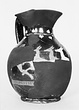
| Mended from many pieces; much missing from rim, walls and base. Restored in plaster. Round-bodied oinochoe on broad flat ring foot; trefoil lip; handle triangular in section. Thin glaze inside and under ... 17 March 1936 |
Pit with marble chips (disturbed); working chips of the Hephaisteion construction. A few vases apparently contemporary with the building of the temple ... 5th c. B.C. to ca. 450 but disturbed. |
Perhaps originally a grave cutting ... Ca. 390-380 B.C. |
| Artifacts, burnt bone, ash, cinders and charcoal in pit in bedrock. The pyre lay directly under mosaic floor A. the deposit is not badly disturbed, however, and it is possible that it was laid immediately ... Early second quarter of 4th c. B.C. |
Debris filling in a pit cut in bedrock at W side of House H, Room 10 ... Ca. 425-400 B.C. |
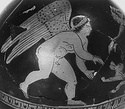
| Small oinochoe, shape III. The upper part preserved, lacking the handle and the back of the lip, mended from several pieces. Eros, right, bending over to catch a ball thrown him by a female figure (head ... 26 September 1947 |
Cistern System #1e: Shaft at 11/ΞΑ.
Agora XXIX: "Well (not cistern shaft, as in Agora XII) ... Communicates with water system through small hole (see C 8:1) probably fortuitously. Single fill, mostly of ... 350-300 B.C. |
Tiled Well in Square Building Foundations, equipped with evenly spaced hand-holds, with a good supply of water. There was no period of use represented and the dumped fill consisted mostly of chunks of ... Third quarter of 4th c. B.C. |
Cistern System #1f: Shaft at 1/ΝΘ = Well A. Scanty dumped filling. Coins:
19 February 1936 #2-#3
20 February 1936 #16-#20
21 February 1936 #5-#7
22 February 1936 #1 ... Mid-4th to 3rd c. B.C. |
Construction filling of the Poros Building west of the Areopagus. Patch of stony fill beneath the courtyard. Accumulation of the second quarter of the 5th c., deposited in the last quarter ... Ca. 475-450 B.C. and later |
Well (diameter 0.91m, water level -7m) in House H, Room 10 (and pit over). Plain shaft cut in stereo; pit at mouth of well,reused as drainage pit at start of tile drain running west.
Scanty use filling ... Ca. 425-400 B.C. |
Well, neatly stone-curbed to bottom. Diameter 0.70m. The use filling, from about 3.50m to bottom, consisted chiefly of water-jars with a few small vases and some black-figured fragments.
Upper filling, ... Use filling of ca. 575-550 B.C. |
Well, unfinished?
The shallow depth, small diameter, lack of water and any use fill make it possible that this was not a well, although the character of the cutting is difficult to explain otherwise. The ... Ca. 440-420 B.C. |
Well at 75/ΚΖ (75/ΚΗ, 76/ΚΣΤ-ΚΖ). A dumped filling; an accumulation for the most part of the late 6th and early 5th centuries.
Tiled well; of the lining only a single set of tiles, of unusual make, remained ... Ca. 450-425 B.C. |
| North of House G (RSY=Pyre 13).
Concentration of artifacts, small pieces of bone, and burnt material in stratum, no pit discerned. The pyre is cut by the trench of a wall of a Roman house to north. It ... 290-250 B.C. |
Well (diameter 0.98m) in House H, Room 13.
Two dumped fills apparently of the same date, but separated by a clay deposit of over 2.00m.
Cf. Hesperia 20 (1951), p. 253. (noted) Subdivisions:
.1=Upper ... Ca. 425-400 B.C. |
|
|