|
|
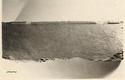
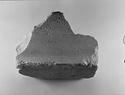
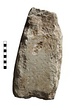
| Fragment of raking sima, broken away at lower end. Only the curved upper part remains. Face heavily water-worn.
Of same scheme as A 1095 (ΚΚ 1250) and A 1096 (ΚΚ 1251).
Pentelic marble.
ADDENDA Line of ... 8 June 1939 |
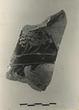
| Fragment of raking sima, broken away toward upper end and close behind.
On lower end, traces of a half-housing joint. Profile and decoration as of A 1094 (ΚΚ 1249).
Curious undercutting on underside of ... 8 June 1939 |
| Preserved: most of helmet, forehead, eye and part of hair of Athena.
Probably by the same artist who decorated the Panathenaic of Ariarathes V (163-130 B.C.) in the National Museum (ArchEph (1948-1949), ... (1956) |
| Fragment of lower part of relief zone and of lower body. Relief decoration: vine tendrils.
Rather gritty buff clay, fired gray at core; dull brownish-red wash. Cistern system 2, west chamber; pre-Herulian ... 1955 |
| A: palmette, border of dots.
B: plain. Black filling. Leica ... 19 February 1936 |
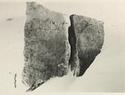
| Inscribed fragment.
Inscribed face only preserved.
Three lines of the inscription preserved; stoichedon.
Space between lines, two including: 0.031m.
Space between letters, two including: 0.022m.
Pentelic ... 5th. century B.C. |
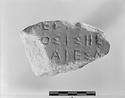
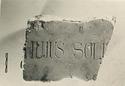
| Latin inscription.
Elizabeth Cumming's Epitaph.
Fragment ΟΕ 10 a), broken behind and on all sides.
Lettered surface smooth but undulating.
Letters lightly cut.
Three lines of the inscription preserved ... a) (ΟΕ 10) 27 January 1934
b) (ΚΚ 1262) 18 July 1939 |
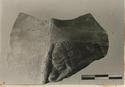
| Fragment of raking sima, broken away at upper ends, and back.
Of same scheme as A 1095 (ΚΚ 1250). Traces of half-housing joint at lower end.
Similar undercutting on underside of lower end.
Pentelic marble ... 8 June 1939 |
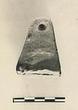
| Broad pyramid, truncated.
Unglazed.
Made of fine pinkish buff clay, with carefully smoothed surface. Marble chips pit. Leica, XX-86 ... 1936-1937 |
| Truncated pyramid.
Smoothed surface. A streak of glaze, worn, over the top and down the two unpierced faces.
Fine pinkish buff clay. Marble chips pit. Leica, XX-86 ... 1936-1937 |
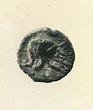
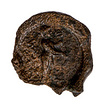
| Obverse: two winged snakes, right.
Probably the serpent drawn car of Triptolemos or Demeter.
Reverse: illegible. Originally entered as coin no. 4. Layer III. Leica ... 30 April 1936 |
| A single fragment preserves the front part of the lamp.
Low raised base; shallow rounded wall and down sloping rim.
Good black glaze considerably chipped; base unglazed.
Type IV of Corinth collection, ... 1936-1937 |
| Foot in two degrees, the lower part glazed.
Lightly scratched on the underside: Marble chips pit. Box 238. Leica, XX-84 PD 1133-17(F 72) ... 1936-1937 |
| The base and part of the lower wall preserved. Substantial disk foot, slightly concave beneath; the outer edge rounded.
Inscribed on underside:
Black glaze, worn, on walls and outer edge of foot; underside ... 1936-1937 |
| Inscribed fragment.
Front face and part of bottom are only remaining original surfaces.
Bottom finished with rough anathyrosis.
Seven lines of the inscription preserved.
Pentelic marble. Finished Found ... 2 August 1947 |
| Chip missing bottom left.
A: Hermes standing nude, bearded, right, with caduceus held out in front.
In field upper left, the letter sigma (Σ).
B: plain. Entered as coin no. 8, for the day. Late fill. Leica ... 20 March 1936 |
| Inscribed fragments.
Inscribed in Latin.
Gott's Epitaph.
Fragment Β 31 a), broken on all sides.
Five and a half letterσ preserved.
Fragment ΚΚ 1190a (b), originally inventoried as I 1257 b, but I 1257 ... a) (Β 31) 2 November 1933
b) (ΚΚ 1190a) 9 March 1939 |
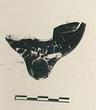
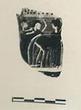
| Part of wall of chimney lekythos; chariot with three personages. White band above with double row of dots; white ground line; white for flesh, and for legs and tail of one horse. Marble chips pit. Box ... 1936-1937 |
| Inscribed fragment.
Lettered face and top preserved.
A moulding broken away from top of face.
Twelve lines of the inscription preserved; stoichedon; vacat between sixth and seventh line.
Space between ... 307/6 B.C. |
| The block is re-used and served originally perhaps as the plinth for a monument.
Its uninscribed face was scooped out in antiquity, apparently to lighten the stone. At either end of the left long edge ... 18 June 1939 |
|
|