|
|
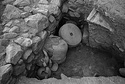
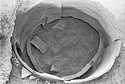
Original bottom of pithos was damaged (probably by ground water) and a second, higher bottom consisting of squarish terracotta tiles laid. Fill above second, higher floor was unusually rich in pottery ... Byzantine |
Room 8, Pit 1 in Layer 2. Notebook ΒΕ XII is missing ... 11th c. A.D. |
Well in Byzantine Room 9. Excavation of the well terminated at 49.00m. due to cave-in danger. Topped by a stone sill and marble putael, the upper part of well is of Byzantine-period stone masonry; lower ... Byzantine |
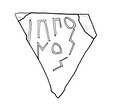
| Layer of crushed bedrock with ostraka, behind Classical Building ... 17 June-17 July 1996
28 July 1997 |
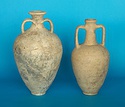
| James Artz Pirisino Daniele Kylindreas Miltiades ... Excavation in Room 3 of ΒΘ West revealed 5 ceramic vessels in a row against the eastern face of Wall 12. 3 complete vessels (ΒΘ 122, 124, and 125) were catalogued, along with the base of a plain glazed ... 9th-11th c. A.D. |
Found while cleaning wall running east-west over 57. Contained late glazed pottery ... Byzantine |
Enchytrismos burial of an infant at the E. corner of Byzantine Room G.
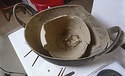
The burial was in brown fill flecked with charcoal and containing brown-glazed pottery (Lot ΒΗ 472). The pot was embedded upside ... Byzantine 10th/11th c. A.D. |
| Anne McCabe ... Enchytrismos burial of an infant in Byzantine Room C, L/15-2/13, at 52.915m. Although disturbed by roots, the skeleton (AA 373) was articulated and lay parallel to Wall 1, with head at the NW and feet ... 14-15 June 2007 |
Anne McCabe ... Pithos D, adjacent to Pithos A at the NE, is built of stone and broken tile, beehive-shaped, unlined, with no floor. The wall of Pithos D appears to have been cut by the construction of the mortar wall ... 4-6 July 2007
31 July 2007 |
Michael Laughy ... Debris pit, located in Room 2 of ΒΘ East. Pit measures ca. 2.30 by 1.70m., and nearly a meter deep. The pottery from the pit dates ca. 10th-12th c. A.D. The fill of the pit consisted of soft, black charcoal ... 10th-12th c. A.D. |
| Deposit of terracottas, molds and pottery in a shallow pit sloping downward from north to south. This deposit was located beneath a layer of fill under a Late Roman plaster floor (Lots ΒΕ 2093-2095). The ... 1st c. A.D. |
| Marcie Handler ... Continued from 2000 season, 10-12 July 2000; BZ XXIII p. 4472.
The hoard was originally excavated during the 2000 season (Lot BZ 1049, 5th-6th centuries AD), from a higher elevation through a gap in the ... 10-12 July 2000
21-22 July 2003 |
| Marcie Handler ... A deposit of six amphorae and one micaceous water jar was excavated between 20 June and 6 July 2005 in the area north of Wall K. The neck and one handle of one of the amphorae (BZ 1213) had been poking ... Ca. 1st c. A.D. |
| In NE corner of Room D. In a Byzantine vessel=P 34464.
The position of the vessel in the corner of the room suggests that the burial was made after the construction of Byzantine Walls G and E. This type ... 10th-11th c. A.D. |
| Terracotta deposit in SW corner of Room K and E of Roman Wall L. Roman layer of red, compact earth.
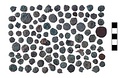
Baskets 50,52,54. Coins:
18 July 2002 #1282
19 July 2003 #1295 ... 4th c. A.D. |
| Marcie Handler ... The remnants of a disturbed pyre in a layer of dumped Hellenistic fill. The fill was found in the area on top of and east of the eastern wall of the Classical Commercial Building at its north end. Fragmentary ... Ca. 225 B.C. |
| Marcie Handler ... The contents of this Hellenistic cistern shaft were excavated in a series of layers: the preserved top of the shaft, six layers in the shaft and the fill within the tunnel. At the bottom of the shaft on ... POU: Mid-3rd c. BC
Dumped fill: after 225 BC |
Trench at O/7,8-6/1,5. Layer 5 of Trench A cut in Rooms 1 and 2 of Greek House γ. Soft green clay with bones, ash, much pottery. Probably leveling fill ... Archaic |
| A tile lined well under Room I of Byzantine House.
A concrete shaft belonging to the mill cut off the top of the well and left in place 3 complete sets of tiles and most of a fourth set. All but the lowest ... 17-18 c. A.D. |
|
|