|
|
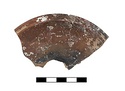
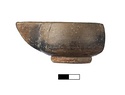
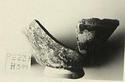
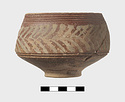
| Two joining fragments preserve one fourth of rim, wall and foot. Center of floor missing. Low ring foot. Convex wall with groove at base. Broad rim, concave on top.
Fine clay, slightly shiny gloss, ... 4 July 1997 |
| Part from neck of amphora.
Micaceous reddish-buff clay.
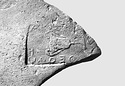
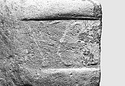
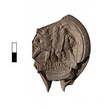
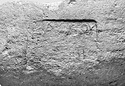
Impression incomplete above, broken away to right. Finished In this region the Byzantine sherds went almost to the bottom; overlying bedrock were ... 1 May 1933 |
| Much worn fragment, of very broad, arched handle.
Coarse micaceous clay, red with yellowish surface.
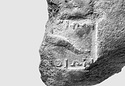
Badly worn impression, its right edge broken away. Finished In continuation of trench with sand. Θ̣α̣σ̣[ί]ων ... 26 June 1933 |
| Preserved are upper right corner (BE 103) and joining section to lower left (BE 61). Broken diagonally above, at left side, and below.
Votive relief with simple fillet and ovolo molding above. Narrow frame ... Late 5th c. B.C. (410-400 B.C. ?). |
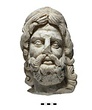
| Male statue head broken at neck. Chipped nose otherwise in very good condition. Small patch of red pigment on moustache.
Bearded figure with elongated head slightly tilted to the left. Prominent facial ... 31 July 2002 |
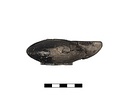
| Two non-joining fragments.
Fragment a), preserving most of discus of lamp, showing two gladiators facing left and one facing right. Beneath them a latin inscription in two lines:
"SABINVS
POPILLIVS" ... 25-28 July 1995 |
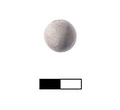
| Intact.
Almost perfectly spherical ball.
Pale yellow clay. Inventoried 30 July 2002. Finished Pyre. Lot 2042bis. 6099 ... 15 June 1995 |
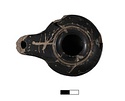
| Mended from numerous fragments. Almost complete except for heavy spalling at resting surface and on body around the nozzle. The lug is chipped away. Glaze very worn.
Type 29A (Howland) lamp with pierced ... 3 August 2006 |
| Almost complete, end of nozzle missing and gaps in the bowl, base chipped. Mended from many sherds. Glaze worn under the nozzle.
Raised base with groove at junction with base and second one just below ... middle of the second quarter of the 4th c. B.C. down into first quarter of the 3rd c. B.C. |
| Mended from five fragments, part of one side missing.
Raised base concave underside with small raised disc in center, interior bottom raises to cone. Nearly vertical wall with slight outward bulge, sharp ... 25 June 2009 |
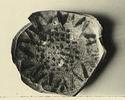
| Almost the complete circuit of the rim is missing. Low foot, flat bottom; bulging, neary spherical sides; slightly flaring mouth; single vertical strap handle. Enclosed in a double circle with cross bars, ... 31 May 1933 |
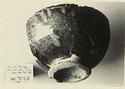
| All of the original rim has been broken away; only the spring of the gently upcurving sides is preserved. Ring base; shallow, flaring sides. Blue and brown conventional decoration on a green ground. In ... 31 May 1933 |
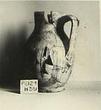
| Mended from many fragments and many bits missing from lip, neck and sides. Trefoil lip; flat bottom; gently swelling sides; single vertical strap handle. In an oval double frame on the central part of ... 1 June 1933 |
| Two-thirds of the rim gone. Mended from three pieces. High ring base; sides curve steeply upward.
Pinkish-buff clay with bits; bright green glaze on the exterior, except for the base which is reserved ... 1 June 1933 |
| Most of the rim and much of the sides are gone. Mended from three pieces. The sides flare out almost horizontally from the high ring base, to turn almost immediately upwards in a flaring line.
Buff clay; ... 1 June 1933 |
| Msc: no par?(VG)* Finished Byzantine filling. [Θ]α̣σίων
horn
[Πυ]θίων Leica ... 7 April 1936 |
| Device(?). Finished Early Byzantine context. Κάδμ̣ου
[device]
[---] Leica ... 27 April 1936 |
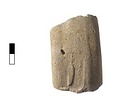
| Section of stamped amphora handle, broken at both ends. Stamp is fully preserved. Stained green in places.
Four(?) letters along one side of stamp; beside them, tall rimmed jar with five leaves or branches ... 9 July 2003 |
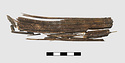
| Broken at edges, fibers splitting.
At least five reeds, closely set in a rows; probable mat.
Species: arundo donax (identified by A. Sarpaki).
Dark brown coloration. Sample of surrounding soil was ... First quarter of the 5th century B.C. |
| Mended from seven fragments. Whole of base with most of lower wall and about one-third of upper wall. Full profile preserved. Glaze worn. Three non-joining rim fragments (b, c, d) and a wall fragment (e) ... 4th-5th c. A.D. |
|
|