|
|
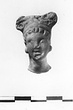
| Intact but somewhat chipped.
Head of a girl with hair done in a bow on top of head.
Prominent round earrings.
Traces of red on hair.
Pale yellow clay. From dump from South Stoa II. Context of 1st.-2nd ... 3 August 1960 |
| Part of one edge preserved.
Uncertain representation: extended arm with drapery behind (?).
Clay buff with coarse pink particles.
ADDENDA: Animal combat. Surface. Leica ... 7 April 1938 |
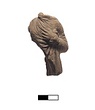
| Girl, "Tanagra" type, wrapped tightly in her himation that she pulls tight to a "chou" fold with her left hand against her breast.
Delicate modelling.
Buff clay. Catalogued 23 July 1966. Container B 236 ... |
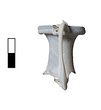
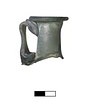
| Rather broad handle.
Clay dark buff, highly micaceous. Late fill. Δ (in O) Leica ... 22 March 1938 |
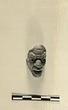
| Back of head broken away.
A bald-headed, round faced fellow, with large ears.
Buff clay. Well, bottom, dump. Lower fill. Leica ... 23 May 1938 |
| Face only preserved.
A thin faced fellow.
Remains of dark red wash.
Light red clay.
Probably a plastic lamp.
Cf. other lamps from this well. Well, bottom, dump. Lower fill. Leica, LXIX-22 ... 23 May 1938 |
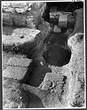
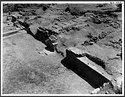
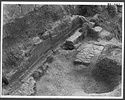
| Southeast corner of the Aiakeion after removal of the Hellenistic fill. Front foundation of the South Stoa II in lower left ... south 3424 Horizontal (normal) ... 29 Jul 1960 |
| West side of the building. Modern masonry supports remains of the aqueduct (marked "XX") ... northeast 3436 Horizontal (normal) ... 29 Jul 1960 |
| Poros Aqueduct at the southwest corner of the "Heliaia" (now identified as the Aiakeion). Foundation for south wall of the "Heliaia" in middle right ... southwest 3447 Horizontal (normal) ... 29 Jul 1960 |
| Late Roman Fortification Wall overlying the foundations of the Propylon. Arrows mark the corners of the Propylon. A) Fragment (I 4720m) from the Bouleutic list of 304/3; B) Dedicatory statue base, I 4850; ... I 4850 and I 4713 were found in section ΘΘ. (SD) east 227 Horizontal (normal) ... 6 Jun 1959 |
It may perhaps be assumed that in the 5th c. the Romans cleaned the well to 25.30m., thus removing 2nd c. and subsequent fill, and then began to reuse the shaft. Coins
20 May 1938 #6
21 May 1938 #1
25 ... POU 1st c. and 5th-6th c. A.D. |
Containers 1-52. Top to 20.00m. = modern fill.
Note a strong presence of W. Asia Minor (non-export-type) closed vessels here - did owner perhaps come from there? [JWH] Coins:
25 May 1938 #1-#2 ... Late Roman 5th-7th c. A.D. |
Containers 53 (transitional)-69. Coins:
20 May 1938 #6
21 May 1938 #1
26 May 1938 #1-#2 ... Early Roman 1st c. A.D. |
Well at 30/ΛΣΤ Coins (none useful)
25 May 1938 #3-#6
26 May 1938 #3-#4 ... Early 3rd cent and of 4th-6th cent. A.D. |
| Apparently intact.
Solid hub. Mixed fill. Store in ziplock polyethylene bag and in area with 40% r.h. or lower.
Wear cotton or latex gloves when handling. Leica ... 8 June 1938 |
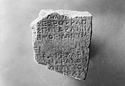
| Fragments of an inscribed stele.
Fragment Λ 59a (a), the left hand is preserved, and on the face the first letter in each of seven lines of the inscription, with traces of a second letter in the first ... Ca. 485 B.C. |
| Inscribed fragments.
List of names; "POLETAI" record.
Fragment Ζ 331 a), inscribed fragment.
Broken on all sides.
Nine lines of the inscription preserved, with a space between the fourth and fifth.
Fragment ... First half of 4th. century B.C. |
| Mouth with pine cone stopper.
The mouth, narrow neck, and most of the handle are preserved.
Handle two-ribbed.
Stuck in the mouth, point downward is a small pine cone, obviously used as a stopper. The ... 20 May 1938 |
| Most of mouth, neck and handle preserved.
Broad flat handle. Well. Lower fill. Container 38. Leica ... 23 May 1938 |
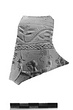
| Fragment from side of a shallow bowl.
Broken all around.
Decoration from top to bottom: 1) Bottom of a row of hooks; four grooves as border. 2) Zone with tree and curved garland. Border of cross hatching ... 31 March 1953 |
|
|