|
|
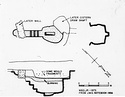
| Section ΠΠ - plan and two sections of Bronze Casting Pit ... W.B. Dinsmoor, Jr ... From ΠΠ notebooks. 87-429 87-429 Dirty Heavy Tracing Paper Drafting Ink ... 1973 |
| Section ΠΠ - plan and two sections of Bronze Casting Pit ... W.B. Dinsmoor, Jr ... From ΠΠ notebooks. 87-429 87-429 ... 1973 |
A well in the industrial area west of the Areopagus, in part beneath one corner of the northwest room of the West Bath. A waterless shaft (diameter 1.05m) refilled with dug bedrock containing no pottery ... Early 6th. c. |
Deposit in the industrial area west of the Areopagus, underlying a Roman bath. Pottery examined in June 1955; latest pieces noted: one fragment Pergamene and one fragment brittle ware; no certainly post-Sullan ... Late 2nd c. B.C. |
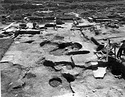
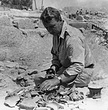
| General view of the area cleared to ancient levels. At center, casting pit (Deposit A 16:1); at right, well at 4/ΜΗ; in background, rooms of the South House ... Cf. "Excavation summary 1948" for miscellaneous name of South House in notebooks. (SD) east 2283 Horizontal (normal) ... 14 Apr 1956 |
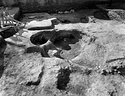
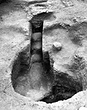
| Near views of casting pit area cleared to ancient levels (Deposit A 16:1); at upper left, well at 4/ΜΗ ... west 2286 Horizontal (normal) ... 14 Apr 1956 |
| Debris filling in a bronze casting pit and workshop, characterized by mold fragments but including also a few plain vases and fragments of wine jars. Third quarter of 4th. c. BC.
The pit was cut into the ... Ca. 350-325 B.C. |
| A well on the lower slope of the Hill of the Nymphs, (diam. 1.20m -water level -7m), to 7.90m. The scanty use filling at the bottom contained water jars and pitchers as well as the inventoried objects; ... Second quarter of 6th. c. B.C. |
| A well in the industrial area of the Areopagus, about 7.00m. west of the West Bath, to a depth of 14.60m. This well was the direct successor to A 17:1, replacing it when it collapsed. The use filling at ... Second quarter 6th. c. |
Nb page 5044: Great shapeless pit with a well (62/Ξ) at its bottom which we were unable to dig because it was too dangerous. Fill in the pit was of sand and white ash. The finds and pottery 4th. and perhaps ... Late 4th.-early 3rd. c. |
Black glazed only ... 4th B.C. |
Semi-glazed ware; bits of bronze; bone; pumice stone; pottery slag; bronze square ... 4th B.C. |
Miscellaneous coarse ... 4th B.C. |
Mould fragments ... 4th B.C. |
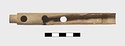
| Cylinder, flanged at one end to fit innermost piece. About two-thirds of the upper side split off; in the remainder two round stop-holes. On the other side another, about half way down the length of the ... 12 July 1947 |
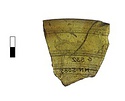
| Rim fragment.
Grooved inside.
Iridescent brown glaze. Molded glass. For context see Hesp. 20 (1951), pp. 279 ff. Excavation Date: (1955). Compartment under hypocaust room of east bath.
Late 2nd c. B.C ... 1955 |
|
|