|
|
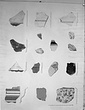
| Fragments of painted wall plaster found north of the Odeion. Watercolor by Marian Welker ... Marian Welker ... PD 758 AMS Horizontal (normal) ... 1949 |
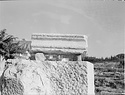
| Moulded plinth course possibly from the Auditorium ... AMS Horizontal (normal) ... ca. 1949 |
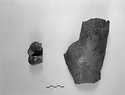
| Two fragments from a bronze statue found in the debris of the Odeion. At left, an ear (B 591); at right, a thigh (B 589) ... AMS Horizontal (normal) ... ca. 1949 |
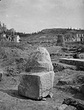
| Corner orthostate block, partly recut, from the wall of the Auditorium ... AMS Horizontal (normal) ... ca. 1949 |
| Corner orthostate block, partly recut, from the wall of the Auditorium. Cf. Hesperia 19 (1950), pl. 36, d ... AMS Horizontal (normal) ... ca. 1949 |
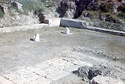
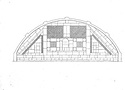
| Restored plan of the marble flooring of the orchestra ... PD 127 AMS Horizontal (normal) ... 1949 |
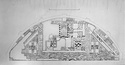
| Watercolor of the actual state of the marble flooring in the orchestra ... Marian Welker ... PD 92 AMS Horizontal (normal) ... 1949 |
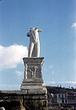
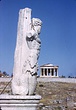
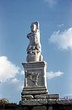
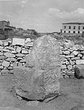
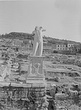
| Giant in easternmost position of the "Gymnasium" series. The Late Roman Complex was identified as a Gymasium because of its scheme and of an inscription found by Pittakis in 1848 alongside the colossal ... AMS southwest Horizontal (normal) ... 1949 |
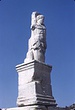
| Giant in easternmost position of the "Gymnasium" series. Front view. The Late Roman Complex was identified as a Gymasium because of its scheme and of an inscription found by Pittakis in 1848 alongside ... AMS south Horizontal (normal) ... 1949 |
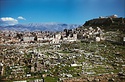
| General view of the Agora from the Hephaisteion, 1949. The Odeion in the center ... southeast Horizontal (normal) ... 1949 |
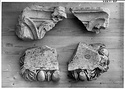
| Fragments of capital from the Odeion, Colossal Figures series.
The scheme of the capital is very similar to the pilaster caps of the Arch of Hadrian in Athens. Its attribution to the Giants is indicated ... 1949 |
| Marble Fragment. Stamped Amphora Handle: Rhodian. Pilaster Capital Fragments ... ΩΔ-4 779, 780 I 6217 SS 10898 A 1491 ΩΔ 456 A 1647 ΩΔ 457 A 1648 I 6217 SS 10898 A 1491 ... 22 July 1949 |
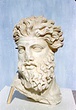
| Head of Triton, reported to have been found in the excavations at Eleusis conducted between 1882 and 1889 (Eleusis Inv. No. 72) rejoined to neck found in the Agora (S 1214). Pentelic marble. Three-quarter ... 1949 |
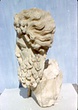
| Head of Triton, reported to have been found in excavations at Eleusis conducted between 1882 and 1889 (Eleusis Inv. No. 72) rejoined to neck found in the Agora (S 1214). Pentelic marble. Proper left profile ... 1949 |
| Giant in easternmost position of the "Gymnasium" series, front view. The Late Roman Complex was identified as a Gymasium because of its scheme and of an inscription found by Pittakis in 1848 alongside ... south ... 1949 |
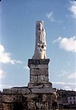
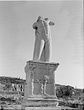
| Westernmost Triton in Late Roman Complex series. Figure and pedestal. Three-quarter view ... southwest ... 1949 |
| Westernmost Triton in Late Roman Complex series. Figure and pedestal. Side view ... west ... 1949 |
| Westernmost Triton in Late Roman Complex series. Figure and pedestal. Front view ... south ... 1949 |
| Triton, third from the west. Front view ... south ... 1949 |
| Southeast corner of the building ... =ΩΔ 147 southeast ... 1949 |
|
|
.jpg.icon.jpg)