|
|
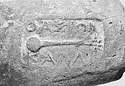
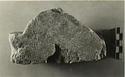
| Device; star.
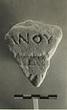
Early Thasian. Finished Third northwest cut, sand and gravel; Byzantine. Θασίων
device star
Καλλι( Leica ... 27 April 1936 |
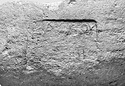
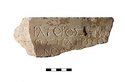
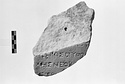
| Device(?). Finished Early Byzantine context. Κάδμ̣ου
[device]
[---] Leica ... 27 April 1936 |
| Part of right side of the figurine preserved, from neck to top of legs, and from breast to beginning of tail.
A dove with simply defined wing. No indication of feathers in the clay.
White slip inside and ... 28 April 1936 |
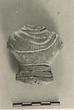
| Back half preserved, from neck to base, and from shoulder to shoulder.
Traces of white paint.
Light red clay.
Late Roman. Found with coins of the day, nos. 65-105. Leica ... 27 April 1936 |
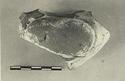
| Fragment of a small comic mask with bored eyes and mouth.
Traces of glaze at the broken top, and red wash inside.
From a pot (?) Cistern. Dumped filling.
200-250 A.D. Leica, LXIX-10 ... 28 April 1936 |
| Front of head preserved; broken at neck and behind.
Head with long straight hair, falling on either side of a central herringbone braid. A cap or band on the top of her head.
Some dark red paint.
Light ... 27 April 1936 |
| Front of head preserved, and nearby portions of top and sides. Battered.
Head with prominent eyebrows. Slightly wavy hair, surmounted by a cap or band.
Little modelling. Traces of white sizing. Thick red ... 27 April 1936 |
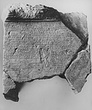
| Fragments of inscribed block.
List of names; possibly the list of those who lost their lives at Syracuse.
Fragment Η 419 a), broken away above, below, and to the left. The right side has anathyrosis ... Late 5th. century B.C. |
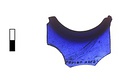
| Four non-contiguous fragments of a stamnos-shaped vase, with wide mouth and short upturned rim.
Dark blue glass; well preserved. Agora sample no. 283. Cistern.
Mixed destruction filling, containing a ... 27 April 1936 |
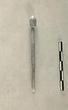
| Point broken off.
Elongated knob head. Cistern. Leica ... 27 April 1936 |
| Inscribed fragments.
Prytany list; Archonship of Dionysios, after Timarchides.
Fragment Ξ 32a (a), the original left edge is preserved.
Fragment Ξ 32b (b), the inscribed face and right face preserved ... 135/4 B.C. |
| Inscribed fragments.
a) (ΠΘ 1056), traces of back preserved; elsewhere broken away.
Fourteen lines of the inscription preserved.
b) (Σ 682), right side preserved.
This fragment joins below to I 4026 ... a) (ΠΘ 1056) 27 March 1936
b) (Σ 682) 27 April 1936 |
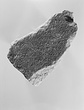
| Inscribed fragment.
Perhaps preserved nearly to full thickness; otherwise broken.
Twelve lines of the inscription preserved.
Hymettian marble. Finished Found in late context in Great Drain, north of the ... 28 April 1936 |
| Inscribed fragment.
Broken at left side and bottom.
Upper right corner of pedimental stele.
Preamble of decree.
Six lines of the inscription preserved.
Hymettian marble. Found in a wall of the church of ... Late 4th. century B.C. |
| Inscribed fragment.
Inscribed face only preserved.
Archon list.
Six lines of the inscription preserved.
Hymettian marble.
ADDENDA Joins above to EM 8046 d (IG II2, no. 1706 d).
Transferred to the Epigraphical ... 221/0 B.C. |
| Inscribed fragment.
Inscribed face only preserved.
Imperial letter.
Two lines of the inscription preserved, with an erasure between them.
The marble probably Pentelic.
Grayish-white marble.
ADDENDA Joins ... 187 A.D. |
| Inscribed fragment.
Back surface smooth dressed, preserved; otherwise broken.
Imperial letter (?); mentions Herodes.
Eight lines of the inscription preserved.
Pentelic marble.
ADDENDA I 4457 joins. Finished ... 28 April 1936 |
| Inscribed fragment of stele.
Inscribed face and back only preserved.
Preamble of decree.
Eight lines of the inscription preserved.
Pentelic marble. Found in a wall of the church of Vlassarou, west of the ... 28 April 1936 |
| Inscribed fragment.
Inscribed face and top only preserved.
The emperor's name in the first line has been erased.
Three lines of the inscription preserved.
Pentelic marble. Found in late Roman context, ... 28 April 1936 |
| Inscribed fragment.
Inscribed face only preserved.
Four lines of the inscription preserved.
Pentelic marble. Found in late Roman context, west of the north end of the Stoa of Attalos. Leica, 92-29-20, ... 4th. century B.C. |
|
|