|
|
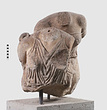
| A group of two girls, one carrying the other.
Missing, the carrier's head, body below the waist, left upper arm, left breast; of the carried, the head, left forearm, the legs from near the knees.
The ... 23 February 1934 |
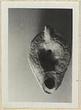
| A chip of the left side missing; otherwise unbroken.
A cross and three filling holes on the discus. Impressed circles on rim and bottom. Unpierced, ungrooved handle.
Pinkish buff clay, unglazed.
Type ... Mid 5th-6th c. A.D. |
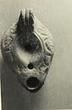
| Plain discus; vine pattern on rim. Handle solid, grooved.
On the bottom, within two almond-shaped grooves, with an impressed circle above and below, the signature.
Type XXVIII of Corinth collection.
... 21 February 1934 |
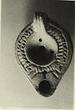
| Plain discus, wavy lines on rim; solid grooved handle.
On the bottom, two almond-shaped grooves enclosing a palm branch.
Type XXVIII of Corinth collection. In well with coins. Leica ... 22 February 1934 |
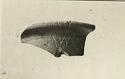
| Back part of lamp.
Two fishes, left, on discus; spirals on the panelled rim. The handle grooved; semi-pierced. On the reverse, a leaf within a double circle.
Greenish-yellow clay.
Close to type XXVII of ... 23 February 1934 |
| Plain discus; herringbone on rim.
Handle solid, grooved.
On the bottom, cross within double almond-shaped grooves.
Type XXVIII of Corinth collection. Well. Leica ... 23 February 1934 |
| Fragment from edge of upper mould.
The rim was to be decorated with two rows of short parallel bars.
Coarse red clay.
Mold for late Roman lamps. Dump. Leica ... 22 February 1934 |
| On the discus, a lamb, facing left.
Unglazed.
Red clay.
Type XXVIII of Corinth collection. With late Roman sherds, in red earth. Leica ... 21 February 1934 |
| Mended from five pieces; most of the sides and rim missing. Fragmentary.
Plain rim with herringbone panels; plain discus with rings round filling hole.
Solid handle, double grooved below, triple above ... 21 February 1934 |
| Part of bottom and side wall preserved.
Within two almond-shaped grooves, part of the signature of "XIONHC".
Tan clay, micaceous; smoothed but unglazed.
Type XXVIII of Corinth collection. Rubble fill, ... 23 February 1934 |
| Mended from many pieces; small body fragments missing. Cylindrical straight-sided body tapering to a point; narrow shoulder, straight neck, double handles.
Pinkish buff clay, covered on the outside with ... 23 February 1934 |
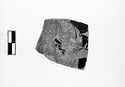
| From the wall of a large pot, unglazed inside, possibly a panathenaic amphora?
To the left, part of a band of black glaze; to the right, two letters: Θ Η, one above the other.
Orange wash over the clay ... 21 February 1934 |
| From the shoulder of a squat lekythos(?). The inside glazed, but not completely. A reserved band at the upper break, presumably around the base of the neck. To the right, carelessly reserved circles; to ... 21 February 1934 |
| Two pieces: one mended from nine, the other non-joining, single. Restored in plaster. Profile complete. Enough remains to make out the stamp on the bottom, probably a rosette.
ADDENDA Signature - Apollodorou, ... 22 February 1934 |
| The fragment curves in sharply at the bottom.
Good red glaze inside and out.
ADDENDA This motif is typical of Pergamene ware, 2nd. c. B.C. [HAT]. In accumulation over strosis. Leica, 92-10-17(18) ... 21 February 1934 |
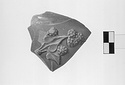
| From a fairly thin-walled vase, but large; unglazed on the inside. Represented is a draped woman, facing half right. Her right arm is held out in front of her. Above the hand is the corner of an object ... 21 February 1934 |
| Bowl fragment(?); the rim flat on top, projecting sharply on the outside, and slightly on the inside. On the top of the rim, two raised rings. Two letters scratched on the outside beneath the rim.
The ... 23 February 1934 |
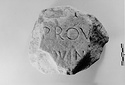
| Fragments of Latin inscription.
Fragments Λ 46 a and Κ 100 b), broken all round.
Part of three lines of the inscription preserved, on each fragment.
Fragment Λ 119 c), also broken all round; on it, part ... a) (Λ 46) 13 January 1934
b) (Κ 100) 22 February 1934
c) (Λ 119) 21 February 1934 |
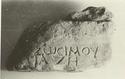
| Inscribed fragment.
Part of pedimental top preserved; broken at left.
Lower right corner broken; remains of a dowel in the break.
Back carefully dressed with traces of a raised band broken off at the right ... 1st.-2nd. centuries A.D. |
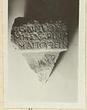
| Inscribed fragment from the top of a stele.
Rough picked at the back; a broad inscribed band above the smooth background of a relief.
Four lines of the inscription preserved; in the first, the lower parts ... 22 February 1934 |
|
|