|
|
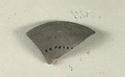
| Fragment from the wall of a kylix, black glazed inside and out. Reserved on the outside behind the handle(?).
Scratched through the dry glaze on the outside, a profile, left, from brow to neck. Metroon, ... 14 April 1934 |
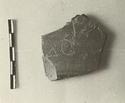
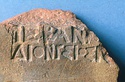
| A fragment from the foot, black glazed on the outside only.
The inscription written in firm black glaze on the underside. Metroon, room iv, exposing south face of north wall of Period I; 6th. c. context ... 14 April 1934 |
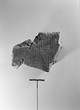
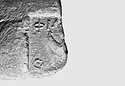
| Fragment from the shoulder of a large closed vase, covered on the outside with a thin wash of brown glaze. Scratched in the dry clay of the outside, the feet of the letters toward the top, two letters ... 13 April 1934 |
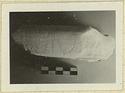
| Part of the back and lower part preserved.
Raised dots on the panelled rim; semi-pierced handle, double grooved.
Beneath, part of a signature: "Δ".
Brownish wash.
Buff clay.
Type XXVIII of Corinth collection ... 13 April 1934 |
| Two fragments:
a) The top surface, toothed, with relieving surface, preserved. Behind, part of a circular cutting, rough-picked. On the crowning molding the marks of a painted egg and dart pattern.
On ... 14 April 1934 |
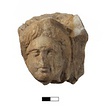
| The face is broad. A veil (?) rises up behind a ring diadem at the center of the head.
Red clay.
Late Roman. Red earth. Leica ... 13 April 1934 |
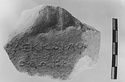
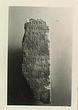
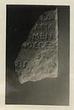
| Inscribed fragment on two opposite faces.
Mended from two pieces; part of the smooth picked top preserved; sides and bottom broken.
"POLETAI" record.
Seventeen lines of the inscription preserved on face ... (smaller piece) 1 February 1934
(larger piece) 13 April 1934 |
| Inscribed fragment.
A finished face (?) at right, not at right angles to the inscribed surface; otherwise broken.
Two lines of the inscription preserved.
Pentelic marble. Found in late context, in the ... 13 April 1934 |
| Inscribed fragment.
Broken on all sides.
"POLETAI" record.
Three lines of the inscription preserved, with two to three letters in each, and a trace of a fourth line below; stoichedon (?).
Hymettian marble ... 13 April 1934 |
| Inscribed fragment.
Part of toothed right side preserved; otherwise broken.
"POLETAI" record.
Fifteen lines of the inscription preserved.
Hymettian marble.
ADDENDA With I 1533. Found in late context, ... 14 April 1934 |
| Inscribed fragment.
Part of dressed right side preserved; otherwise broken.
Five lines of the inscription preserved.
Pentelic marble. Finished Found in late context, in the Bouleuterion Square. Leica ... 14 April 1934 |
| Inscribed fragment.
Broken on all sides.
Two lines of the inscription preserved.
Hymettian marble. Found in late context, southeast of the Bouleuterion Square. Leica ... 14 April 1934 |
| A tegula with a bit of the over locking end preserved.
Cf. A 304.
Mother of the Gods series. Burned layer of Burned Building, as A 309 etc. Leica, color slide ... 13 April 1934 |
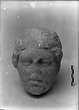
| Small head, broken all around; the left cheek chipped. Behind the head a mass as of drapery(?).
Red cement on the surface, as if from nearby heavy Roman wall.
Pentelic marble. In late fill. Leica ... 13 April 1934 |
| Broken off at the neck. Nose, mouth and chin damaged; minor fractures all over; otherwise intact.
About half life-size. The hair, tied in a large knot which projects behind, is held in place by three bands ... 14 April 1934 |
| Star crescent. Dim: W 0.045* Finished Red Hellenistic fill. Φιλ[ίσκος]
[star]
crescent
Θ[άσιον] Leica ... 14 April 1934 |
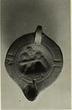
| Complete.
Plain panelled rim. On the discus, a man, facing right, attacking some indistinguishable animal with a spear. Gladiatorial scene (?).
The handle semi-pierced; on the bottom, two concentric grooves ... 13 April 1934 |
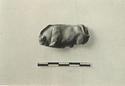
| Fragment of discus.
Preserved is the body of a bull, left.
Red glaze.
Pinkish-buff, slightly micaceous clay.
Type XXIV of Corinth collection. Leica ... 13 April 1934 |
| Plain discus and rim, panelled with herringbone.
Half-pierced handle; herringbone beneath.
Red glaze.
Type XXVIII of Corinth collection. Red earth. Leica ... 13 April 1934 |
| Plain discus, herringbone on rim.
The handle solid, double grooved above, single below.
On the bottom, within a double almond-shaped groove, a palm branch with impressed circles.
Unglazed.
Light red clay ... 14 April 1934 |
|
|