|
|
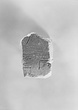
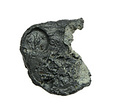
| A crudely indicated left hand and wrist resting against some object.
Bracelet of shallow grooves.
Dirty brown slip.
Coarse red clay. Finished In retaining wall along east boundary. Leica ... 9 May 1936 |
| Inscribed fragments.
Dedication by the "επιλεκτοι" of the tribe Demetrias.
Fragment ΗΗ 215 a), inscribed face and part of the bottom is preserved, the bottom picked, with a dressed edge at the front.
One ... 3rd. century B.C. |
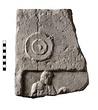
| Inscribed fragment of grave stele with relief.
Broken at right and bottom.
Only the head and shoulders of a man facing right are preserved in the relief panel.
On the surface above the relief, two lines ... 9 May 1936 |
| Rectangular.
A roughly octagonal stamp, deeply impressed, on top. Underside slightly hollowed; corners rounded. Hellenistic filling in pillaged back wall-trench of Hellenistic building. Leica ... 9 May 1936 |
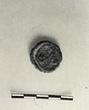
| Obverse: at right, Herakles, nude, left, sitting on rock. At left a tripod. Just below late Roman level. 1313 Leica ... 11 May 1936 |
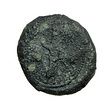
| Obverse: standing semi-draped Serapis, left, holding staff, right arm raised. Plant-like scroll on either side.
All within border of dots.
Reverse: Triton with attributes and stance of poseidon, left ... 9 May 1936 |
| Partly broken.
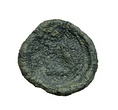
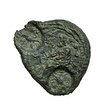
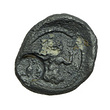
Obverse: at right, Herakles, nude, left, sitting on rock. At left a tripod. Above tripod a circular countermark of stork and lizard.
Reverse: apparently plain. Just below late Roman level ... 11 May 1936 |
| Obverse: Serapis with countermark of stork and lizard.
Reverse: Triton with attributes and stance of Poseidon. Just below late Roman level. Leica ... 11 May 1936 |
| Obverse: Helios driving forward in chariot, two horses galloping left and two right.
All within border of dots.
Reverse: plain. Just below late Roman level. in zip lock bag in conservation
with gloves ... 11 May 1936 |
| Obverse: Helios in four horse chariot, two horses galloping left and two right.
All within border of dots.
Reverse: plain.
Cf. IL 379. Just below late Roman level. Leica ... 11 May 1936 |
| Obverse: Zeus seated left holding Nike in right hand, grasping spear with left. At right of chair a thunderbolt; below it a crescent; to left a star.
All within border of dots.
Reverse: Winged figure (Nike ... 11 May 1936 |
| Obverse: Serapis, draped, standing, left; an A in upper left field, a small square in lower right.
Reverse: Triton seated left, with attributes and stance of Poseidon.
Holding trident in left hand, in ... 11 May 1936 |
| Obverse: Serapis and countermark. A raised square with a curving line joining it at one end.
Reverse: Countermark; four raised bosses. Just below late Roman level. in zip lock bag in conservation
with ... 11 May 1936 |
| Obverse: semi-nude figure of Asklepios left, at right of seal. At left, Hygieia, draped faacing right. snake by Asklepios ' right leg : Telesphoros between two figures. Countermark at bottom with prow ... 11 May 1936 |
| Obverse: Asklepios, semi-nude, seated left, leaning on staff which a snake is entwining. At right, five stars, at left curved lines, perhaps representing tree. Countermark at lower right with scorpion ... 9 May 1936 |
| Obverse: Serapis.
Reverse: five-petalled rosette. Countermark of stork and lizard below. Just below late Roman level. Leica ... 11 May 1936 |
| Obverse: Serapis, draped, left, with right arm upraised; left arm has uncertain object.
Reverse: Triton with attributes and stance of Poseidon. Half-nude, seated left, holding upright trident in left hand, ... 11 May 1936 |
| Obverse: Serapis, draped, left, right arm held out, left arm with uncertain object.
At either side of legs faint scrolls and circles.
Reverse: Triton with attributes and stance of Poseidon. Half-nude, ... 9 May 1936 |
| Obverse: Serapis standing, semi-draped, head left, right arm raised, staff in left hand. Two countermarks of stork and lizard at one side.
Reverse: illegible. Just below late Roman level. in zip lock bag ... 11 May 1936 |
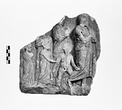
| Broken above and at right. Back rough.
Two adults, one (or two?) adolescents, and three children advancing right.
Surface considerably damaged; blackened at right.
Pentelic marble. Modern wall. Leica, ... 9 May 1936 |
|
|