|
|
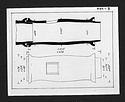
| Broken, but nearly complete. One long and one short joint tongue; rectangular clean-out hole.
Pale yellow clay with coarse grit; thin brown glaze on inside only. Finished From the drain of the kitchen ... 550-525 B.C. |
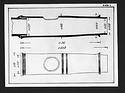
| Broken but practically complete. One long joint tongue only. Oval clean-out hole.
Buff clay, unglazed inside, four brown rings outside.
Cf. Hesperia Suppl. 4 (1940), pp. 88, 90, n. 66, fig. 67. Finished ... 470 B.C. |
| Broken, but complete.
One long and one short joint tongue. Oval clean-out hole.
Buff clay; thin glaze on inside only. Finished From a drain to the S.E. of the Bouleuterion Propylon, perhaps with earliest ... 470 B.C. |
| Perhaps part of a door jamb.
The back is smooth, the front rough-picked, with a curved molding of crosses and degenerate palmettes.
Byzantine.
Pentelic marble. Lying on the floor in the passage of the ... Byzantine |
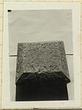
| A virtually square capital carved with seven petaled palmettes on the face and leaves at the corners. A square dowel hole irregularly placed on top.
A rosette above the palmette is preserved on only one ... Byzantine |
| A square impost block, carved on the beveled edge with trefoil ornament in the corners, cross with circles in the center, with two crosses in diamonds with dotted triangles as filling ornaments on either ... Byzantine |
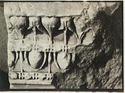
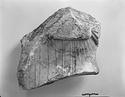
| One end preserved, with anathyrosis. Top toothed, with dowel cutting. Back roughly picked.
Along center of front, ornamental moldings: Lesbian leaf above, then bead and reel, egg and tongue, and bead ... 4th century B.C. |
| Complete. Torus from Ionic base, horizontally fluted with six flutes. Square empolion cutting through center, carved from both sides, and at different orientations.
Naxian marble.
Same series as A 266 ... Second half of 6th century B.C. |
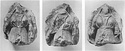
| The heads and the legs above the knees broken off, the forearms broken and chipped.
Three draped female figures standing back to back: type of triple Hekate. The pose varies, one carries a torch in her ... 1st c. B.C. |
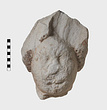
| Head of an unknown, middle aged man in a skullcap. The head is broken off at the base of the neck; most of the right ear, the end of the nose and the tip of the left ear are missing. Chips gone from the ... 1st c. B.C. |
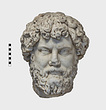
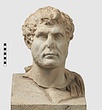
| The head is considerably over life-size, broken off below the beard; the tip of the nose is missing, and the back of the head has a rectangular patch of hair (doweled on, with the dowel still in place) ... Early Antonine period. |
| The back of the head was apparently attached separately as the head is cut off in a line running obliquely from a point directly above the ears to one on the back of the neck. There is a cutting for attachment ... 145-175 A.D. |
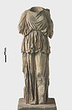
| The head, set into a rough picked socket, now missing; arms missing from elbows; the left knee and the front of the leg below it broken away; the drapery much chipped, especially at the sides.
The figure, ... 4th century B.C. |
| The figure is nearly intact except for some object in the right hand. Mended from three pieces.
A standing male figure clad in himation and Phrygian cap and carrying pine cones and fruit. The man is nude ... 2nd century A.D. |
| The nose and chin have been considerably damaged. At the base of the neck, a roughly picked tongue indicates that the head was inserted into a separate body.
Head, larger than life-size, perhaps of Trajan ... Flavian period. |
| Missing: upper part of left ear, edges of right ear, tip of nose, left side of neck at join. Mended from two adjoining pieces. The tenon is chipped and broken. The head is preserved from top to tenon, ... 10 B.C.-20 A.D. |
| Chopped off behind and much battered, the features nearly gone.
The high coiffure is Flavian, with rows of snail-shell curls in an erection over the forehead, drill holes in the center of each curl. Round ... Flavian period. |
| In fine preservation.
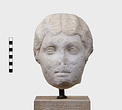
A portrait of a middle aged woman (Faustina the Younger ?) with rather severe features and with hair parted in the center and drawn down in waves to a chignon in the back, below which ... Ca. 162-166 A.D. |
| The fragment first found comes from the middle of the back of the figure. The hair, worn in a heavy mass, square at the bottom, falls nearly to the small of the back. The folds of the garment, drawn tight, ... Early Roman Period (?). |
| Mended from five pieces. Missing: end of nose, edge of left ear; right shoulder and back; small breaks in drapery and neck on left side, slice of hair over the right temple.
The height of the bust is ... Ca. 215-225 A.D. |
|
|