|
|
Nbpp. 3104-3105: Represents well deposit; the [baskets] from this layer showed no stratification. Containers marked "earth" presumably represent primarily Layer II.
... it is presumed that the sherds of ... Late 6th-7th c ... Well Deposit: Layer II- POU |
| David Scahill ... Protogeometric/Early Geometric well under floors in Room 1, Classical Building II, on north side of south ashlar wall. See J 3:9 for the burial within this well.
Cf. Hesperia Suppl. 50 (2018), p. 106, ... 27 June 2001
17 July 2002 ... Protogeometric/Early Geometric well under floors in Room 1, Classical Building II, on north side of south ashlar wall. See J 3:9 for the burial within this well.
Cf. Hesperia Suppl. 50 (2018), p. 106, n. 10. |
Nbp. 3104: When dug, the fill of the well divided itself into 3 deposits.
Objects catalogued from the "earth" are: L 4838, P 21602, P 21603, P 21604. Dumped filling of Turkish times. Coins:
17 May 1937 ... Late 6th-7th c. A.D. |
Found while excavating Stoa Pit E in 1933. See also I 849 (Ε 329) found in the North Well in Stoa Pit E (Deposit H 9:1). Fragment Ε 496 of this inscription, listed with the finds of H 10:6, is likely from ... 8-10 May 1933
17 May 1935
18-26 May 1937 ... Well in Metroon Porch to East of Room II |
Tins 1-5.
"D" ware; a medallion plate; the jar with flaring mouth and purplish glaze and gouged decoration, a 28 lamp fragment and one fragment of combed ware ... 4th. c. A.D. |
Estimated Grid ... Early 3rd c. A.D. |
Coins:
22 April 1937 #1-#5 Containers 7-5 ... Second half of 1st. c. A.D. POU |
Represents excavated levels II-III ... 275-150 B.C. |
| Laura Gawlinski ... Well in courtyard of Early Building I, adjacent to wall of Room B. Tile lined; upper course in situ, lower two collapsed probably in antiquity. Letters inscribed on rims (eta, phi, omicron, theta). Medium ... First quarter of the 4th c. B.C ... Well in courtyard of Early Building I, adjacent to wall of Room B. ... Well contained three main dumped fills: a slightly later fill perhaps for leveling after filling settled (Layer I and perhaps Layer II), a fill with ceramic and some stones (Layer III and perhaps Layer II), and a fill with large stones, tiles, and collapsed well lining (Layer IV).
Layer I 58.03-57.40m., softer brownish fill
Layer II 57.40-57.16m., sandier fill with streaks of charcoal
Layer III 57.16-56.24m, similar to Layer II, increase of stones and tiles
Layer III/IV 56.24-56.07m., transition between fill of Layer III and Layer IV
Layer IV 56.07-54.94m., fill primarily consisting of large stones, tiles, and collapsed well lining (little soil or ceramic) |
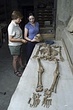
| David Scahill ... Burial in Geometric well (J 3:8), in Classical Building II, Room I, next to south ashlar wall. "No grave goods!"
ADDENDA: J. Papadopoulos later associated P 34449 and P 34450 to that grave. (Cf. Agora ... Geometric ... Burial in Geometric well (J 3:8), in Classical Building II, Room I, next to south ashlar wall. |
Just east of Building II near its south end. The tiles were in place.
Upper filling (to 3.00m.) of Hellenistic-Byzantine dump all discarded.
POU fill a gradual accumulation of typical Justinianian ware ... 6th c. A.D. POU-7th c. A.D. |
| Well South of Soft Yellow Poros Foundation. Dumped filling of a collapsed well, that, due to hazardous conditions, could not be cleared below- 2.50m. The well was partly cut on the east side by a Byzantine ... Protogeometric-Early Geometric II, ca. 850 B.C. |
A well on the NW slope of the Areopagus; unfinished well-shaft dug to a depth of only 3.05m., and refilled with broken pottery and other debris. The shaft clearly was begun with the intention of digging ... Ca. 520-480 B.C ... A well on the NW slope of the Areopagus; unfinished well-shaft dug to a depth of only 3.05m., and refilled with broken pottery and other debris. The shaft clearly was begun with the intention of digging a well, since footholds were cut in the sides; the reason for the abandonment was not clear; the rock appeared quite suitable for well-sinking. ... Lots ΓΓ 512-515: -1.75m to bottom (Fill II), coarse. |
| Well cut into bedrock, associated with late Roman building G in ΕΛ 1.2m in diameter, narrows to 0.5m at bottom. Disturbed by later pits at top. Excavated from 85.77-79.25m (6.52m), but bedrock at 85.91m ... Late 4th/early 5th AD ... Well cut into bedrock, associated with late Roman building G in ΕΛ 1.2m in diameter, narrows to 0.5m at bottom. ... Layers:
I. (85.77-84.94m) mixed rocky fill.
II. (84.94-83.92m) dark fill with tiles.
|
Mycenaean Well at Q/8-9;23/2-3.
Small pieces, few joins. From the lowest levels a few somewhat larger pieces, from jars suited to drawing and transporting water, but no characteristic POU fill.
Proportion ... LH IIIC ... Mycenaean Well at Q/8-9;23/2-3.
... Very little intrusive material; earlier: Neolithic, EC, EH, Minyan, Matt painted, LH II/IIIA; later: black glazed, Hellenistic.
|
Well at 19/ΚΔ, beneath the west colonnade of the Square Market Building in the northeast corner of the Agora. Diameter ca. 1.25m. Water level ca. -3.50m. The construction of the well was rather careless, ... Ca. 580-560 B.C ... Well at 19/ΚΔ, beneath the west colonnade of the Square Market Building in the northeast corner of the Agora. ... In the mouth of the well was a small amount of supplementary fill (425-400 B.C.) ... Baskets I and II found 7 April 1938
Basket IV and mud found 14 April 1938 |
Roman well, stratified.
Finds from the earth (not recorded in a subdivision):
P 7995, P 8036, P 21834, SS 6338, IL 483, IL 486, BI 309, BI 310,
BI 314.
According to the excavator the shaft had been cleaned ... 2nd-4th c. A.D ... Roman well, stratified.
Finds from the earth (not recorded in a subdivision):
P 7995, P 8036, P 21834, SS 6338, IL 483, IL 486, BI 309, BI 310,
BI 314.
... The well might for some reason have been used only sparingly or it might have been equipped with a metal bucket which was used in preference to clay jars on most occasions ... Subdivisions:
.1=Fill I
.2=Fill II
.3=Fill III
.4=Fill IV
.5=Fill V
.6=Fill VI |
Roman Group L.
Layer I (cont. 59-64) Pre-Herulian second half of 3rd c. (bottom, 15.95-13.90).
Layer II (cont. 42-58) 4th c.-first quarter of 4th c. (11.90-13.90).
Layer III (cont. 17-41) -4th c. (10.00 ... Second half 3rd c.-early 5th c. A.D. |
Well dug through cistern at 64/Γ. Seems to have been stratified; four fills recorded but here treated as one as divisions are rather "arbitrary".
Agora V, p. 126: Constructed in late 1st c.; use filling ... 3rd c. A.D. POU (before 267 A.D.) |
| Eugene Vanderpool Homer A. Thompson ... Mycenaean Tomb to NW of Pier 19 (Burial 7).
The chamber was roughly square in shape (2.70m wide by 2.10m deep), oriented northeast to southwest across in transverse axis. The entrance was at the northwest ... Myc. II-IIIA:1 |
|
|