|
|
Slightly convex side wall.
Shiny black to reddish brown glaze.
Cf. Brann 190 ... LG IIB |
Half of foot and lower portion of side wall preserved.
Reserved band on wall just above foot painted red; otherwise all glazed inside and out as far as preserved.
Black glaze.
For type cf. Agora XII, ... 6th c. B.C. |
Part of base and side wall preserved.
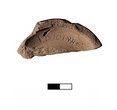
An alpha in relief, with raised ring; uneven row of globules around body (three rows preserved).
Cf. Agora VII, pp. 15-16 ... 150-200 A.D. |
Disk foot; slightly convex side wall; plain rim, thickened inward and flat at top.
Stroke series on top of rim; all glazed inside.
Dull glaze, black to brown.
Cf. Brann F 29 ... 650-625 B.C. |
Half preserved.
Flat bottom; side wall slightly incurving at rim; hemispherical bowl inside. All glazed except for the reserved resting surface.
Good, lustrous black glaze.
Cf. Agora XII, pl. 34, no ... Late 5th c. B.C. |
Probably from the wall of an alabastron.
Part of a winged figure running right: part of torso with wing, extended left arm, and knee; figure is wearing an incised short-sleeved chiton.
Cf. H. Payne, ... Late Transitional ... Probably from the wall of an alabastron.
Part of a winged figure running right: part of torso with wing, extended left arm, and knee; figure is wearing an incised short-sleeved chiton.
Cf. H. Payne, Necrocorinthia, pl. 15:10 for a similar chiton. |
Straight wall; plain lip. From left to right: man with sword (head missing), a shield-like object, and a bird (?) facing right. Glazed inside as far as preserved except for a reserved band below the lip ... LG II |
Flat bottom and convex side wall.
The letters -AI- (Greek?) incised on the resting surface after firing with a sharp point. Left to right?
Coarse, pinkish buff clay, unglazed.
Jugs with flat bottoms ... Early 7th c. A.D. |
A fragment from the side wall, mended from two pieces.
Part of a lion with elaborately incised mane; over back of lion, a large incised rosette. Unglazed inside as far as preserved.
Greenish buff Corinthian ... Late Transitional ... A fragment from the side wall, mended from two pieces.
... Greenish buff Corinthian clay; dull black glaze.
Cf. H. Payne, Necrocorinthia, Oxford, 1931, pl. 15:7, 8
Similar (fragments from the same shape); H 558 (with part of a bird or siren), H 559 (with part of a bird). |
Nothing of handle or mouth.
Flat bottom; squat, convex lower body; high, upward-tapering upper wall. Legs and round shield of a man walking right and carrying two spears (head missing); behind, tree (?) ... Early Protoattic |
Flat bottom; high, flaring upper wall; one vertical band handle (missing but restored correctly as indicated by handle attachments), and one horizontal rolled handle.
Inside all glazed except for a reserved ... LG II |
| Fragment from the lower wall and bottom of a closed vessel with flat bottom.
Inscription incised on the inside of the sherd after the pot was broken. It is complete and written retrograde
Σημιοι Δι
... 7th c. B.C. |
| Eleven pieces comprising two non-joining fragments. To Young's publication of six pieces are now added five more, two of which help to complete to inscription.
Part of the side wall with reserved panel ... 600 B.C ... Part of the side wall with reserved panel preserved; panel filled with lion walking right. ... According to M. H. Jameson ,δράω should have more force, referring possibly to the performance of a rite, as it does in I.G., I, 4. |
| Uneven.
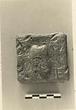
On top in relief an uncertain object, and the letters Δ] Ε Μ [Ο (?).
"Floor" of room 14B, north of wall H.
Late Roman. Leica ... 24 March 1937 ... "Floor" of room 14B, north of wall H.
Late Roman. |
| Inscribed fragment.
Broken all around.
Fragment of inscribed marble having list of names by tribe and deme.
Raised border with one line of the inscription above. Several lines on face below.
Crystalline ... 14 August 1974 ... Found in Byzantine Wall H. |
Small part of underside and segment of wall and rimrestored.
Small foot; flat resting surface; convex underside. Angular profile.
Wall offset from floor inside. Shiny black-to-red glaze, peeling; finger ... Ca. 110 ... Small part of underside and segment of wall and rimrestored.
... Angular profile.
Wall offset from floor inside. Shiny black-to-red glaze, peeling; finger marks on foot and lower wall.
Similar: P 3352 (H. |
One-third of rim and fragments of wall missing.
Flat resting surface. Irregular, straight wall with slight angle below rim. Shiny black glaze, red on stacking circle and underneath; finger marks on foot ... 150-110 |
Two-thirds of rim and wall missing.
Irregular, angular foot; flat resting surface; pointed underside, mostly unglazed. Straight wall, flaring at top. Rim deeply undercut on inside. Dull black glaze with ... 150-110 |
Chips of wall and floor missing.
Flaring foot, concave to outside; rounded resting surface; slightly convex underside. Angular wall. Dull black glaze; finger marks on foot and lower wall.
The earliest ... Ca. 260? ... Chips of wall and floor missing.
... Angular wall. Dull black glaze; finger marks on foot and lower wall.
... Similar: P 1815 (H. A. Thompson 1934, A 11, p. 317, from same context), P 14171 (O 20:3, III). |
Half of rim and wall missing.
Broad, flat resting surface; pointed underside. Upper body straight, rim not turned out. Wall offset from floor. Dull brown glaze; finger marks on foot and lower wall ... Ca. 110? |
|
|