|
|
Pit along house wall foundations to south = footing trench. Uncertain context, possibly no later than ca. 425 B.C ... 450-400 B.C. |
House K: Brown fill (publ. House U). Filling between terrace wall and house wall at the extreme west end of the Areopagus; a brown gravelly filling of early Roman date found here undisturbed but occurring ... Early Roman |
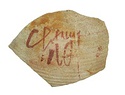
P.H. 1.98m; greatest diameter 1.70; wall thickness 0.20. The walls are of rubble set in clay, and the bottom is flat. Pottery was coarse Byzantine sherds but discarded except for one graffito ... 25 May 1956 |
Ca. 73-81/Drain. Fillings associated with the construction of the Great Drain South, especially the fill thrown in behind the east wall of the drain at the time of its building.
Cf. A 20-21:1 and B 19:7 ... Ca. 425-400 B.C ... Fillings associated with the construction of the Great Drain South, especially the fill thrown in behind the east wall of the drain at the time of its building.
... A 20-21:1 and B 19:7.
Cf. Hesperia 20 (1951), pp. 247, 256. |
Pit in House N, Room 2 (RSY, House C). Filling thrown in behind the west wall of the Great Drain South at the time of the building of the drain and the extension of House C.
Cf. Hesperia 20 (1951), pp ... Ca. 430-410 B.C. |
Well L: PG, ELS. Includes a displaced grave (K 12:2 bis). The pottery appears less consistent than that in the pit at 70/ΜΕ. Depth of well 6.25m. below the top of wall B. PD 2780 ... Protogeometric ... Depth of well 6.25m. below the top of wall B. |
Well (diameter shaft 0.95m) with POU and dumped fillings, separated by about 2.00m. of plain mud apparently fallen from the collapsed sides of the well. The fillings are, however, closely contemporary ... Ca. 425-400 B.C. |
RSY Grave A.
Under the Roman House with three rooms floored with mosaic near the southwest side of the area. The burial consisted of a pot laid on its side over the bedrock, presumably containing a child ... 7 August 1947 |
| Pyre in House C, Room 12 (RSY=Pyre 9) in the industrial area west of the Areopagus.
Notebook refers to House N.
Beside west wall of room 12. Pottery, burnt bone, and cinders in a roughly round pit; disturbed ... Ca. 250 B.C ... Beside west wall of room 12. Pottery, burnt bone, and cinders in a roughly round pit; disturbed by Byzantine pit. ... The pyre predates the fill of the cistern in the room (B 18:13), and it is therefore contemporary with continued activity there. |
| Pyre in House D, Room 4 (RSY=Pyre 4) in the industrial area west of the Areopagus.
Notebook refers to House N.
Pottery belongs late in third quarter of the 4th. c. BC. Pyre burned near beginning of last ... 350-300 B.C. |
| Pyre in House N, room 2, layer 5 (RSY=Pyre 8).
Near northern corner of room 6. Artifacts, bone, burnt logs, and cinders in square pit dug from level of layer 5, through layers 5 and 6; thin clay floor ... 325-300 B.C. |
| Pyre in House N, room 4 (RSY=Pyre 7), in the industrial area west of the Areopagus.
Pottery, mall pieces of calcined bone, log, wood cinders, and charcoal in diamond-shaped pit in floor sequence. The pyre ... Late 4th-early 3rd c. B.C. |
| Mycenaean tomb: Myc. III A:1-2.
SAI
Small rectangular chamber, 2.30m wide by 1.80m deep,, entered from the east through a dromos 1.10m wide which contracted to a doorway 0.92m. wide. the doorway preserved ... 2nd half of 14th c. |
Double Well by Entrance to Square Building (Well B)
Wall A (R 9:2) was Late Geometric or transitional well, into one-half of which a bothros had been sunk in Turkish times (16th c. A.D.)-R 9:3.
This bothros ... ca. 17th century A.D ... Double Well by Entrance to Square Building (Well B)
Wall A (R 9:2) was Late Geometric or transitional well, into one-half of which a bothros had been sunk in Turkish times (16th c. ... This bothros was lined on the side of the Geometric well by a wall made of rough stones and pink cement, supported by three small round wooden beams. |
| Marcie Handler ... Fill within the drain from the basin on the west side of Roman Room B through Wall A.
After we removed the fill within the basin on the west side of Roman Room B (BZ XXVII p. 5325), we began excavating ... Late Roman ... Fill within the drain from the basin on the west side of Roman Room B through Wall A.
After we removed the fill within the basin on the west side of Roman Room B (BZ XXVII p. 5325), we began excavating in the cutting on the east face of a conglomerate block that is part of Wall A. ... The cutting is probably a drain that carried water from the basin through Wall A and onto the North-South Road. |
Mycenaean Tomb under Valerian wall (Burial 12).
It was impossible to fix the limits of the tomb in any direction, since at the north and south it was cut by the wall, an operations could not be extended ... Myc. III B |
Two chambers connected by a tunnel, all filled at the same time, but with slight Hellenistic disturbance. Chamber A, to west at 14/ΛΗ, B to east at 14-15/ΛΒ on grid for section RR.
Cistern system ca. 20.00m ... Ca. 325-275 B.C ... Chamber A, to west at 14/ΛΗ, B to east at 14-15/ΛΒ on grid for section RR.
... B.C. very possibly ca. 277/6 (see Garden article), the southerly side of Kolonos, outside the Precinct Wall, was levelled off and the double cistern were cut down and filled p. 833. |
| Laura Gawlinski ... Well in courtyard of Early Building I, adjacent to wall of Room B. Tile lined; upper course in situ, lower two collapsed probably in antiquity. Letters inscribed on rims (eta, phi, omicron, theta). Medium ... First quarter of the 4th c. B.C ... Well in courtyard of Early Building I, adjacent to wall of Room B. Tile lined; upper course in situ, lower two collapsed probably in antiquity. |
| Anne McCabe ... Adjacent to the SW face of Byzantine Wall 14. The circular cutting, 0.90m in diameter, appeared at 53.504m under a layer of loose rubble (Lot 481). Wall of the well roughly built, consisting at the top ... 11-19 July 2006
24 June-21 July 2009 |
The deposit notebook lists S 1439 here, but the following information on that card indicates that D 18:4 could be considered with D 18:3 and not as a separate deposit.
"Excavation of pit, which partly ... "Excavation of pit, which partly underlies later cross wall, has not been finished. Other mixed fragments, so far removed, stored in B 155, cf. vol. VI, p. 1030-1033. See also XVIII, nb. pp. 3583-3584 and container B 603. T 604 for other fragments possibly of bronze workers molds from street to north of Poros Building. 4th. century context; XV, nb.p. 2866, for mold fragments from southwest room stored in T 732."
|
|
|