|
|
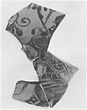
From the shoulder of an amphoriskos or squat lekythos. Stamped with pairs of concentric circles in diagonal rows.
Pink-buff clay, rather metallic glaze, somewhat worn.
Cf. Langlotz (1932), Würzburg, ... March 1950 ... Langlotz (1932), Würzburg, pl. 253, figs, 713, 714. |
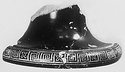
| Three joining fragments make up section of upper part; stem flares to rounded rim, flat on top. Top and inside unglazed. Outside, on rim, parts of maeander alternating with saltire squares; reserved offset ... 1940 ... Langlotz (1932), Würzburg, no. 540, pl. 198. |
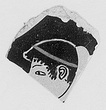
| From a cup medallion. Head of boy left, his hair bound by a fillet in added purple; his cloak drawn up over the back of his head. Above, part of extended arm? Relief contours.
Cf. the Dourian cup in Würzburg ... Ca. 480 ... Cf. the Dourian cup in Würzburg. |
Wall fragment, broken all around. Above a band of two ridges separated by a grooves, incised verticals (pseudo-ribbing), to the left of which a black zone (under handle?) with incised X.
Clay pink-buff ... 13 September 1954 ... Langlotz (1932), Würzburg , pl. 223:704 [BAS]. |
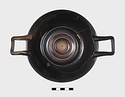
Flaring ring foot; triangular handles. Totally glazed.
From the same deposit P 19048 Hesperia, XX, 1951, pl. 51 a (Pyre 4-3). For other late skyphoi, see Cambridge, Mass., Harvard, acc. no. 2731: CVA ... Ca. 325 B.C ... For other late skyphoi, see Cambridge, Mass., Harvard, acc. no. 2731: CVA (8) pl. 23(361) 3; Würzburg 695: Langlotz, W, pl. 223; Salonica, from tomb Γ at Sedes: Ἐφ., 1937, p. 890, fig. 25, middle and p. 891, fig. 26, above. |
From the wall of a large open vase. Outside, elaborate painted decoration: an ivy garland (white); hanging from it, two broad dark red streamers and a white leaf; over painting in thinned glaze on the ... 11 May 1938 ... Langlotz (1932),Würzburg, pl. 241, no. 833, and T.B.L. ... Webster dates Würzburg vase (p. 223, no. 29) 3rd. quarter of 4th c.
|
Lid. Top of knob broken; chips at edge of brim and on side of rim. Concentric band and circle on underside. P.H. 0.05; diam. 0.15. R. R. Holloway, Hesperia 35, 1966, pl. 27:e; Roberts, Pyxis, p. 77, cat ... Ca. 425-400 B.C ... Class of Würzburg 542 [Roberts, p. 77]. |
About half of bottom and lower wall preserved, and start of upper wall; chipped. Flat bottom; side concave in profile with a pronounced keel separating it from upper wall. Traces of wreath decoration in ... May-June 1947 ... Perhaps from a pitcher like Langlotz (1932), Würzburg, no. 844, or possibly inkwell. |
Part of the handle and rim of a black-glazed oinochoe. Sloping handle, round in section. The end of the handle projects inwards beyond its junction with the rim, and its end inside is finished with a moulded ... 19 July 1947 ... Langlotz (1932), Würzburg, pl. 241, no. 841, trefoil oinochoe, dated by Webster (JHS 71, 1951, p. 222, no. 3) "after 300 B.C.".
|
Handle and fragments of wall and lip missing; restored in plaster (handle restored on the basis of a similar incomplete pot in DB 525). Low plump body on low offset flat base. A faint angle separates body ... 2-19 May 1939 ... XCII, no. 571; Langlotz (1932), Würzburg, pl. 254, no. 677. |
Lid fragment with start of knob on top side and brim. Unglazed on underside, except for band of glaze (pitted) and circle with central dot. Glaze has flaked on brim. Max. dim. 0.094.
From knob out, egg ... Ca. 425-400 B.C ... Perhaps from the Class of Würzburg 542. See Roberts, Pyxis, pp. 75--77. |
Floor fragment. Max. dim. 0.041.
I, youths (top of head of one; head of other) facing. Around tondo, stopped-maeander pattern. A, feet, start of drapery of man to right; toes of another facing. Between ... Ca. 450-440 B.C.? ... Méd. 815 (ARV2 941, 32) and Würzburg 489 (ARV2 941, 35). |
Wall fragment. Max. dim. 0.085.
Woman at a tomb. The woman (most of head, part of body) stands to right, holding a long, narrow box decorated with a maeander pattern. It overlaps the shaft of the stele ... Ca. 430-420 B.C ... Perhaps by the Painter of Würzburg 566. Compare, especially for the composition, anthemion, and drawing, Villa Giulia 43574 (ARV2 1246, 4). |
| Mended from many pieces. A small part of rim and the end of one handle restored in plaster. Stamped inside with tongue pattern and palmettes in band around central rosette with pointed petals. Lip offset ... 4 April 1933 ... ADDENDA Silver parallel in Würzburg, see article by W. |
Wall fragment with turn of shoulder. Max. dim. 0.043.
Man, probably Dionysos (part of his face and wreathed head), to left. In front of him is an object that is probably the rim of his drinking horn ... Ca. 490-480 B.C ... For Dionysos, see Würzburg 526 (ARV2 239, 19; Addenda 201); Louvre Cp 10759 (ARV2 239, 20); and New York, M.M.A. 07.286.73 (ARV2 240, 45; Addenda 201).
|
Floor fragment. Max. dim. 0.055; est. outer diam. of tondo 0.13.
I, man (head) to left. Behind him:
retrograde. Around the tondo, stopped-maeander pattern. A, warrior or Amazon (short chiton, right ... Ca. 470 B.C ... For the drapery, cf. several of the figures on Louvre G 264 (ARV2 869, 54; Addenda 299) and the figure of Nike on Würzburg H 4937 (ARV2 871, 95; Paralip. 426, 95; Addenda 300). |
Wall fragment.
Amphoriskos. Thin fabric with a few white bits, the core black, the surfaces red and covered outside with a pinkish orange slip. Decoration in red, black and white: bands, and a double ... For the plump shape of P 2871 cf. Würzburg 672: Langlotz, W, pl. 254, to be compared with Cypriot "bottles" as S.C.E., IV, 3, fig. 24, 20. |
| Fragment a) (side A), made from two pieces: warrior striking right (head, right side and arm), another warrior in a crouching(?) attitude (head and part of right shoulder). Above: part of tongues.
Fragment ... 26 May 1954 ... For the Kerberos scene, cf. black figure neck amphora in Langlotz (1932), Würzburg, pl. 43. |
Floor fragment with ring base. Grooved on underside with broad concentric bands. Max. dim. 0.07.
Woman (legs enveloped in a chiton and himation) seated to right on a klismos (legs, seat). Small reserved ... Ca. 420-410 B.C ... X.22.17 (ARV2 1132, 183) and that of the bride seated on the bed on Würzburg H 4445 = 541 (ARV2 1133, 196; Addenda 333). |
Lower part of stand with flaring torus base, flat on underside. Unglazed on inside. Glaze chipped in places, especially on torus. Some abrasion on base. P.H. 0.055; est. diam. of base 0.135.
On side of ... Probably mid-5th century B.C ... These are the dinos stands known to me: Würzburg 540 by the Achilles Painter (ARV2 992, 69); Ferrara 9379 = T.11 C VP by the Kleophon Painter (ARV2 1144, 11; Paralip. 456, 11; Addenda 334; Matheson, Polygnotos, p. 408, cat. no. |
|
|