|
|
Lower fill:
See Deposit G-I 11-12, where the finds are again listed.
Dug as Tholos Trench A, Layer VI, no finds.
Dug as Tholos Trench C, Layer IV+Va, A 756, A 757, P 10507.
Dug as Tholos Trench N, Layer ... 6th c. B.C ... Dug as Tholos Trench A, Layer VI, no finds.
Dug as Tholos Trench C, Layer IV+Va, A 756, A 757, P 10507.
... Upper fill:
Dug as Tholos Trench A, Layer V, no finds.
|
Trench at O/7,8-6/1,5. Layer 5 of Trench A cut in Rooms 1 and 2 of Greek House γ. Soft green clay with bones, ash, much pottery. Probably leveling fill ... Archaic ... Trench at O/7,8-6/1,5. Layer 5 of Trench A cut in Rooms 1 and 2 of Greek House γ. |
Rectangular cutting at 58-60/ΚΘ-Λ, probably a plundered wall trench ... 350-290 B.C ... Rectangular cutting at 58-60/ΚΘ-Λ, probably a plundered wall trench. |
| Homer A. Thompson ... Cremation burial (trench-and-hole) under S. edge of E-W Street, southern burial. In some records as Grave XLVI.
Neat trench, rectangular as preserved, but may have originally been square, cut partly through ... Early Geometric I ... In some records as Grave XLVI.
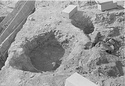
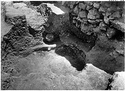
Neat trench, rectangular as preserved, but may have originally been square, cut partly through earth, partly into bedrock, to a depth of about 0.25m. The north side of the trench was destroyed by the a Turkish cess pit. ... Be that as it may, a deep, circular urn-hole was cut into the southeast corner of the pyre trench to a depth of 0.45m below the level of the floor, and measuring 0.35m in diameter.
|
| Homer A. Thompson ... (Grave XXX: EG)
Rectangular cutting with burned bones of a female 40-45 years old, and both burned and unburned pottery fragments.
Rectangular trench, measuring approximately 0.80m long, 0.40m wide, with ... Middle Geometric I ... (Grave XXX: EG)
Rectangular cutting with burned bones of a female 40-45 years old, and both burned and unburned pottery fragments.
Rectangular trench, measuring approximately 0.80m long, 0.40m wide, with a preserved depth of 0.20m, cut through earth, partly into irregular outcroppings of bedrock, oriented northwest-southeast. A fieldstone paving was found closing the mouth of the trench and lining the sides cut in earth. |
Horos terrace trench Layer III, under line of tiles. Coins:
19 March 1953 #16-#17 ... 2nd c. A.D. |
| Dorothy Burr Thompson ... Grave 11 in notebook (E.L. Smithson: Grave XII: PG). Bones discarded. Burned deposit in a rectangular trench in bedrock.
JP ... Late Protogeometric ... Burned deposit in a rectangular trench in bedrock.
|
Narrow trench in bedrock; one section found to NE of Circular Building west of the Stoa of Attalos, another (Q 8:1) beneath the terrace of the Stoa of Attalos opposite Pier 19. A single filling in both ... Ca. 450-425 B.C. and shortly after ... Narrow trench in bedrock; one section found to NE of Circular Building west of the Stoa of Attalos, another (Q 8:1) beneath the terrace of the Stoa of Attalos opposite Pier 19. A single filling in both sections, with a high proportion of good black vases. |
A strosis into which were set the foundations of house of 7th c. B.C. to SE of Tholos (=Building A and Trench W, layers h + i) ... 8th-7th c. B.C ... A strosis into which were set the foundations of house of 7th c. B.C. to SE of Tholos (=Building A and Trench W, layers h + i). |
| Rodney S. Young ... Grave 2 in notebook (E.L. Smithson: Grave XV: PG). Urn cremation (trench-and-hole), adult female.
JP
It consists of a roughly rectangular pit or trench cut into bedrock to a depth of 0.35m., measuring ... Late Protogeometric ... Urn cremation (trench-and-hole), adult female.
JP
It consists of a roughly rectangular pit or trench cut into bedrock to a depth of 0.35m., measuring 1.12m long and 0.67m wide. ... The urn-hole, cut to a depth of 0.62m., measured roughly 0.40m in diameter. the urn-hole itself, but not the rectangular trench of the tomb, was sealed by a large, flat stone, broken in situ. |
| Grave 1 in notebook (E.L. Smithson: Grave XXV: PG). No remains. Probable trench-and-hole.
JP
Roughly circular pit measuring 0.39m in diameter cut into bedrock to a depth of 0.72m. Pyre refuse-described ... Late PG/EG I ... Probable trench-and-hole.
JP
Roughly circular pit measuring 0.39m in diameter cut into bedrock to a depth of 0.72m. Pyre refuse-described as "ashes and cinders etc"- was encountered throughout the tomb pit, below, around and above the urn. although there is no specific mention of a trench, Young's description of the tomb suggests that a rectangular trench, with a maximum length of about 0.80m and a preserved width of ca. 0.60m, was cut through earth into bedrock. consequently, the tomb appears to be a classic example of an Athenian trench-and-hole, oriented east-west,with the urn-hole at the east. There was no clear evidence that the tomb as a whole was sealed in any way, and any tomb covering would have been destroyed by the construction of the mudbrick foundry. |
In stone water channel and trench above. A. Walker? ... In stone water channel and trench above ... A. Walker? |
| Rodney S. Young ... Grave 6 in notebook (E.L. Smithson: Grave XXII: PG). Bones discarded. Urn cremation (trench-and-hole).
JP
Roughly rectangular trench cut through hard earth into bedrock to a depth of about 0.35m, approximately ... Late Protogeometric ... Urn cremation (trench-and-hole).
JP
Roughly rectangular trench cut through hard earth into bedrock to a depth of about 0.35m, approximately 1m long and 0.50m wide. Trench oriented southeast-northwest, with the urn-hole adjoining the southeast corner. ... The urn-hole (diameter ca. 0.34m and about 0.35m deep- was evidently cut after the fire had subsided, not quite deep enough to conceal the full height of the cinerary urn below the floor of the trench. A fire-hardened mudbrick, 0.23m square and 0.08-0.09m thick, formed a barrier between the urn and the trench.
|
From kiln in house of 7th c. B.C. (=Building A), to southeast of Tholos. Tholos Trench U, furnace ... 675-625 B.C ... (=Building A), to southeast of Tholos. Tholos Trench U, furnace. |
Drain Trench at 62/ΜΗ.
The presence of a number of fairly well preserved vases of good quality suggested to the excavator the possibility that the cutting might once have contained a burial. No skeletal ... 325-300 B.C ... Drain Trench at 62/ΜΗ.
The presence of a number of fairly well preserved vases of good quality suggested to the excavator the possibility that the cutting might once have contained a burial. No skeletal remains were found; the content is however unusually consistent in date for a dumped filling. |
A well in room A of the Archaic House. Well with very irregular outline, cut down in the bedrock some 10m NE of the Tholos. Its filling yielded a handful of plain potsherds and the oinochoe P 13256 of ... Sub-Mycenaean(?) |
| (Grave XXIX: EG).
Rectangular cutting with remains of charred human bones and both burned and unburned pottery fragments. Bones discarded.
Rectangular trench cut through earth into bedrock, oriented east-west ... Middle Geometric I ... Rectangular trench cut through earth into bedrock, oriented east-west and measuring 1.10m long, 0.70m wide and under 0.30m deep. A thin layer of hard-burned clay mixed with charcoal, ash and cremated human bone. ... Burned and unburned sherds representing at least nine vessels were found throughout the trench. The inclusion of the fragmentary cooking pot or chytra led Smithson to suggest that the deceased was a woman. |
| Filling in footing trench at 63/ΝΔ Packing of coarse pottery, including numerous stamped jars and a small amount of kitchen ware ... Ca. 250-210 ... Filling in footing trench at 63/ΝΔ ... Packing of coarse pottery, including numerous stamped jars and a small amount of kitchen ware. |
| Rodney S. Young ... Grave 7 in notebook (E.L. Smithson: Grave XXI: PG). Bones discarded. Disturbed and damaged cremation (originally trench-and-hole), the east end cut away, probably contained the burial urn.
JP
It consisted ... Late Protogeometric ... Disturbed and damaged cremation (originally trench-and-hole), the east end cut away, probably contained the burial urn.
JP
It consisted of a rectangular trench cut through hard-packed fill and slightly into bedrock to a depth of 0.48m. the trench oriented east-west, had a preserved length of 0.70m and a width of 0.60m. The east end where the cinerary urn would have originally been located in an urn-hole, was almost completely cut away by the Hellenistic water channel that skirted the tomb to the south. evidence of heavy burning, in the form of reddened earth, was noted on the ground around the mouth, rim, floor and three sides of the trench. The preserved east end, built up from redeposited green schist bedrock streaked with reddened earth, may have been a barrier between the destroyed urn-hole and the pyre trench, constructed after the fire had subsided. |
| Homer A. Thompson ... Cremation burial (trench-and-hole) under S. edge of E-W Street, northern burial. In some records as Grave XLVII.
The western part of the offering trench of the tomb was lost to a Turkish cess pit, and ... Middle Geometric I ... The western part of the offering trench of the tomb was lost to a Turkish cess pit, and disturbances at least as early as the 7th c. B.C. had cut away the upper part of the cinerary urn and the adjoining trench filling. The tomb was found directly below a Classical wall. What survived was the south and east section of the original grave, including a strip of the pyre trench, reddened from burning to a depth of 0.05m, and below it a shallow urn-hole, roughly square, ca. 0.60m to the side, cut through earth almost to the level of bedrock, to a depth of about 0.30m.
|
|
|