|
|
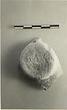
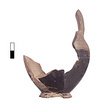
| Flat squat face.
The features nearly obliterated. The hair is done low in a great mass at the back.
Light red clay. Cleaning area disturbed by late tombs. Leica ... 23 March 1934 ... Cleaning area disturbed by late tombs. |
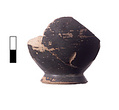
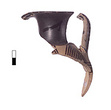
| The raised base, and a bit of the wall only, preserved.
Signature incised in unbaked clay, before glazing.
Red glaze.
Type XVIII (?) of Corinth collection, Signed Bases type of Agora collection.
In ... 21 May 1935 ... In Hellenistic fill below tombs. |
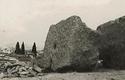
| One face roughly dressed. The other faces more roughly dressed, or broken.
Egyptian granite.
Cf. A 1232 (ΔΔ 254) and A 1233 (ΔΔ 255). Found 1940, removed 1947 and placed on terrace between two large Mycenaean ... 1940 ... Found 1940, removed 1947 and placed on terrace between two large Mycenaean tombs (of ΔΔ and ΕΕ).
|
| Mended from two fragments.
Low conical foot reserved underneath; lower body rising steeply.
Good black paint; preserved exterior painted solid; interior reserved.
Clay in floor discolored due to burning; ... 9-18 March 1932 ... Sherds overlying Tombs F 16:3 and F 16:4. |
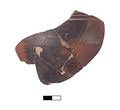
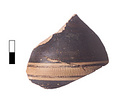
| Six joining body fragments.
Body thick-walled, as P 34965 and perhaps from same vessel. Paint as P 34965, though variously fired from red to black. Preserved lower body painted solid. Portions of three ... 9-18 March 1932 ... Sherds overlying Tombs F 16:3 and F 16:4. |
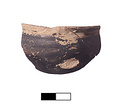
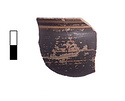
| Rim and body fragments (two joining).
Upper wall vertical; gently flaring rim. Handle stumps of vertical handle attached from mid-body directly to rim. Paint relatively dull, fired black. Body on exterior ... 9-18 March 1932 ... Sherds overlying Tombs F 16:3 and F 16:4. |
| Rim fragment.
Gently flaring rim with rounded lip. Good lustrous black paint. Preserved body on exterior painted solid. Rim decorated with tremulous line approaching zigzag framed by one thin band above ... 9-18 March 1932 ... Sherds overlying Tombs F 16:3 and F 16:4. |
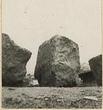
| One face roughly dressed, with rough round hole near center and two adjacent round holes at edge. The opposite face also roughly dressed, in a parallel place. Other faces left rough.
Egyptian granite ... 1940 ... Found 1940, removed 1947 and placed on terrace between two large Mycenaean tombs (of ΔΔ and ΕΕ).
|
| One face roughly dressed with rough round hole near one edge and two square holes at opposite edge. Opposite face dressed in parallel place. Other sides more roughly dressed, or broken.
Egyptian granite ... 1940 ... Found 1940, removed 1947 and placed on terrace between two large Mycenaean tombs (of ΔΔ and ΕΕ).
|
| Four joining body fragments.
Rounded body from a globular pyxis. Good semi-lustrous paint, mostly fired black, with small patches of red/reddish-brown. Lower preserved body painted solid. Mid-point decorated ... 9-18 March 1932 ... Sherds overlying Tombs F 16:3 and F 16:4. |
| Four joining body fragments of a small closed vessel.
Upper body curving in; neck becoming vertical.
Good black paint, with a sheer luster. Preserved body painted solid except for reserved band near mid-point, ... 9-18 March 1932 ... Sherds overlying Tombs F 16:3 and F 16:4. |
| Three joining fragments of rim and body of a small open vessel, probably one-handled cup. Paint worn off on exterior.
Upper wall vertical; gently flaring rim with rounded lip. Good quality lustrous black ... 9-18 March 1932 ... Sherds overlying Tombs F 16:3 and F 16:4. |
| Base and lower body fragments (six joining pieces).
Ring foot of medium height; body rising steeply. Wheelmarks prominent on interior. Paint mostly dark brown approaching black, red in parts; lower exterior ... 9-18 March 1932 ... Sherds overlying Tombs F 16:3 and F 16:4. |
| Shoulder and neck fragments (four joining, one non-joining).
Curved shoulder; narrow vertical neck. Paint mostly fired red, reddish brown. Lower body as preserved painted solid. Three thickish bands on ... 9-18 March 1932 ... Sherds overlying Tombs F 16:3 and F 16:4. |
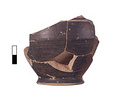
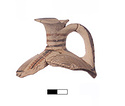
| Mended from six fragments preserving part of shoulder, neck, rim, and complete handle.
Shoulder curved; narrow vertical neck; sharply flaring rim, with rounded lip. Vertical handle attached from shoulder ... 9-18 March 1932 ... Sherds overlying Tombs F 16:3 and F 16:4. |
| Fragmentary small closed vessel reconstructed from six joining fragments. Paint much wear, especially on upper body.
Low ring foot; underside flat. Ovoid body, one preserved vertical handle. Paint fired ... 9-18 March 1932 ... Sherds overlying Tombs F 16:3 and F 16:4. |
| Main fragment (a) from eight joining fragments plus a group of three joining fragments (b) and one of two fragments (c).
Body rounded; tall vertical neck; flaring rim, flat on top. Two vertical handles ... 9-18 March 1932 ... Sherds overlying Tombs F 16:3 and F 16:4. |
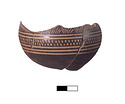
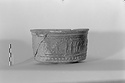
| A small fragment from the side and a chip from the rim are missing. The bowl has an offset rim, flat, with two mouldings below: one wide, one narrow. Between two raised ridges under the main zone is a ... 13 May 1933 ... He sets the date to a period later than 280 B.C., or the invasion of Delphi by the Gauls (two fragments of the same ware were found with relief bowls, apparently Hellenistic, in tombs at Delphi). The context in which P 1966 was found, however, seems to be pure Roman and the clay and glaze are far inferior to the usual Hellenistic output.
|
|
|