|
|
| The Architecture. The Architecture; Greek House γ. The Architecture; Greek House γ; Archaic. The Architecture; Greek House γ; Classical. The Architecture; Greek House γ; Hellenistic. The Architecture; ... 1970 ΒΔ ... The Architecture; Late Roman ... The Architecture; Late Roman; The Long Walls ... The Architecture; Late Roman; The Isolated Blocks |
Bookidis, Nancy Stroud, Ronald S ... American School of Classical Studies at Athens ... A careful and detailed presentation of the architectural remains of the Sanctuary of Demeter and Kore on the slopes of Acrocorinth, beginning with the earliest traces of occupation in the Mycenaean period ... 1997 ... A careful and detailed presentation of the architectural remains of the Sanctuary of Demeter and Kore on the slopes of Acrocorinth, beginning with the earliest traces of occupation in the Mycenaean period and ending with the Late Roman cemetery. ... In the chapters on the architecture, arranged chronologically, the authors describe in detail the buildings found on each of the three terraces of the sanctuary, including the dining rooms, cooking and bathing facilities, and religious structures. A separate chapter discusses the elements of the Acrocorinth dining rooms and their place in the architecture of sacred dining. |
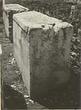
| The six upper drums are preserved lettered ΑΑ-ΒΒ, etc.
One of the series A 3008 - A 3011 and A 2987 and A 2988. With this shaft is to be associated the capital A 2987.
White, strongly laminated marble ... 5th c. B.C. |
| One drum only, viz. third from top, with the letter Δ on under side. Top drum exists but has no letters.
Apparently from the late 5th c. B.C., but reused in the Roman period before being employed in the ... 5th c. B.C. |
| Fragment from the edge of the volute. The spiral is a flat band. Careful work.
Pentelic marble. From late Roman fill. Leica, 90-23-8 PD 2403, PD 2712 ... April 1950 |
| The first, second, third and sixth drums from the top survive and may be recognized from the letters ΑΑΑΑ, etc. The sixth was here the bottom drum.
One of the series A 3008 - A 3011 and A 2987 and A 2988 ... 1 September 1959 |
| Complete except for most of crown molding. Crown is cavetto-crowned ovolo. Lower and upper fascia. A dowel and a clamp cutting on top surface. Very granular soft yellow poros, perhaps Aeginetian.
Another ... 30 July 1970 |
| The second, fifth and seventh drums from the top survive, the seventh marked ΗΗΗ, being the bottom drum. The top drum also survives but retains no letter and so cannot be assigned with certainty.
One of ... 5th c. B.C. |
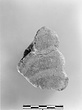
| Part of an edge preserved, otherwise broken.
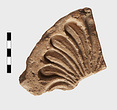
Some of the petals of the palmette of an antefix.
Coarse pink to buff clay. Finished Late Roman Fill in S.W. corner of section. Leica ... 20 April 1938 |
| Taenia all broken away; left end preserved. Right end seems to have been cut back a few centimeters (the clamp cutting is only 0.06m. as compared with 0.13m. at the other end). Cuttings for Π-clamp at ... 1959 |
| Fragment a) comes from the base of the shaft; fragment b) from the top, preserving about one third of the periphery.
Excellent workmanship.
From Propylon of Bouleuterion.
Pentelic marble. Found in late ... 1933 |
| Corner block. Dimensions fully preserved. Top surface worked with tooth chisel; lewis hole. At the back, the upper left corner has a cutting, apparently to receive a wooden beam. Its width continues across ... 17 May 1933 |
| Much worn by traffic in its present position. From same series as A 2987, with which it corresponds in material, measurements and workmanship.
Marble cloudy gray in color with pronounced lamination. Excellent ... 1959 |
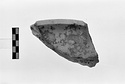
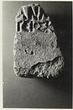
| Broken at the back and chipped at the sides. The edges are scalloped; the front plain, as if prepared for color, of which however no trace remains.
Parian marble.
ADDENDA Central lines of metals and traces ... 30 March 1934 |
| Parts of three flutes preserved. Broken on all sides save flutes. Fine white stucco in two flutes, the other broken on the surface.
Stoa Poikile series.
Poros. Late Roman Wall west of Stoa of Attalos ... April 1949 |
| One end is preserved, though slightly battered. At the other end the tile has been rudely cut off, probably somewhere near the middle. The underside is rough-picked, with a sort of swelling near the original ... 18 April 1934 |
| Top drum, without flutes. On both the top and bottom the smooth dressed original outer joint surface stands out from the roughly reworked inner area. On the top a carefully cut mason's mark. Empolion cutting ... 3 June 1964 |
| Broken at right end, otherwise fresh. In top an original cutting for a double T-clamp to join this with the next backer; a replacement in the form of a cutting for a Π-clamp; a cutting for a Π-clamp 0.21m ... August 1959 |
| A single fragment preserves the tips of two petals of a palmette, and most of a third. Broken at right; finished surface below. A round smooth dowel hole goes through the fragment lengthwise; traces of ... 3 July 1947 |
| Bottom rough; otherwise broken. Rather coarse yellowish clay.
Stamped: 'Mother of the Gods'.
Metroon series.
Cf. Negative number XXXIV-23. In late Roman fill, above level of strosis. Leica ... 2 April 1934 |
|
|