|
|
In stone water channel and trench above. A. Walker? ... In stone water channel and trench above. |
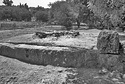
Stone-curbed well at NE corner of 18/ΞΓ ... 2nd c., at least as late as ca. 140 B.C ... Stone-curbed well at NE corner of 18/ΞΓ. |
| Dorothy Burr Thompson ... Grave 4 in notebook. (E.L. Smithson: Grave XLIV). No remains (not really a grave, note on p. 331).
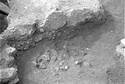
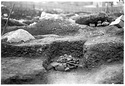
Roughly rectangular patch of unworked fieldstones, measuring about 1.20x0.80m neatly laid on bedrock, ... 19-21 March 1932 ... Funerary Deposit on Stone Pavement |
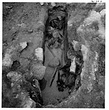
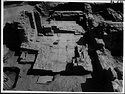
| David Scahill ... Roman temple north. Adult male inhumation. Pit tomb, partially stone-lined ... Late Mycenaean or Final Mycenaean/Submycenaean ... Pit tomb, partially stone-lined. |
Pit under fallen stone at 13/ΜΔ Recorded in Ω Books (no page) ... Pit under fallen stone at 13/ΜΔ |
Tile lined bothros with field stone collar. Coins:
19 June 1992 #818-#819 ... 12th-13th c. A.D ... Tile lined bothros with field stone collar. |
| Fill in stone-curbed well P 35772 possibly belongs to this deposit, Lot 899 ... 3rd. c. A.D ... Fill in stone-curbed well |
Stone-lined Well at R/16-13/18,19.
Stop at -7.00m due to danger of collapse and time ... 450-425 B.C ... Stone-Lined Well at R/16-13/18,19 |
| At the northwest foot of Areopagus. Square stone-curbed well with no clear evidence for a period of use; appears to be a single dump ... Ca. 500 B.C ... Square stone-curbed well with no clear evidence for a period of use; appears to be a single dump. |
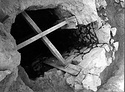
Well in Byzantine Room 9. Excavation of the well terminated at 49.00m. due to cave-in danger. Topped by a stone sill and marble putael, the upper part of well is of Byzantine-period stone masonry; lower ... Byzantine ... Topped by a stone sill and marble putael, the upper part of well is of Byzantine-period stone masonry; lower part lined with tiles.
|
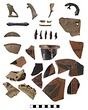
| Rodney S. Young ... Grave 4 in notebook. Amphora, no other pots but carbonized remains of food offerings. Over urn two stone slabs, on top, mass of small stones containing Late Geometric sherd ... Late Geometric ... Over urn two stone slabs, on top, mass of small stones containing Late Geometric sherd. |
Material from trenches:
a) 1.00-7.00m. from East End of Stoa.
b) 18.40-21.40m. from East End of Stoa.
c) 46.60-48-60m. from East End of Stoa.
d) 51.00-53.00m. from East End of Stoa.
e) 79.00-81.00m. from ... 2nd c. B.C ... Includes drain trench in front of back wall of Stoa (some disturbed, some undisturbed fill), soft fill above stone drain, fill from within stone drain, channel behind stylobate. |
Fill to 6.50m., masses of stone, animal bones and coarse pottery with some unfinished poros sculpture at 6.50m. - a dump of early 3rd c. ... At 6.50m. begins use filling with numerous BHWJs and other water ... Late 1st c. to early 3rd cent. and of 4th and 5th cents ... Fill to 6.50m., masses of stone, animal bones and coarse pottery with some unfinished poros sculpture at 6.50m. - a dump of early 3rd c. ... |
Slag pit in front of South Stoa II. The filling consisted ... of a very miscellaneous lot of stone and marble. ... In among the stones was a loose filling of ash and charcoal and iron slag ... (nbpp. 6510, ... Second half 1st c. A.D ... The filling consisted ... of a very miscellaneous lot of stone and marble. ... |
Well, neatly stone-curbed to bottom. Diameter 0.70m. The use filling, from about 3.50m to bottom, consisted chiefly of water-jars with a few small vases and some black-figured fragments.
Upper filling, ... Use filling of ca. 575-550 B.C ... Well, neatly stone-curbed to bottom. |
Fillings in a stone-curbed well in the industrial area west of the Areopagus. Diameter (shaft)1.45m. Water level -5.20m. Drain at mouth 0.58m., increasing to a regular 74m. Coin:
24 July 1947 #5 Subdivisions: ... 350-325 B.C./3rd c. B.C ... Fillings in a stone-curbed well in the industrial area west of the Areopagus. |
| Stone-curbed Pit (Sacred Pit) to North of Altar of Ares.
An accumulation of votives dating at least from the middle of the 7th. c. B.C. into the early 5th. c. Finds include those from the immediate area ... 7th-5th c. B.C ... Stone-curbed Pit (Sacred Pit) to North of Altar of Ares.
|
| Well in Room 7 of Roman House H, partially covered by caldarium of added bath complex (Room 6). Stone well-head; 0.85m in diameter. Stpped because of danger of collapse. Cut through bedrock, water from ... 6th c. A.D ... Well in Room 7 of Roman House H, partially covered by caldarium of added bath complex (Room 6). Stone well-head; 0.85m in diameter. |
| Not completely excavated due to instability of chamber walls and water. Sherds of all periods - Greek, Roman and Byzantine - were found in it [nbp. 424].
Re-examined in 2010. Photos and notes on NB pages ... 10th c. A.D ... Photos and notes on NB pages listed below.
2010 Final Report
Cistern G 14:3 is plaster lined and built with stone, at least in its upper portion, and contains a series of footholds at the northeast and southwest. Around its mouth is the remains of a square platform of tile, stone and mortar, with a segment of a square ceramic drain running along the northeast. |
Displaced curbing stone had fallen into top of shaft; fill with and around it is presumably second half of 2nd c. A.D. Below tumbled filling at top, shaft was empty to 10.80m. Tiles were missing to ca ... Late 1st-early 2nd c ... Displaced curbing stone had fallen into top of shaft; fill with and around it is presumably second half of 2nd c. |
|
|