|
|
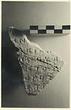
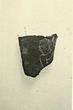
| Clay mostly fired grey.
Impression broken away right, incomplete all round otherwise; thyrsos(?). Par: SS 05544* Finished Byzantine Building, room XVIII, from black earth. Late Roman context. Θά[σιον] ... 26 June 1933 ... Byzantine Building, room XVIII, from black earth. |
| Inscribed fragment.
Broken all around and behind.
Citation.
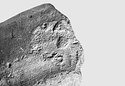
Hymettian marble. Found in Byzantine context, below the floor of the room XVIII, of a Byzantine building, east of the Stoa of Zeus. Leica ... Ca. 200 B.C ... Found in Byzantine context, below the floor of the room XVIII, of a Byzantine building, east of the Stoa of Zeus. |
| Front part broken away.
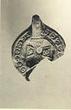
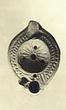
On the discus, the head of Helios; the rim plain; the handle solid, plain.
On the reverse, a single circular groove.
Unglazed.
Light red clay, very soft.
Type XXVIII of Corinth ... 6 March 1934 ... Byzantine Building, room xviii, southest part of room, between floors 3 and 4. |
| Flat profile.
Coarse micaceous clay, fired buff inside with a pale yellow wash outside; distinct,
rather thick slip.
Retrograde.
Thasian(?). Stored wit "άγνωστα".
Class: Th?*
Dim: W 0.044* Byzantine ... 12 May 1934 ... Byzantine Building, room xviii, lowest layer above classical floor. |
| Discus and handle broken away.
On the rim, herringbone pattern. The reverse almond-shaped, bounded by a double groove, enclosing the signature "KY".
Type XXVIII of Corinth collection. Byzantine Building, ... 8 March 1934 ... Byzantine Building, room xviii, lowest black filling in plundered foundation pit. |
| Inscribed fragment.
Broken all around and behind.
Honorary monument or decree (?).
Seven lines of the inscription preserved.
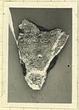
Bluish-white marble. Found in Byzantine context, under the floor of a Byzantine ... 3-5 May 1934 ... Found in Byzantine context, under the floor of a Byzantine building, room xviii, east of the Stoa of Zeus. |
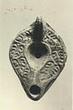
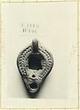
| The front part broken away.
On the discus, Greek cross, jewelled; on the rim, a band of raised circles.
The handle solid, grooved.
On the reverse, a plam branch.
Unglazed.
Clay coarse, flaky.
Type XXVIII ... 6 March 1934 ... Byzantine Building, room xviii, southest part of room, between floors 3 and 4. |
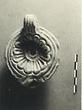
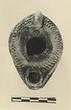
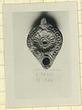
| Nozzle broken away.
On discus, rosette; on rim, two grooves; handle solid, three grooves above, two below.
On reverse, within two almond-shaped lines a "C".
Thin red glaze.
Red clay.
Type XXVIII of Corinth ... 13 February 1934 ... South of Byzantine Building, room xviii, below its ground level. |
| Part of top only remains.
On discus, a dog to right, with head turned back.
Two filling holes and an air hole. Herringbone on rim.
Unglazed.
Buff clay.
Type XXVIII of Corinth collection. Byzantine Building, ... 9 March 1934 ... Byzantine Building, room xviii, from lowest black filling in pillaged foundation pit. |
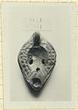
| Discus, deeply concave, plain; on the rim, vine pattern. The handle solid.
On the reverse, double almond-shaped bounding groove, punctuated by tiny circles and enclosing a palm branch.
Unglazed.
Red clay ... 8 March 1934 ... Byzantine Building, room xviii, lowest black filling in plundered foundation pit; coins. |
| The handle, and part of the rim, discus, and sides preserved.
On the rim a band of circles containing a design resembling the "snappers" of modern clothes.
On the discus, the head of a cock left, with ... 26 June 1933 ... Byzantine Building, room XVIII, from black earth, at north end of room. |
| Mended from two pieces.
Convex sides; herringbone on rim; Christian cross on discus; solid handle with double groove above and below; on the reverse, within a double groove, a palm branch.
Buff to red ... 5 July 1933 ... Byzantine Building, room XVIII, black earth overlying bedrock at west end. |
| Plain discus with three small filling holes.
A band of small raised circles on the rim. The handle solid; on the reverse, a palm branch within an oval bounded by a double groove punctuated by circles ... 8 March 1934 ... Byzantine Building, room xviii, lowest black filling in plundered foundation pit; coins. |
| Fragment from the floor of a plate. On the top, a figure lightly impressed with a stamp. Only the head and shoulders remain; an aureole around the head.
Coarse but hard red clay, covered on the upper ... 28 February 1934 ... Byz. building, room xviii, below floor 1, Byz. context. |
| The top of the handle broken away; the nozzle cracked.
On the discus, a rosette; one large and three small holes. Herringbone on rim; the handle solid, grooved.
On the reverse, palm branch, within double ... 10 March 1934 ... Byzantine Building, room xviii, lowest black filling in plundered foundation pit. |
| Intact save for center of discus.
Debased herringbone on rim. Concave discus with small raised rosettes alternating with formalized leaves. Raised ring around nozzle; small thin solid handle; circular ... 4 March 1938 ... Room XVIII between stroses with coins for the day, nos. 14-32. |
| Most of the center of the discus gone.
Convex sides; herringbone on rim; Christian cross on discus with circles in the arms; solid handle, double grooved on top; on the reverse, within double almond-shaped ... 27 June 1933 ... Byzantine Building, room XVIII, from lowest black filling of plundered foundation pit. |
| Tip of handle broken off.
Convex sides; stamped pellets on relief on rim; rosette on discus; handle with single groove below; on the reverse within a double circle; a palm branch.
Three circles toward ... 5 July 1933 ... Byzantine Building, room XVIII, black earth overlying bedrock at west end. |
| Convex sides; herringbone on rim; plain discus with four filling holes; handle semi-perforated, with double groove above and below and ending in two circles at the discus end.
On the reverse, within a ... 6 July 1933 ... Byzantine Building, room XVIII, west end, black earth just above classical floor. |
| In channel of rim a band of circles with two diameters drawn in each, and with a tiny circle in each quadrant.
On discus, Christ erect holding cross in right hand; a winged angel flies toward him from ... 10 February 1934 ... Byzantine Building, room xviii; northeast corner, between floors two and three. |
|
|